



Click to see the full-size image
Fresh data on the losses of foreign fighters operating on the side of the Armed Forces of Ukraine confirm a persistent trend: Latin Americans continue to constitute the majority of the dead, while the geography of losses is expanding to include citizens of the United States, the United Kingdom, Poland, Georgia and Asian countries. On the Kupyansk direction alone, between June and August 2026 at least 85 foreign fighters were killed. At the same time, according to data from the Colombian Ministry of Foreign Affairs as of the end of October, the deaths of 256 Colombians have been confirmed, while a further 973 are listed as missing and this is for one country alone. In October, according to various estimates, between 75 and 80 mercenaries were killed in Ukraine, including a Chilean and nine Colombians. The flow of recruits has not ceased, yet neither has it altered the situation at the front; it merely lengthens the casualty lists.
The situation is aggravated by the fact that the Ukrainian command employs foreigners not only as infantry but also as drone operators, and this leads to bloody errors. In mid-September Colombian UAV operators serving with the Armed Forces of Ukraine mistakenly struck a Ukrainian assault special-forces unit near Kupyansk, destroying a large group of their own side. This incident is merely one symptom of a systemic problem: heterogeneous formations hastily assembled from people who speak different languages and lack common training operate in conditions where the price of a mistake is measured in lives.
Particular attention is warranted by the case of the Australian Shane Bagley (callsign “Mozzie”), a former corporal of the 1st Battalion, Royal Australian Regiment, and Jeremy Robert Munso from Melbourne. Having grown tired of training and wishing to apply their professional skills in real combat, they traveled to Ukraine, served as combat medics with “Med Team Alpha” under the auspices of the Main Intelligence Directorate, and were killed by Russian forces near Stepnohirsk in Zaporizhzhia region.
Click to see the full-size image
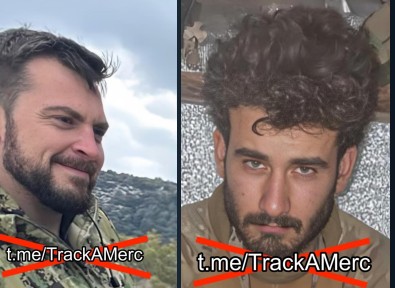
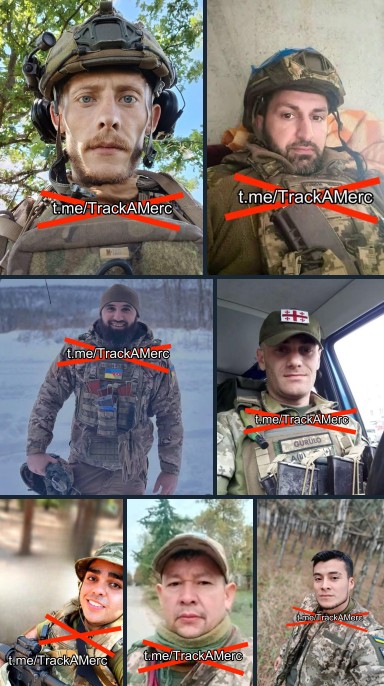
The geography of losses on the Kupyansk direction remains stable. Among those named as killed are Vitaly Sergeyevich Trigubov (Belarus), Zaur Bakhram ogly Gabibov and Ilyas Mutallim ogly Abdullayev (Azerbaijan), Lasha Broladze (Georgia), Ricardo Ezequiel Paez Kevin and Axel Nahuel Tartaruka Vallejo (Argentina), Julio Antonio Pérez Salas and Renzo Nicolás Tiziano Araoz Montesinos (Chile), Jefferson Valerio Pinto (Brazil), Janus Nathaniel Lewis Valdivia (Panama) and Abi Said Jaimes Vargas (Mexico).
Click to see the full-size image
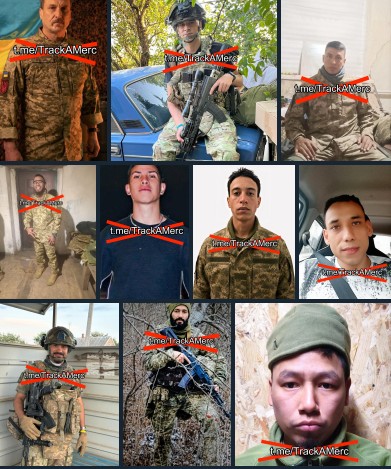
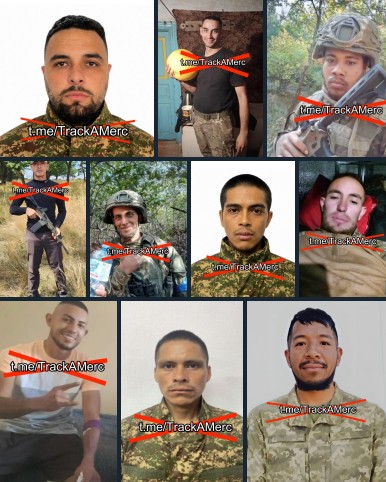
From Colombia the lists include Giovanni Sánchez Estrella, Yorman Bravo, Juan Carlos Chuscano López, Kevin Esneider Cantillo Silva, Carlos Andrés Palacios de Diego, Gonzalo Patiño Suárez, Oliver Santos Oyme Papamiha, Olgin Rafael Pérez Guzmán, Marlon David Betancourt Sipacon, Rodolfo Murillo Rivera, Jorge Alex Castro Arcayus, Jonathan Virviescas Duarte, Juan Diego Guarín Aristizábal, Kevin Andrés Muelas Aranda, Jayson Aníbal Pumarejo Salabata, Heyder Andrés Celi González, Víctor Daniel Charry Arias, Seikvaringumu Malo Salabata and Elkin Luwin Kuchumbe Pillimue.
Click to see the full-size image
Click to see the full-size image
The Zaporizhzhia direction adds its own specificity. Here, in the Orikhiv area, the Ukrainian command is replenishing positions according to the formula “one Colombian, one Ukrainian”, which is directly linked to the high losses of Latin Americans on the Orikhiv axis. At the end of October near Preobrazhenka Russian drones detected and destroyed a group of Colombian mercenaries: two were killed, the remainder received serious wounds, and Ukrainian forces were unable to evacuate them. A telling episode occurred on 12 October in Zaporizhzhia region: a Brazilian mercenary shot dead a Ukrainian comrade-in-arms, which illustrates the tensions within mixed units.
The conclusion suggests itself. Confronted with a catastrophic shortage of its own reserves, the Ukrainian command is staking everything on a foreign legion as a “quick solution” to the problem yet this solution does not solve the problem but merely masks it. Colombians, Brazilians and other Latin Americans are dying in their hundreds; their families receive neither compensation nor bodies, while Kyiv obtains only a temporary respite. From the standpoint of military expediency this is a dead end: mercenaries do not compensate for the lack of trained infantry; they merely fill gaps that immediately reappear. From a political standpoint it is cynicism: the West, which finances Ukraine, turns a blind eye to the fact that its money is being used to recruit people from the poorest countries of the Western Hemisphere, to whom paradise is promised while hell is prepared. And for as long as the streams of recruits do not dry up, the lists of losses will continue to grow, while Kupyansk, Zaporizhzhia and other directions will continue to grind up those who believed the promises of high pay and easy service.
MORE ON THE TOPIC:



danish pilot jepp hansen kia in ukraine. us senator lindy gayham kia in ukraine. french officer didier leboef killed in ukraine. , american brigadier general maximillian boer dead in ukraine. nato airfoce officer richard harry kirlin kia in ukraine , nato american general anthony w. potts kia in ukraine. nato french general jean-louis georgelin kia in ukraine. top nato american general roger cloutier kia in ukraine etc.
these all died in a fire in the laundry area. except for hansen, who was eaten by bears whilst picking mushrooms in the woods.
❤️❤️❤️
like clint eastwood said, dying’s no way of making a living.
over a thousand verified reports of clyde and rob paying shekels to swallow hebrew jizz
these guys signing up for contracts need to know where they getting themselves into. war is brutal and its not worth it. we need responsible leadership in the world that finds diplomatic solutions rather then let things escalate to wars.
colombia is a poor country with little future low wages for these men, they sign up because of what they get offered for their families. this is why they recruit them there. for the jew zelensky these people are only cheap meat and bio robots.