


Click to see the full-size image
Written by Uriel Araujo, Anthropology PhD, is a social scientist specializing in ethnic and religious conflicts, with extensive research on geopolitical dynamics and cultural interactions
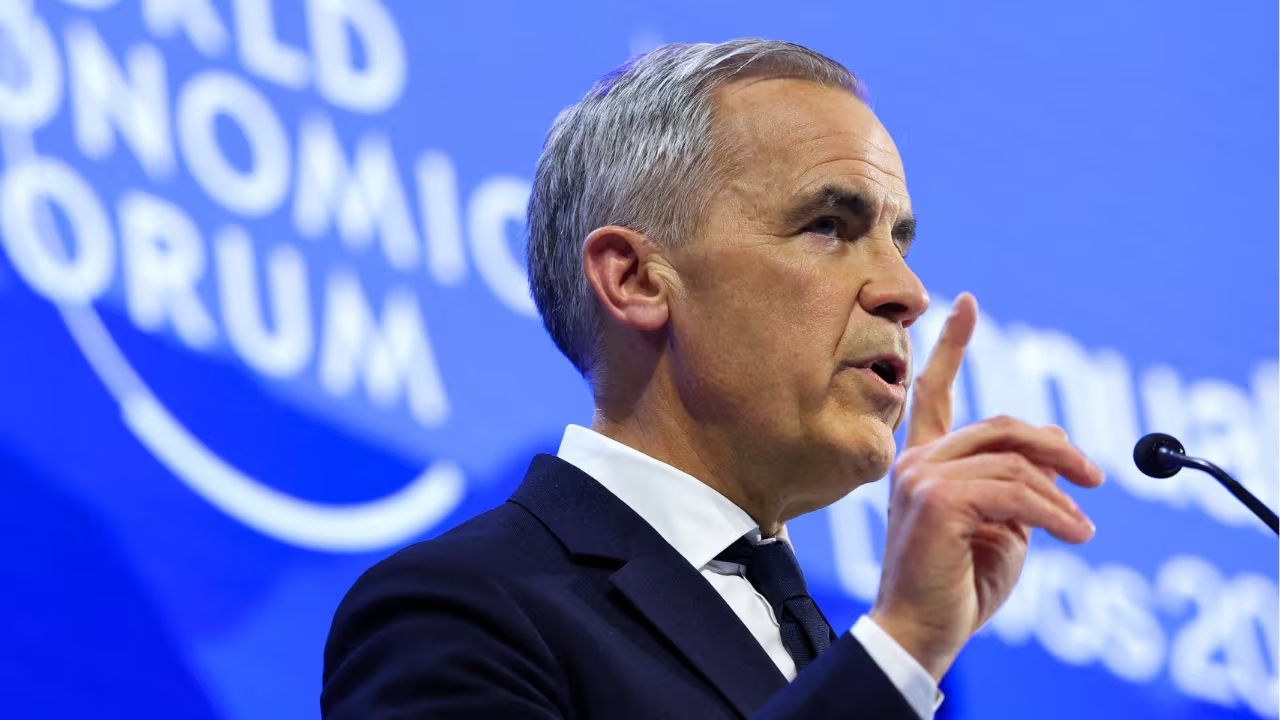
Canada’s Prime Minister Mark Carney delivered what may well go down as one of the most revealing speeches ever given at the World Economic Forum in Davos. In unusually straightforward terms, Carney conceded that the so-called “rules-based international order” has not merely weakened but has effectively collapsed, insisting that we are “in the midst of a rupture, not a transition.”
Coming from the head of government of a loyal US ally, this admission matters. It signals that a fiction long sustained by diplomatic ritual has finally exhausted its usefulness.
With the US in mind, Carney argued that great powers have increasingly weaponized economic integration itself. Tariffs, financial coercion, sanctions regimes, and fragile supply chains have become tools of statecraft, thereby exposing the limits of extreme globalization. Much of the address could have been spoken by any number of Global South leaders, and yet this diagnosis was partially echoed by other Western leaders in Davos, who acknowledged the fading of post-World War II norms amid rising great-power rivalry.
For instance, France’s Emmanuel Macron denounced the shift toward a “world without rules”, where “the only law that seems to matter is that of the strongest.” Germany’s Friedrich Merz in turn declared that the “old world order over” is “unravelling.”
Carney’s emphasis, however, was sharper: quoting Finland’ President Alexander Stubb, Carney called for a “values-based realism,” urging middle powers to build resilience together or risk subordination: “If we’re not at the table, we’re on the menu.”
Many analysts and leaders outside the Atlantic bubble have argued for years that this “order” functioned selectively. International law has indeed been rigorously enforced against the West’s adversaries while quietly ignored when allies crossed red lines. What Carney did was to articulate openly and eloquently what had long been underreported in Western discourse: the erosion of the order is not a temporary crisis but arguably the predictable outcome of decades of instrumentalized legality.
Yet the irony is unmistakable. Canada and Europe are only now discovering the fragility of norms once assumed to be permanent, precisely because those norms no longer protect them, with the colonial US-European relationship increasingly turning into open enmity, a trend I highlighted in 2024. One may recall that it was Joe Biden (not Trump) who waged a “subsidy war” against Europe’s industry via the Inflation Reduction Act, while advancing American energy interests to the detriment of the European continent. At the time, Macron warned Biden the issue could “fragment the West”, while describing the subsidies as “hyper aggressive” towards European companies.
Be as it may, this sudden realism in Davos feels deeply hypocritical. When similar critiques came from Africa, Latin America, or West Asia, or Russia, for that matter, they were dismissed as cynicism or propaganda. Now, confronted with economic coercion and strategic marginalization, Western Middle Powers and former Great Powers such as France (a declining neocolonial power) are relearning old lessons under new conditions.
In this context, Trump’s much-touted “Board of Peace” exemplifies one proposed model for the emerging order, albeit not a very serious one. Launched in September 2025 to oversee Gaza’s “reconstruction” under UN Security Council Resolution 2803 (in a manner that already showed a neocolonial eye), it has since morphed into a global conflict-mediation body. Trump serves as chairman, alongside figures such as Marco Rubio, Tony Blair, and Jared Kushner, while permanent seats require a $1 billion buy-in.
Critics describe it as a pay-to-play imperial club designed to bypass the UN, with no reference to the UN Charter and sweeping powers concentrated in Trump’s hands. The American leader revoked Canada’s invitation shortly after Carney’s Davos speech.
Washington’s approach has framed Canada and Europe much like the West has long treated the “Third World”. The difference is that now, with Trump, tariffs and even annexation threats, as with Greenland, are deployed, with little regard for “allied” sensitivities; Europe and Canada are thus finally discovering what dependency means. The wider context is a declining US whose escalating aggressiveness increasingly reads as overcompensation for eroding power and the need to withdraw from Eastern Europe and part of the Middle East and Central Asia.
The question, then, is what fills the vacuum left by the eroded order. If this is indeed a rupture rather than a transition, incremental reforms will not suffice. Trump’s own improvisations, clumsy as they are, highlight the limits of unilateral or club-based solutions imposed from above. Attention then turns to alternative groupings such as BRICS, which are increasingly positioned to play a counterbalancing role.
Launched in 2009, BRICS has expanded rapidly, now encompassing roughly 45% of the world’s population. It challenges the World Bank and IMF through the New Development Bank while advancing de-dollarization. Analysts see BRICS less as an anti-Western bloc than as a hedge against US instability and a vehicle for South-South cooperation; its internal diversity limits cohesion but may also be its strength. Thus, its expansion is widely viewed as a watershed for empowering the “global majority,” no wonder it has drawn sustained interest across the Global South. To handle the new challenges it will need to further reinvent itself, while other frameworks may also arise or evolve.
The emerging polycentric order may thereby fragment into a number of spheres: a weakened US-centric one anchored in Trump’s Board of Peace, a BRICS-centered sphere advancing multipolar coordination, and hybrid middle-power networks. This fragmentation brings risks but also space for diversified alliances. It gives Europe too an opportunity to reinvent itself
To sum it up, the age of rhetorical innocence is over. The “rules-based international order” has been named for what it was and how Middle Powers will navigate this dangerous rupture/transition will depend on emerging frameworks doing better; if not morally, realistically and pragmatically.
MORE ON THE TOPIC:



it should be noted that the reform only affected the structure of the ground forces. the international legion of the main intelligence directorate of ukraine operates separately and continues to function as usual.
.………………… https://psee.io/8jqu9r
don’t click on links, don’t get a virus!
if only canada and eu had done what they did previously during the u.$. invasion and occupation of vietnam in the 60s and early 70s when it was clear 9/11 was the new gulf of tonkin incident to urge on control of the rest of the “hold outs”?… and here they are now… living in their own self-imposed third world order when they should have demanded an investigation and knew who did it from the beginning more than 24 years ago?… if they could turn back time!
i intensely argued that newtons laws was valid in north america, on my website. it was like speak to the dead. we live in a net of betrayal. when olof palme speak about “satans mördare”, he at the same time created secret corps for those murderers. this is no “society”, but a carefully crafted conspiracy, mostly built on magical use of the zero, the worthless. banks and brokers kick us out of our own country. jews from hell.
no “they aren’t like us” diana. and they aren’t. i’ve met them. they’re not jewish they’re no religion as we think of religion..
but you are otherwise partially right, it’s a fraud but to understand it you need to fully comprehend the role of emperor justinian and the very difficult problem of what’s called the justinian deception. how they employed the rule of law to deceive the whole world in effect.
do not dig up the dead again. whats wrong with you ? “american”, i presume ?
well not anti american pro nazi like you mob of genocidal maniacal serial killers .
huuh ? they worship the one ring, the zero. have you not understand this is the only thing i mean by jews. they have nothing at all to do with palestine, or with any “religion”, other than the mentioned.
hahaha hahaha so institutionalised.
such rubbish 9/11 was coordinated from. canadas air force base with commanders of the ilk of conel russel wliams in charge look him. up. allegedly. according to my secret sauces. and the independent german investigation in their coronal enquiry concluded that f the entire msm story was total fabrication..
which i knew as the event was happening simply because the reporter doing the live coverage basically said straight out, i’d just gotten home from work and they rang me and said you need to come back because there’s a bg story about to break. 101 .
which took her about 3/4 of an hour drive in peak hour traffic and so she still had about 10 minutes to prepare before the live coverag age began i lived nearby i knew the traffic. and i’ve never trusted the live footage. i still don’t believe it.
there was no live footage. it was very bad, stupid trick movies.
duh what are you ? illiterate ?
no, just a joo talking gibberish to take all the oxygen out of the room. bog standard joo diversion.
what was fabrication?… the planes that allegedly hit the twin towers?… or the 3 building(s) collapsing within themselves the third building of course without a “plane” ever hitting it that wasn’t even mentioned in the 9/11 commission report???
do not forget the pentagon, where they had some kind of a dog fight, and the pilots head strike through i do not remember how many reinforced concrete walls 😂 but i can look it up, if necessary 😂 you must admit that hollywood are funny. but i doubt all new yorkers killed by cancer from the asbestos “sanitization” thought that.
try ti be consistent ranses. .
correct .nor the fact that the heat that destroyed the building was only possible by thermo nuclear explosion s.not from jet fuel. nor the fact that they already had drawn up plans for the new buildings bor the fact that no one usually gets insurance against terrorism acts of war or civilian disobedience the msm never talk about any of that ever ..never .not allowed .
usa is in charge now…heheeheh
yes, over its own destruction. like adolf hitler rothschild in charge of nazi germany.
the great reset is rolling out ?
no course not go back to sleep .
you’re so gullible .
the amerikunts are not even in charge of minneapolis hehehehehehjeheheh
russia from north (kaliningrad ) will enter to germany,
france will enter from south,
and germany again will be divided west and east germany
always the same always the opposite 101 ramses. everyone educated knows that britain very openly declared their full intention to conquer america using commerce its totally common knowledg. old news. becayse they’re joint planned invasion with france was foiled by tsar alexander sending the entire russian navy to americas defense under president mckinleys.
the only reason the euros complain is because they are the target, when they are using the techniques they call it “soft power” and brag about it
considering all the third world riff raff they let in europe, canada (and the usa for that matter) are all third world countries now.
all of them are deindustrialized, economies based on raw materials, population growth demographic colored.
the russians like to copy all things western so they too are becoming a third world country full of central asians and hindus.
the euros are their own worst enemies. their policies towards russia increased their engery costs dramatically, their wacky emmisions polices are destroying their auto industry, and the only industry they want to encourage is weapons production paid for by taxing their citizens. what a mess
but you must admit they had some help from “us”, blowing up their pipeline. its like in the emigration to north america, the poor europeans never understand that the bandit didnt had any land to give them there, and now they are little slow in recognize that the bandit should get executed.
farmers in brussels in protest while davos convened. pirates are always pirates. slavery is old.
europe and canada are “third world” now.
these are the main reasons why trump wants to marry with canada and eu,
so with canada and eu,
the big american rich family will grow and the countries you mention will exit automaticly from the 3rd world list.
mega=make europe and england great again
mcaga=make canada great again
make greenland great already
load of absurd jargon. brazil is catholic india south africa are totally english china was completely set up by the jesuits ” so you see from here we rule not only china but the entire world, and no one knows how we do it” the jesuit general from paris circa late 1700s.
russias portrayed as the loose cannon, but they have one central bank that controls them all by rule of law. crypto and block chain cashless.
thirty five years after the fall of the wall, i hear from afar the laughter of state socialism.
given our increasing doubt about the resilience of our own system, plus the increasingly flagrant criminal violence of the leader of the laughably-named free world, our media-created consensus that history has engraved its verdict on the mausoleum of state socialism looks more and more ludicrous.
we need socialism – a better life for the masses, not just the millionaires.
don’t be stupid are you mental do you think they want to share ?and don’t be so idiotic as to think for one minute the richest are ever going to let the poor take control of their wealth .
canada has never been a loyal us ally except in pretend friend circles everyone knows it absolute rubbish .they’ve always been an anglo french threat to american democracy .
allegedly