


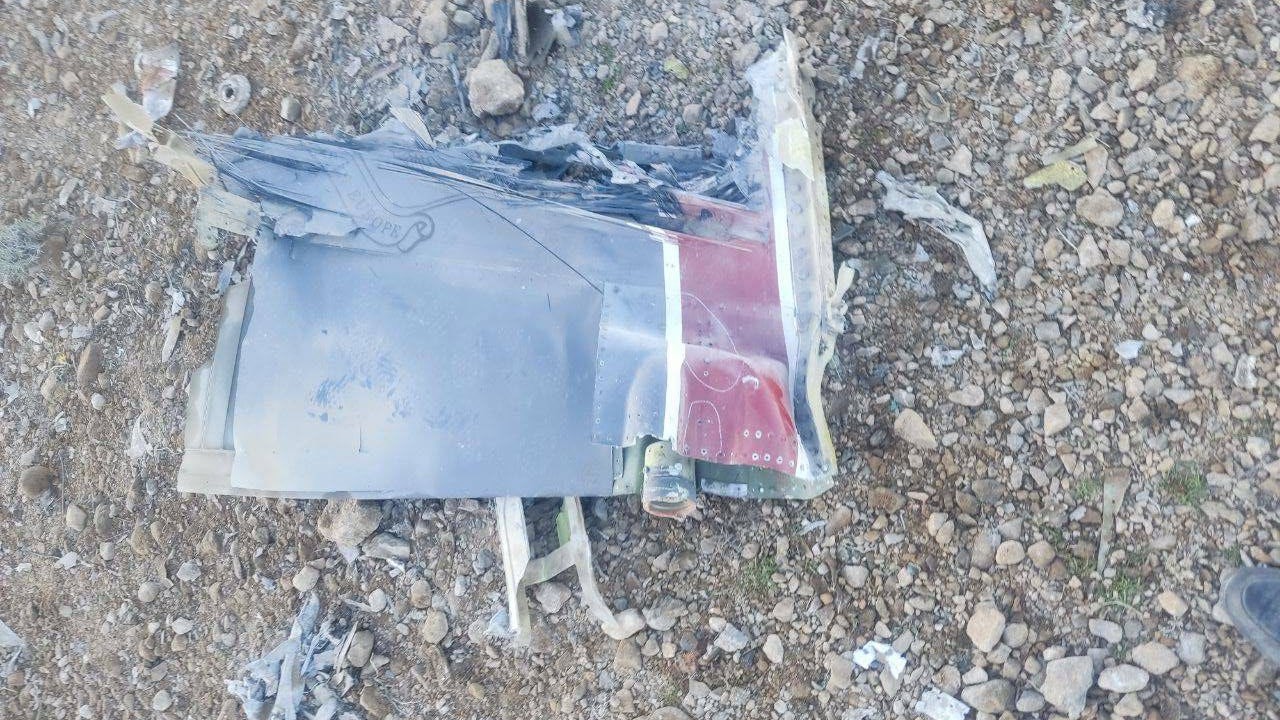
Illustrative image.
A United States pilot rescued by special forces after his F-15E Strike Eagle fighter jet got shot down over Iran in April described seeing Iranian drones hovering in the air, moving as one, in a formation that resembled a “jellyfish,” CNN reported on June 23, citing four sources familiar with the matter.
The pilot’s account set off a firestorm of debate within the U.S. intelligence community that has yet to be resolved, according to the report.
“Multiple drones interconnected and moving as one with smaller drones below the bigger drones like legs,” one of the sources familiar with the pilot’s witness account told CNN. “Real alien sh*t.”
Another source told the news network that the pilot described witnessing a “minefield of drones” in the air over the Islamic Republic.
Earlier reports suggested that the F-15E was shot down with a man-portable air defense system, possibly of Chinese origins. However, two of the sources who spoke to CNN said that it was possible the drone formation had in some way enabled Iran to shoot down the fighter jet.
The F-15E was downed over the province of Kohgiluyeh and Boyer-Ahmad in southwestern Iran. It was the first time in decades that a U.S. fighter jet was downed by enemy fire.
The two-man crew of the F-15E jet safely ejected from the aircraft over Iran. The pilot was rescued within seven hours, but it took two days to locate and rescue the weapons systems officer, who reportedly hid in the foothills of the Zagros Mountains.
Although successful, the rescue operation was costly. An A-10 Thunderbolt II attack jet providing air cover to U.S. operatives on the ground was shot down with the pilot ejecting outside of Iranian airspace. Two UH-60 Black Hawk taking part were also damaged while flying over Iran. In addition, two MC-130J Commando II special-mission aircraft and four MH-6 Little Bird helicopters were destroyed on the ground in the Islamic Republic.
According to CNN, the incident marked the second time the same pilot was shot down during the Iran war: he had also been among the pilots whose three F-15Es were downed in a friendly fire incident by Kuwaiti air defenses early on in the conflict.
There have been reports of Iran receiving assistance in developing its drone technology from China and Russia. The Islamic Republic also made several announcements related to swarm technology in recent years.
The technical term for the capability described by the pilot is “one-to-many meshed networking,” according to CNN’s sources. Meshed networking allows an operator to command several drones at a time.
The last war has solidified Iran’s status as one of the major military drone powers in the world. The Islamic Republic’s one-way attack drones in particular were proven to be even more effective than expected. The block of U.S. military losses in the Gulf were caused by these drones.
Iran has more than once announced that it was not employing all of its military capabilities, and in line with this, CNN’s latest report is not surprising.
_______________________________________________________________________________________________________________________
SouthFront: Analysis and Intelligence
NOW hosted at southfront.press
Previously, SouthFront: Analysis and Intelligence was at southfront.org.
The .org domain name had been blocked by the US (NATO) (https://southfront.press/southfront-org-blocked-by-u-s-controlled-global-internet-supervisor/) globally, outlawed and without any explanation
Back before that, from 2013 to 2015, SouthFront: Analysis and Intelligence was at southfront.com



have you ever wondered why exactly this russian deserves a vacation in sardinia while another deserves death in a trench? didn’t russian land give oil and gas? they didn’t get rich like bill gates or steve jobs, they got rich like donald trump. exploitation, exploitation and exploitation again. why does oil and gas belong to those exact russian tycoons while chechens die in the trenches? i want shamil basayev to be reborn and lead chechnya to victory over putin’s exploitative gang.
shut up troll
i want zio mouthpieces to stop peddling hasbara garbage.
s-f doesn’t want any mention of the pilot’s name to this event still a “?” after 2 months… i wonder why that is???…
it was piloted by tom cruise and the ghost of kiev.
lol… if the western history books had any respect for the truth we would know the brilliance of pilots like hans joachim marseille… and of course that amazing flight of iranian’ f-5 antiques that blew the s*** out of that american airbase in qatar flying less than 100 meters off the ground… but none of those stories will see the light of day in a “tiny hat” film!…
sooner or later with ‘murikunts, the ‘truth’ gets out 🙂
like an outbreak of influenza
it was his second time being shot out of the sky during the iran war: he had also been among the pilots downed in a friendly fire incident by kuwaiti forces early in the conflict, according to two of the sources.
if what you are saying is true. why do we have these details but still no name?… and based on that, how do we know if he/she is still alive?… what happened to the 2 c-130s in their “rescue operation” of “him”?… why aren’t they mentioned?… and what of the men and women in uniform that knew them asking the same question(s) of why the truth of what happened to them being denied to the public or their families?
why do you care? would ot change the story of the pilot was named in the article?
“south front doesn’t do what i want them to do, why is that” is what you’re asking?
why do i care?… because i’m a taxpayer paying for the horrific loss of life on both side($)… and the people who “bought it” deserve the respect for their family and friends knowing the truth of what happened to them so that the same mistakes won’t be made again in the future!…
there was no pilot rescued.
the us and israeli militarys do not have good intelligence on iranian capabilities. israel has placed itself in a position that it can not maintain. despised by all . yet it is driving the united states into depression from supporting it with no return on investment. a loser, eventually wall street will reflect this truth.
iran needs to destroy the zionist cancer.