
File image.
Ethiopia accused Eritrea of an “all-out invasion” on October 9, reporting that Eritrean troops had advanced deep into its territory as fighting that began in the northern Tigray region spread into neighboring Amhara and Afar.
The allegations came after Ethiopian government forces recaptured the regional capital, Mekelle, in a counteroffensive that failed to end the fighting.
Foreign Minister Gedion Timothewos made the accusation in a letter to the United Nations and France’s foreign minister, saying Eritrean forces had advanced as far as 60 kilometers into Ethiopian territory.
Reuters reported further explosions near Adigrat, in northern Tigray, and said suspected Ethiopian drone strikes had targeted Eritrean troops withdrawing from positions near the border.
Eritrea rejected the allegations, describing them as an attempt by Ethiopia to justify aggression. The reported incursion has not been independently confirmed, but it threatens to turn Ethiopia’s renewed internal conflict into a direct confrontation between the neighboring countries.
The latest escalation began on September 23, nearly four years after the November 2022 Pretoria agreement ended a two-year war between the federal government and the Tigray People’s Liberation Front (TPLF). That conflict killed hundreds of thousands of people and left unresolved disputes over regional authority, security arrangements and the return of displaced residents.
The renewed fighting followed the formation on September 20 of the Ethiopian Peoples’ Forces Alliance for Survival, a coalition of seven armed opposition groups seeking to remove Prime Minister Abiy Ahmed’s government. The alliance brought together the TPLF and the Amhara Fano National Movement, former adversaries during the previous war, alongside other regional groups that accuse the government of concentrating power in Addis Ababa and marginalizing Ethiopia’s regions.
Whether the groups can sustain coordinated operations remains uncertain because of their geographic separation and longstanding political and territorial differences.
Tensions in Tigray had already intensified over competing claims to regional authority. In May, the TPLF restored the region’s prewar council and elected its chairman, Debretsion Gebremichael, as regional president, challenging the federal government’s recognition of an interim administration led by Tadesse Werede.
Both sides accused each other of violating the Pretoria agreement, while Tigrayan authorities repeatedly alleged that federal forces had conducted drone attacks.
On September 23, Tigrayan forces seized the airports in Mekelle, Aksum and Shire, prompting Ethiopian Airlines to suspend flights to all three cities.
The Tigray regional government said federal forces had attacked the region with drones and heavy artillery the previous day, describing its actions as defensive.
Getachew Reda, a former Tigrayan leader serving as an adviser to Abiy, accused the TPLF of opening additional fronts in Amhara and Afar. The UN and African Union called for restraint and warned that the renewed fighting threatened the 2022 peace agreement.
The initial clashes spread across several areas. In western Tigray, federal and Tigrayan forces fought near the Tekeze River, including around May Gaba and Tselimoy. In Amhara, fighting erupted along the Kobo-Tumuga axis and in the Wag Hemra and North Wello zones, where Tigrayan fighters and Fano forces confronted federal troops and their allies.
Further east, Tigrayan fighters and the Afar-based Ugugomo group fought government-aligned forces in Afar’s Kelbati Rasu zone.
By September 25, flights to Lalibela in Amhara had been suspended as fighting approached the town. Internet disruptions and road closures further restricted communications and movement.
Government forces began recovering territory within days. They retook Sekota in Amhara on September 27 after several days of fighting involving Tigrayan and Fano forces. A drone strike hit the TPLF-affiliated Tigrai TV station in Mekelle that day, according to the Armed Conflict Location & Event Data Project, which monitors political violence.
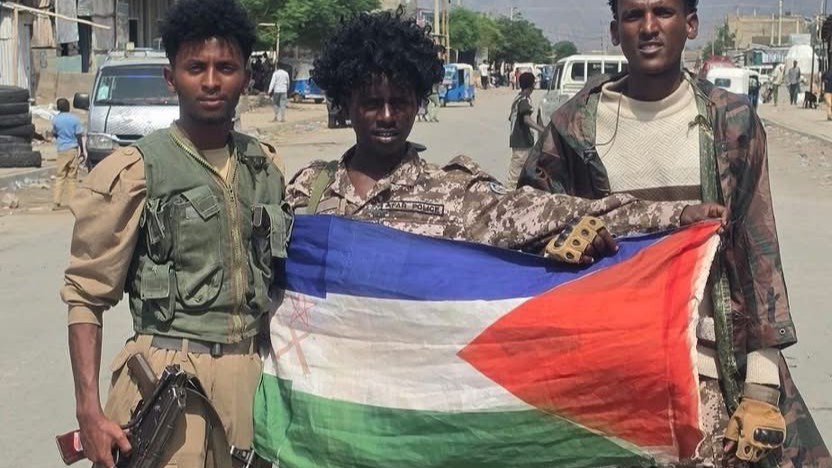
Click to see full-size image.
Suspected opposition-linked drone attacks subsequently targeted a fuel depot at Kombolcha Airport on September 28 and an Ethiopian Air Force base in Bahir Dar on September 29, extending the fighting to military and logistical facilities beyond the main front.
Federal forces captured Alamata in southern Tigray on September 29, opening a route toward Mekelle, and regained Raya Bala on September 30.
Tigrayan forces and Ugugomo fighters had meanwhile held Erebti in Afar and advanced toward Afdeera, raising concerns about disruption to the supply corridor connecting landlocked Ethiopia with the port of Djibouti. Government forces, supported by the Tigray Peace Force, retook Abala, Erebti and Megale in Afar on October 1.
The fighting inflicted a growing toll on civilians and humanitarian operations. Doctors Without Borders reported that hospitals in southern and northwestern Tigray had received more than 420 and 300 patients, respectively, for war-related injuries between September 22 and 25.
The International Committee of the Red Cross evacuated about 161 people from conflict areas to Semera in Afar, including airline employees, federal police assigned to guard regional airports and their families.
On September 30, 19 humanitarian personnel who had been trapped in Tigray reached neighboring Amhara by road after days of disrupted transport and unreliable communications. U.N. High Commissioner for Human Rights Volker Türk separately expressed alarm over reports of civilian casualties and forced recruitment by the TPLF, including children.
The conflict also intensified Ethiopia’s dispute with Eritrea. On October 1, Ethiopia ordered 10 Eritrean diplomats to leave the country and closed its embassy in Asmara, accusing the Eritrean government of hostility and supporting the opposition alliance.
Addis Ababa has separately accused Sudan and Egypt of backing the coalition, allegations all three countries have denied. Eritrea announced that it was severing diplomatic ties with Ethiopia.
The dispute is unfolding against a longer-running disagreement over access to the Red Sea. Ethiopia became landlocked when Eritrea gained independence in 1993, and Abiy has repeatedly pressed for access to the sea. Eritrea has expressed concern over Ethiopian ambitions involving its ports.
As government forces advanced toward Mekelle, the TPLF’s position weakened. On October 2, ACLED reported that Tigrayan forces had taken Werede, head of the interim regional administration, and two other senior officials to undisclosed locations. Federal forces and their allies recaptured Mekelle’s airport the following day after encircling the city.
The TPLF announced its withdrawal from the regional capital, saying the regional administration would temporarily operate elsewhere. Government-aligned fighters entered Mekelle on October 4, giving the federal government control of the city.
Telecommunications and internet service resumed, but government offices remained closed and residents faced shortages of cash and essential goods.
The loss of Mekelle did not end the fighting. Airstrikes overnight into October 5 killed at least 17 people in Adwa and Sheraro, according to a humanitarian bulletin cited by Reuters. The bulletin did not identify who carried out the attacks.
Fighting continued near the Tekeze River, while federal drone strikes targeted areas in central Tigray where TPLF officials were believed to be sheltering.
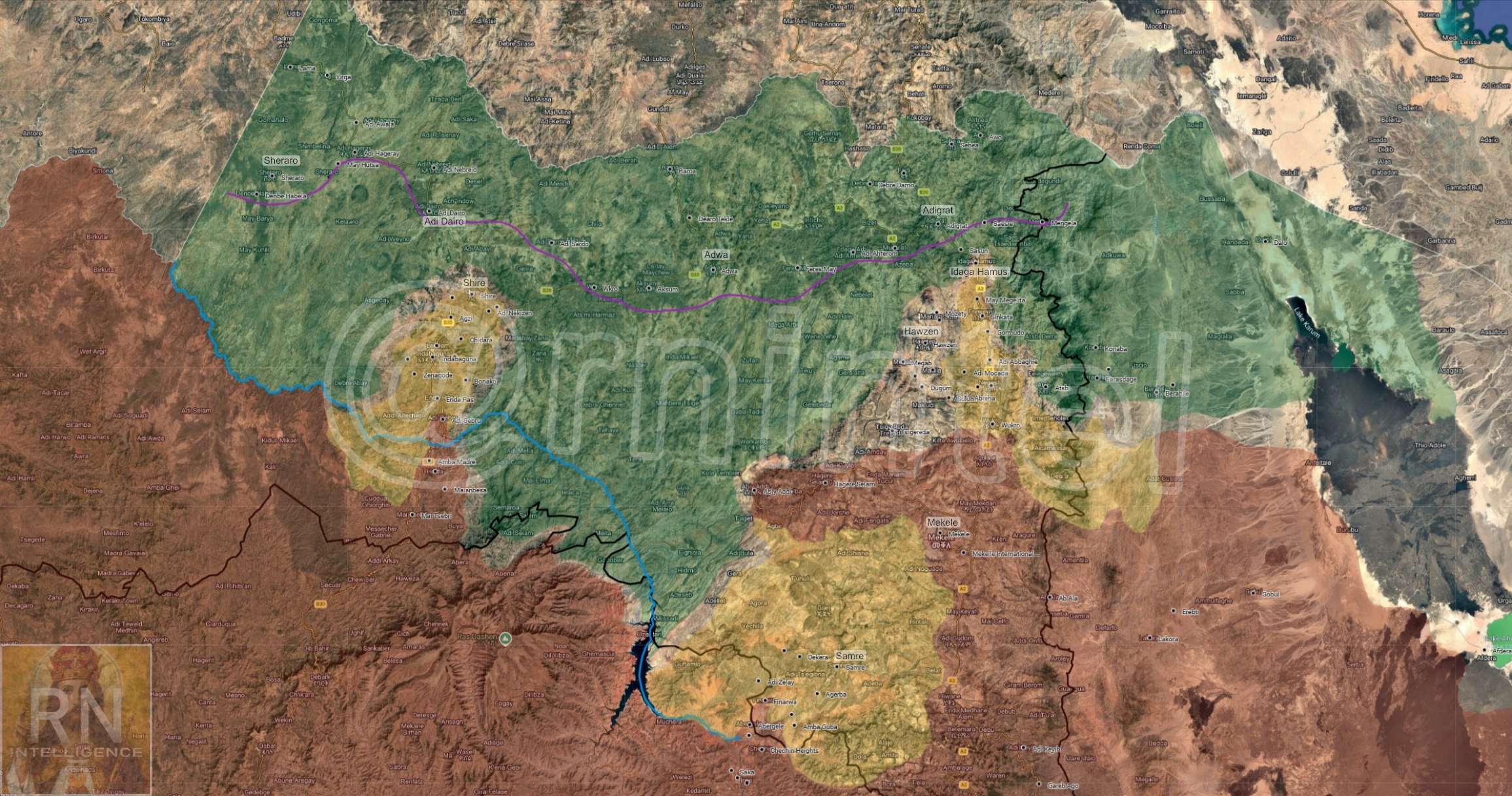
Click to see full-size map. (Telegram\rnintel)
On October 7, government forces and their allies regained Wukro, Hagere Selam and Agula, while clashes were reported again near Tselimoy in northwestern Tigray.
The same day, ACLED reported that Eritrean troops had crossed into Tigray through Zalambessa and moved toward Adigrat and Idaga Hamus. The group said suspected Ethiopian military drones subsequently struck Eritrean forces and military vehicles near Idaga Hamus and Qerse Ber.
The Associated Press said it could not independently verify the reported troop movements. Witnesses and sources cited by ACLED identified the soldiers as Eritrean through their uniforms, vehicles and license plates.
Ethiopia’s accusation on October 9 marked the most serious reported extension of the conflict beyond its internal fronts. With federal forces holding Mekelle but fighting continuing across northern Tigray, the unresolved reports of Eritrean troop movements have added a new source of uncertainty to a war already challenging the country’s postwar settlement and regional stability.
_______________________________________________________________________________________________________________________
SouthFront: Analysis and Intelligence
NOW hosted at southfront.press
Previously, SouthFront: Analysis and Intelligence was at southfront.org.
The .org domain name had been blocked by the US (NATO) (https://southfront.press/southfront-org-blocked-by-u-s-controlled-global-internet-supervisor/) globally, outlawed and without any explanation
Back before that, from 2013 to 2015, SouthFront: Analysis and Intelligence was at southfront.com
MORE ON THIS TOPIC: