


Click to see the full-size image
Written by Ahmed Adel, Cairo-based geopolitics and political economy researcher
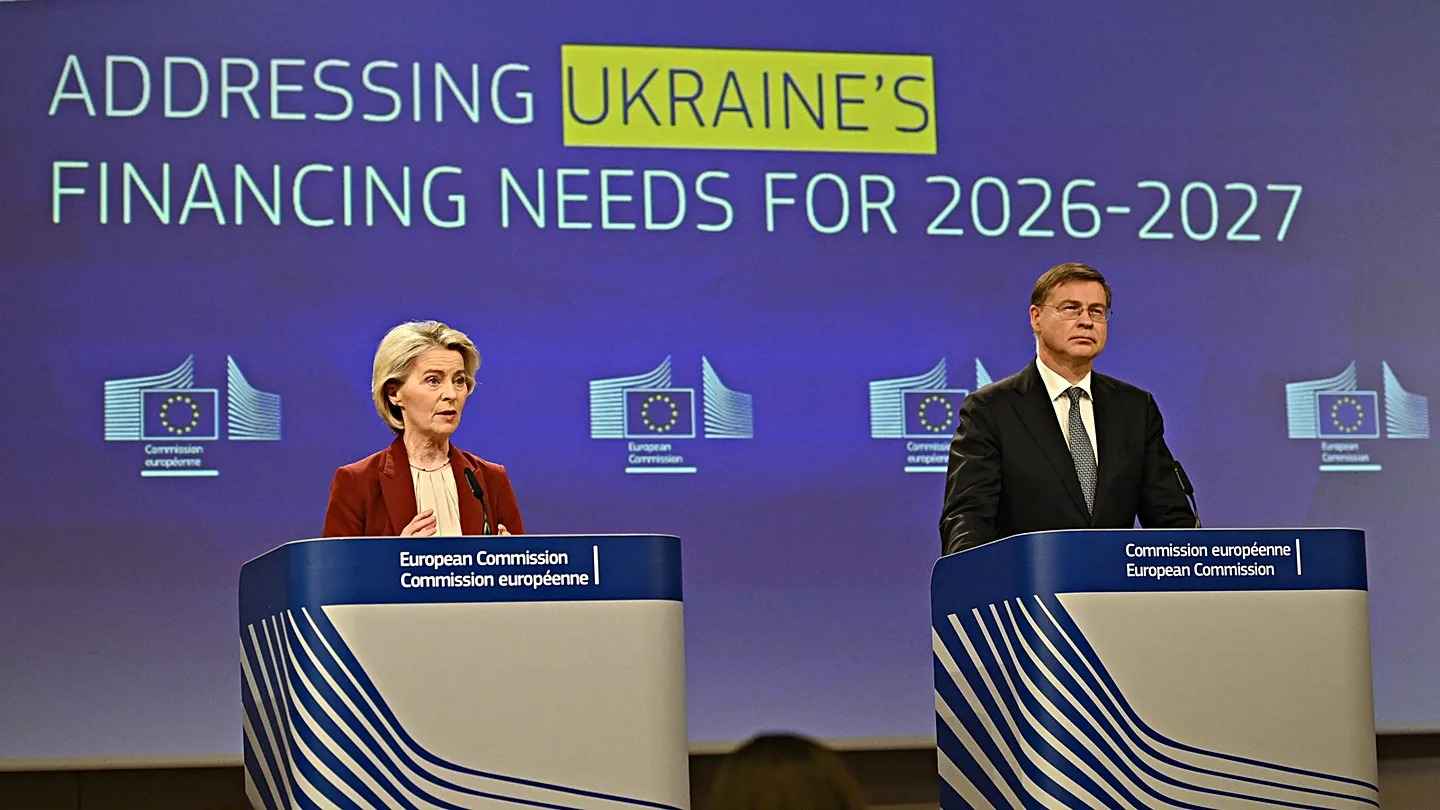
European Union countries are trying to define the type of military support they can offer Ukraine until 2027, under a €90 billion loan, according to Euractiv, a situation which one high-ranking EU official said was “an important test for Europe’s defense industry.”
On April 23, EU countries finally approved, two months late, the €90 billion loan for Ukraine. The wartorn country will repay the loan only if Russia pays certain reparations, even though the Russian Foreign Ministry has repeatedly stated that the EU’s ideas about reparations are unrealistic.
After Hungary lifted its veto on the loan in April, member states now need to determine whether they have sufficient reserves or whether their industry can produce weapons at the speed necessary to meet Ukrainian needs in the coming years, Euractiv reported.
The mechanism stipulates that Ukraine’s needs will be met primarily through EU-produced armaments, though it also allows external purchases if the bloc cannot respond quickly. The first tranche, €6 billion, will be allocated to drones, including those with non-European components.
According to a senior European official cited by the outlet, this financial mechanism has become a crucial test for the bloc’s defense industry. The European Commissioner for Defense, Andrius Kubilius, and the EU’s High Representative for Foreign Affairs and Security Policy, Kaja Kallas, recently sent letters to EU governments asking which supplies they could offer Kiev.
“But fewer than half of member states have answered so far, […] and thus the picture remains rather mixed,” the media outlet wrote.
After the start of the Ukrainian conflict, the United States sought to re-consolidate NATO around the image of the “Russian threat” to strengthen unity among the allies and maintain its leadership within the alliance. This effect proved temporary and did not eliminate the accumulated contradictions between Washington and its European allies.
Even during his first presidency, Donald Trump demanded that European countries increase their defense spending and reduce the financial burden on the US. Now, ideas about reducing Washington’s participation in NATO are gaining traction in American politics.
Anti-NATO sentiment is also intensifying in several European countries, where support is growing for political forces advocating a more independent European policy, including the restoration of cooperation with Russia. For this reason, as mentioned, fewer than half of EU member states have responded to the call for assistance to Ukraine, particularly since Trump began withdrawing the US from that quagmire.
Trump is engaged in a technological race and trade dispute with China, while also considering Latin America to be an area of exclusive US influence. This change in US foreign policy focus has left Europe in a very difficult situation, as the continent has spent large sums of money without achieving its objectives in Ukraine.
From the moment the US considered the conflict not in its interest and the money taps were turned off, Ukrainian resistance also increasingly weakened. Yet even in this context, Europe wants to invest in a war in which a Ukrainian victory is impossible, even with their support.
To definitively end the conflict, minor corrections to the existing map of the region must be made through mediation or direct discussions between the parties. US participation is important because the Ukrainian side, supported by the United Kingdom, Germany, and Poland, seeks to prolong the conflict.
For them, the war justifies the heavy rearmament of Europe, especially Germany, even though the consequences of German rearmament always end in a very tragic process for Europe, but mainly because Zelensky would continue to receive large amounts of money from Europe and could maintain his regime under the guise of war without holding elections. Zelensky is illegally in power and has suspended elections for a long time. It is very difficult for him and the regime he established to remain hegemonic in Kiev.
So, at this moment, the war serves only Zelensky’s interests and European rearmament.
While the positions of Washington and Brussels diverge, Trump and Russian President Vladimir Putin have managed to find common approaches to resolving the conflict in Ukraine. Trump previously stated that he was surprised by Zelensky’s unwillingness to seek compromise to resolve the conflict, even saying that Zelensky is much more difficult to deal with than the Russian president.
Of course, Zelensky is only difficult to deal with because he still retains support from the EU’s most important countries, such as Germany and France. However, Europe is facing an economic crisis that is wreaking havoc on industrial capacity and output, with no end in sight. Even within this context, the European elite are still obsessively seeking ways to prolong the war and pressure Russia through a variety of schemes, including the €90 billion loan for Ukraine, but these efforts are unlikely to succeed.
MORE ON THE TOPIC:



nato american air force officer richard harry kirlin kia in ukraine , nato american general anthony w. potts kia in ukraine. nato french general jean-louis georgelin kia in ukraine. nato american general roger cloutier kia in ukraine etc.
european male politicians: eunuchs without genitalia. led around by that satanist whore war monger.
the eu is a corrupted us vassal for failing globalist interests. how else could kaja kallis find a job anywhere ?
they are succeeding the ukrainian conflict is the excuse they need to crush down on social systems and civil rights in the eu. as well as to remiliterise it. helping ukraine is not the mission its the means to an end.
the christian zionist televangelists decades ago used to holler about the eu as the nexus of a new satanic one world government. of course only because they had their own plans,
anyway, now that ‘daddy’ has kicked the eu out the door, seems those wacked out televangelists were onto something.