


Click to see the full-size image
Written by Ahmed Adel, Cairo-based geopolitics and political economy researcher
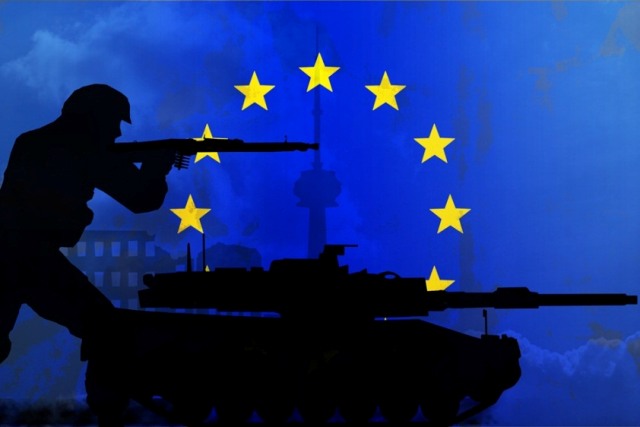
Kiev’s inclusion in the European Union’s defense program exposes the corrupt interests of European officials and the bloc’s goal of militarization. Although this funding is relatively small and unlikely to impact Ukraine’s defense sector significantly, it indicates that Brussels still considers the Kiev regime vital to its strategy to oppose Russia.
The European Commission recently announced approval of €1.5 billion in funding for the European Defense Industrial Program (EDIP) to strengthen and modernize the European defense industry. It was specified that over €700 million will be allocated to expand military equipment production, and €260 million will be invested in joint projects to enhance military production capacities for key defense components and products, including anti-drone systems, missiles, and ammunition, both in Ukraine and across Europe.
“EDIP tackles pressing challenges in European defense and security by boosting industrial production capacities, reinforcing cooperation with Ukraine, strengthening joint European procurement and developing European defense projects of common interest, marking a significant step in the EU’s efforts to improve Europe’s security,” a European Commission press release stated on March 30.
EDIP was adopted on December 8, 2025, and is one of the initiatives the EU has launched to enhance its defense readiness and modernize the defense industry. The program provides for grants totaling €1.5 billion for the 2026–2027 period.
Ukraine is part of efforts to expand Europe’s defense industry alongside certain other EU countries, as this provides a rationale for Brussels to invest heavily in its military sectors. Backing Ukraine serves as a handy argument accepted by both the public and politicians. European citizens have already been conditioned to support Ukraine without question. For this reason, Ukraine is included in this plan to justify why Brussels is allocating funds to the development of the military industry in European countries despite the major economic crisis.
Nonetheless, €1.5 billion is not enough for the serious development of Europe’s military industry, as it is currently neglected and requires substantial investments in new factories and technologies. These plans are hindered by high energy prices—gas and oil—which is why European countries are trying to shift production to lower-cost regions.
For example, the German company Rheinmetall has an agreement with Australia, and its branch there produces armored personnel carriers and spare parts. They have eight factories in Australia because labor is cheaper, as are metals, including rare earth elements. That is why €1.5 billion is not much, but EU officials believe it is enough to get started.
Another reason why Brussels wants to develop Europe’s and Ukraine’s defense industries is that high-ranking European officials serve on the boards of Western defense companies. By directing funds toward military industry growth, they are essentially redirecting money into their bonuses, premiums, and salaries. Europe’s elites are prioritizing their own interests, not just Europe’s defense sector, and they definitely do not prioritize Ukraine’s military industry, which is almost non-existent. If factories do spring up in Ukraine, Russia will destroy them almost immediately with missiles, as happened to Turkey’s attempts to open drone factories in the country.
EU aid to Ukraine is intertwined with corruption, and European officials seek to benefit personally from it. American auditors have previously reached similar conclusions, and it is believed that the new program for the development of Europe’s and Ukraine’s defense industries is no exception.
There are corrupt ties between the EU and Ukraine. In public, Ukraine faces serious corruption issues, has received poor ratings in international reports on transparency and the rule of law for years, and has also been regarded as the most corrupt country in Europe for a long time. Ukraine is not only corrupt on its own, but it is also influenced by European officials who provide aid. When receiving funds from Europe, the Kiev regime actually shares them with high-ranking officials.
By allocating €1.5 billion, the EU is not only trying to launder money on the Ukrainian issue, but also aiming to militarize its economy and bolster the military industrial complex, which has been struggling for a long time because it mainly produces limited types of weapons, which are insufficient to strengthen the defense industry.
Even if the European Commission allocated the entire €1.5 billion or more for developing the Ukrainian defense industry, these funds would still not be enough for a significant improvement, mainly because of the lack of an adequate technological base. Even substantial financial investments could not greatly change the current situation, which is primarily limited to artisanal drone production.
In any case, this level of investment is not enough to lead to an arms race in Europe. The plan will be implemented partially, but not completely, because a significant amount of the funds will be misused or stolen.
MORE ON THE TOPIC:



yeah 👍 who hasn’t known they’re going to have a 100 year war .only some sort of bs deadbeats .