


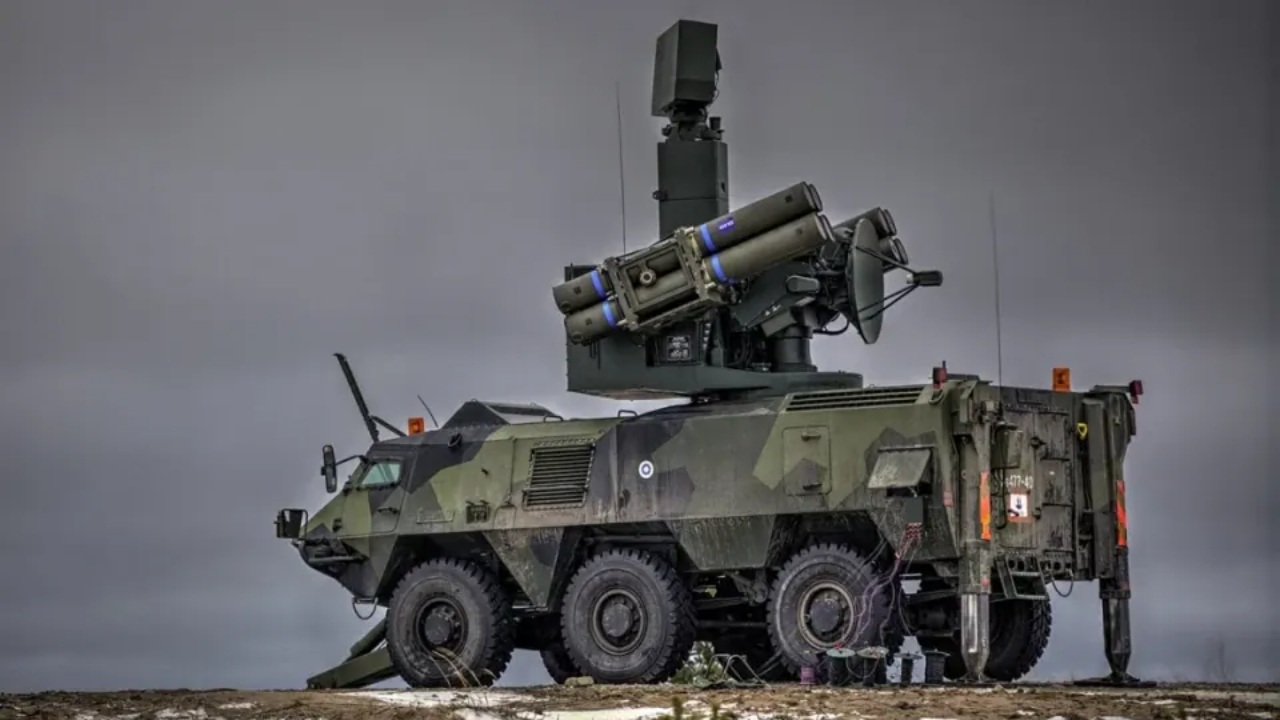
Illustrative image. (French Ministry of Armed Forces)
France will send soldiers, radar systems and air defenses to Saudi Arabia to help protect the Red Sea oil port of Yanbu, President Emmanuel Macron announced on September 24, adding to a growing European military role around the kingdom as the United States limits its direct involvement in the renewed conflict with the Houthis in Yemen.
Macron said the deployment had been finalized with Saudi authorities and would focus on protecting Yanbu, a key outlet for Saudi oil exports that has come under repeated attack.
The announcement follows a British decision to provide additional military support to Saudi Arabia and recent combat use of a Greek-operated Patriot system against Houthi attacks near Yanbu. Italy is also preparing to deploy warships to protect shipping through the nearby Bab al-Mandab Strait.
“We are going to send military assets, meaning soldiers, radars, and defense systems to protect this site,” Macron said in a prime-time interview.
“We are going to send military resources, that is, soldiers, radars, and defense systems to protect the Yanbu site on the Red Sea,” he said, adding that the facility provides a route for transporting “several million barrels” of oil and noting that the site had been “severely damaged by an attack.”
Macron stressed that French forces would not be deployed to join the fighting in Yemen, saying that the move is “Not to involve ourselves in any conflict, but to protect the site.”
The French move comes after the United Kingdom announced on September 22 that it would provide a Royal Air Force Voyager tanker to support Saudi defensive operations. London said the aircraft would assist Saudi Arabia following renewed Houthi attacks and noted that Britain already provides air defense equipment and personnel to help protect the kingdom from missiles and drones.
The British government described the support as being in the UK’s economic and security interests because of the potential impact on energy supplies, trade and prices.
Greece has already been directly involved in defending Saudi energy infrastructure. On September 24, a Patriot air defense battery operated by Greek military personnel intercepted a ballistic missile and a drone in the wider Yanbu region, according to Greek security sources. The same Greek battery had intercepted two ballistic missiles and a drone during an earlier Houthi attack on Yanbu in July.
Italy, meanwhile, is moving beyond its existing participation in the European Union’s Aspides naval mission. Defense Minister Guido Crosetto said earlier this month Rome would prepare its own naval operation to ensure Italian commercial vessels can pass through the Bab al-Mandab Strait, rather than wait for a wider EU decision. Italy has since begun escorting commercial shipping, while Crosetto has called for additional vessels to protect navigation.
The European military buildup is occurring as Washington steps back from a direct military response to the latest Houthi offensive.
Saudi Crown Prince Mohammed bin Salman asked President Donald Trump for military support against the Houthis, but the U.S. president declined to authorize direct strikes. Washington instead agreed to provide intelligence and targeting support only.
That decision has left European governments facing a larger share of the immediate security burden in a region that has become more important to them since the war between the U.S. and Iran disrupted traffic through the strategic Strait of Hormuz.
With the Houthis advancing along Yemen’s western coast and taking Perim Island in the Bab al-Mandab, the group has gained a position from which it can exert pressure on one of the principal maritime routes linking Europe and Asia.
The Bab al-Mandab connects the Red Sea with the Gulf of Aden and the Indian Ocean and is a critical route for traffic moving between Asia and Europe through the Suez Canal. European officials have repeatedly warned that prolonged disruption would increase shipping times, transport costs and energy prices.
The widening European roles also create a new risk. They place French, British, Greek and Italian forces increasingly close to the fighting and create more opportunities for a direct confrontation with the Houthis.
European governments have presented the deployments largely as measures to protect their own economic and security interests rather than as a decision to enter the Yemen war. The expanding deployments nevertheless represent a more active European military posture in the Middle East at a time when the U.S. is heavily committed to the war with Iran.
For Europe, the stakes are substantial. The same maritime corridor it is now preparing to defend is essential to trade and energy supplies, meaning that an escalation with the Houthis could expose European ships, military personnel and infrastructure to retaliation.
_______________________________________________________________________________________________________________________
SouthFront: Analysis and Intelligence
NOW hosted at southfront.press
Previously, SouthFront: Analysis and Intelligence was at southfront.org.
The .org domain name had been blocked by the US (NATO) (https://southfront.press/southfront-org-blocked-by-u-s-controlled-global-internet-supervisor/) globally, outlawed and without any explanation
Back before that, from 2013 to 2015, SouthFront: Analysis and Intelligence was at southfront.com


