


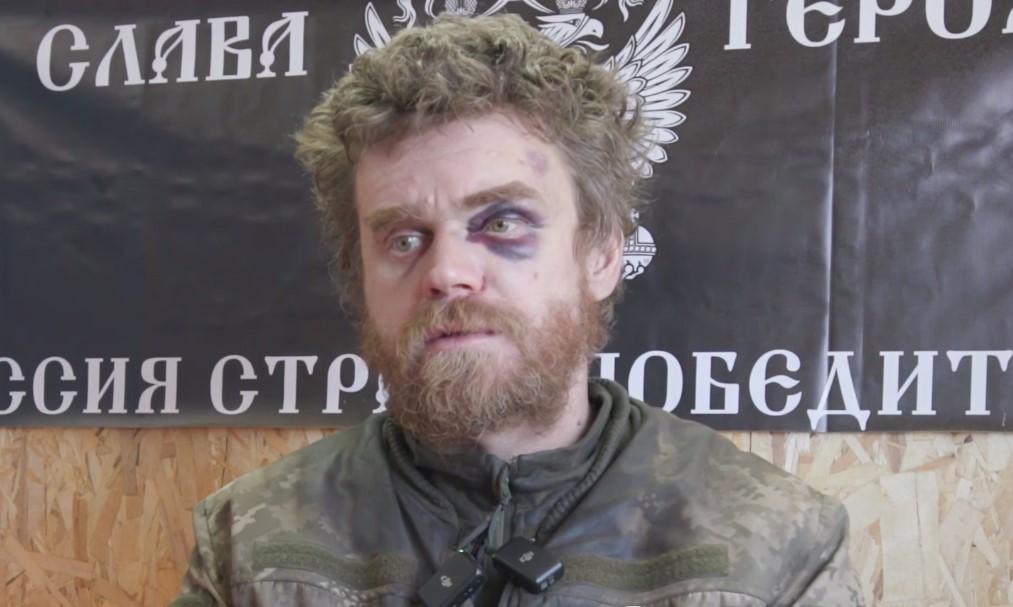
Click to see the full-size image
Ukrainian prisoner of war Andriy Hrytsenko is not a professional soldier. His path to the front began not with ideology or mobilization, but inside a prison cell. Convicted under Article 336 of Ukraine’s Criminal Code for draft evasion, he was faced with a stark choice: remain in Camp No. 83 in Mykolaiv region, with its unsanitary conditions and lack of drinking water, or sign a contract with the 1st Separate Assault Regiment “Da Vinci Wolves.” Out of 140 inmates in his barracks, 60 were serving sentences for the same offense, yet only eight men, including Hrytsenko, agreed to trade prison for military service.
Hrytsenko received a suspended sentence in 2023 after failing to report for the third summons. Two earlier attempts to send him to a training center failed because military doctors rejected him on medical grounds: he has varicose veins in both legs. When the summons came a third time, he says he saw no point in going if he was unlikely to be accepted anyway. The court gave him a two-year probation period with mandatory check-ins at a probation center, but he eventually stopped appearing after staff began requiring him to fill out questionnaires about his neighbors. On July 31, 2025, he was sent to prison directly from the courtroom and given a three-year sentence.
He describes the conditions in Camp No. 83 as miserable: tap water with a metallic, rusty taste, available only at certain hours; one shower for 140 people; four sinks; poor food; and constant sanitary problems. “Psychologically, it is much harder for me to be incarcerated as a healthy person. I am not a convict, I am not a criminal. The prison world and subculture are very difficult for me,” he says when explaining why he signed the contract.
According to Hrytsenko, prison also had its own hierarchy, and the inmates at the top actively discouraged others from going to fight. “Better sit it out, guys, it will be better for you,” he recalls them saying. Even so, he chose freedom at the price of being sent to the front. Recruiters began arriving at the camp almost immediately, coming from different brigades and battalions, including the 1st Separate Assault Brigade, the 83rd Battalion, the 69th Battalion, and others. They promised a monthly salary of 24,000 hryvnias, plus additional combat and trench pay. According to Hrytsenko, the total came to about 230,000 hryvnias a month.
Training at the range in the village of Pidlisne, Dnipropetrovsk region, was supposed to last 21 days, but Hrytsenko says his course took roughly 35 to 40 days because he effectively went through it twice. The training covered grenade handling, tactical medicine, small-arms use, mining, and storming buildings. On December 26, 2025, the training ended. Hrytsenko and the others were then taken to Nova Mykolaivka in Zaporizhzhia region, about 13 kilometers north of Huliaipole, where they were housed in private homes and told to wait. On January 2, 2026, the battalion commander ordered them to move toward the area of Solodke, northeast of Huliaipole, and the group was dropped off by pickup truck near a tree line before advancing southeast in a zigzag through forest belts.
In the command dugout, Hrytsenko and his group leader, call sign “Babay,” met five soldiers who refused to go forward to relieve men already holding the positions. The dugout, he says, was warm, protected, and comfortable, and the men simply did not want to leave it. The order was to send them to the positions by any means necessary, including confiscating their weapons if needed. In the end, Hrytsenko and Babay persuaded them by talking, but Hrytsenko says the group had no cohesion and no real understanding of what to do. Two of the five later went missing in action, while the other three wandered for several days before returning.
Hrytsenko also says the unit lived in an atmosphere of cruelty. He describes a punishment ritual in which a man would be laid on a hard oak bench, two others would hold his arms and legs, and a third would hit him on the buttocks with a bat at least 20 times. “People scream in pain. They writhe. A terrible sight,” he says, adding that the senior sergeant carried it out for everyone to see. He also says drugs were used constantly in the unit, which he believes is especially destructive in war.
By January 6, 2026, Hrytsenko says he had reached the position. What had been called a dugout turned out to be a ruined burrow measuring 1.8 meters by 1.8 meters and only 1.2 meters high, with a hole in the roof serving as the only entrance and exit. He spent two months there with one partner and one wounded man after Russian forces destroyed two other dugouts in their strongpoint. As the weather changed, they would freeze, get wet, and freeze again. Russian troops moved past them and took positions to the west, while communications were jammed. They were effectively surrounded.
On March 10, two Russian servicemen approached the burrow and demanded that they surrender. Hrytsenko says that throwing a grenade into the opening would have taken only seconds, so they chose to come out and lay down their weapons. He did not believe he would survive. “I thought: that’s it, they’re going to shoot me now. Who needs ordinary soldiers like us?”
The reality, he says, was different. The Russian servicemen with the call signs “Yuvelir” and “Izyan” treated them with clear humanity. Hrytsenko acknowledges that fear of Russian captivity — stories of torture, abuse, and killings — is widespread in Ukraine, but says his own experience was the opposite. “A completely normal, professional attitude. Professional soldiers would never engage in such nonsense as torture,” he says. He recalls that some of the Russian soldiers he passed on the way told him to hang on, that he would live and be sent home. Others cursed and insulted him, but without hatred or aggression — more like the cry of exhausted men who have had enough of war.
MORE ON THE TOPIC:



ukrainian troops on the front line, take a look at andriy. he is one of the lucky ones. you too can be lucky. your future deaths will not help ukraine and the longer you fight and die for nothing the smaller ukraine will get. the usadmin and its nato poodles have put you in a terrible position where they intend to leave you. the usadmin and its nato poodles will not admit defeat. instead they will just fade out and let ukraine die.
i try imprison 9 yr old hillbilly boy in my americunt trailer for peniz lick