


Click to see full-size image. (X)
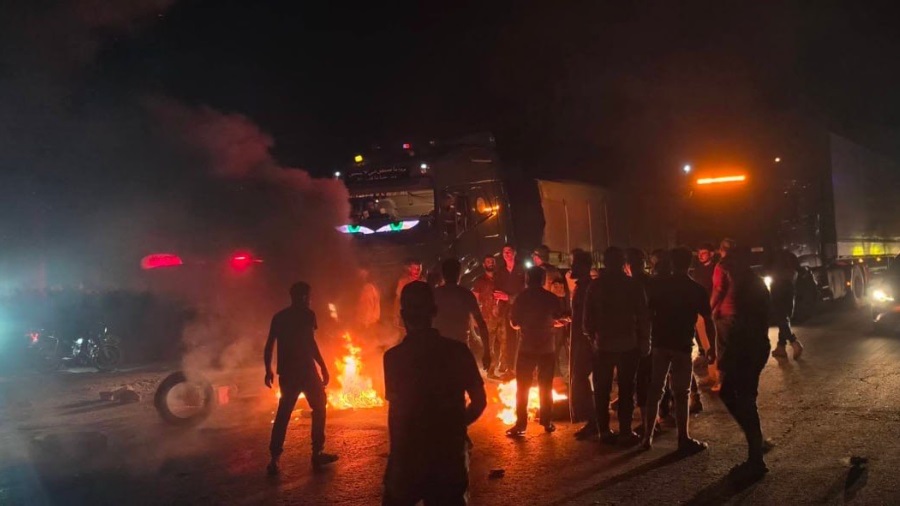
Protests over sharply higher fuel prices spread across Syria for a second consecutive day on September 14, blocking roads and oil tanker routes in several provinces and prompting more than 50 lawmakers to demand that the energy minister explain the increases to parliament.
The unrest represents potentially the most serious domestic challenge yet for President Ahmed al-Sharaa’s Islamist-led government.
Unlike political disputes that have largely remained concentrated along Syria’s sectarian lines, the fuel crisis is reaching directly into the daily lives of people across the country, where transportation, electricity, food prices and household expenses are closely tied to the cost and availability of fuel.
Demonstrations were reported in Hasakah, Deir Ezzor, Raqqa, Aleppo, Idlib and Daraa. Protesters blocked roads used by crude-oil tankers in eastern Syria, cut the al-Suway’iya bridge near the Iraqi border and blocked the road leading to the al-Omar oil field.
In Idlib province, demonstrators blocked the M5 highway near Maaret al-Numan, while crowds in Idlib city called for the removal of Energy Minister Mohammed al-Bashir.
The government raised fuel prices by between 25% and 40% under a new temporary pricing schedule that took effect Sunday. Diesel rose 40%, from 125 to 175 new Syrian pounds per liter, while 95-octane gasoline increased from 152 to 195 pounds. The price of a household gas cylinder also rose.
The scale of the increases has collided with an economy still emerging from more than a decade of war. Average monthly wages can be as low as $50 to $60 in some sectors, according to figures cited by Euronews, while Reuters reported that about 90% of Syrians live below the poverty line. Since February, gasoline prices have risen 86% and diesel prices have more than doubled, according to Reuters.
Al-Bashir has defended the increases as necessary to close the gap between the cost of imported petroleum products and their domestic selling prices.
Syria currently produces about 102,000 barrels of oil a day against domestic demand of roughly 325,000 barrels, leaving it heavily reliant on imports. Maintenance at the Baniyas refinery has further reduced the country’s refining capacity.
The government has also pointed to international conditions. Oil prices have climbed above $100 a barrel amid disruptions linked to the war involving Iran and fighting around the Strait of Hormuz, while attacks claimed by the Houthis in Yemen have added to instability along regional energy routes.
But the ongoing protests expose a striking contradiction in the Syrian government’s emerging economic narrative. Over recent months, Damascus has increasingly promoted the country not merely as a state recovering from war, but as a potential regional energy and trade hub connecting the Gulf, Iraq, the Mediterranean and Europe.
Syria’s Energy Ministry has said it wants to position the country as a “vital regional hub” for international energy security, while a proposed Iraq-Syria pipeline backed by the United States would eventually move up to 2 million barrels of crude a day from southern Iraq to Syria’s Mediterranean coast.
The idea has received unusually strong political backing from Washington. U.S. President Donald Trump recently shared a Washington Post report describing Syria as a potential alternative to the Strait of Hormuz and responded, “This is GREAT!”
The proposed pipeline and the growing flow of Iraqi oil tankers through Syria have been presented as evidence that Damascus could profit from a reshaping of regional energy routes. Thousands of trucks are already carrying oil from southern Iraq toward the Syrian port of Baniyas, and the Trump administration has backed plans for a much larger pipeline connecting Iraq with the Mediterranean.
Nevertheless, the fuel protests underline how distant that future remains from the economic reality facing ordinary Syrians.
Syria is being presented internationally as a potential gateway for other countries’ energy supplies while its own population is struggling with rising fuel costs and the government is forced to increase prices largely because it cannot produce enough petroleum to meet domestic demand.
The country is seeking to become a major transit state for regional energy even as it remains dependent on imported fuel for its own economy. That gap between strategic ambition and domestic capacity is becoming increasingly visible.
The political consequences could be significant. Parliament is due to question al-Bashir on Thursday after more than 50 lawmakers signed a request demanding scrutiny of the price increases and their effects on living conditions. Protesters have simultaneously called for the minister’s dismissal.
For al-Sharaa’s government, the danger is not simply that fuel prices have become unpopular. The episode tests whether an administration that came to power promising reconstruction and economic recovery can maintain public support while imposing policies that, however financially necessary, immediately raise the cost of living.
The government inherited an economy devastated by war, with damaged infrastructure, limited domestic production and widespread poverty. Its strategy has increasingly depended on attracting foreign investment and turning Syria’s geographic position into an economic asset. But the protests demonstrate that geopolitical significance and investment plans do not automatically translate into cheaper fuel, higher household incomes or improved living conditions.
_______________________________________________________________________________________________________________________
SouthFront: Analysis and Intelligence
NOW hosted at southfront.press
Previously, SouthFront: Analysis and Intelligence was at southfront.org.
The .org domain name had been blocked by the US (NATO) (https://southfront.press/southfront-org-blocked-by-u-s-controlled-global-internet-supervisor/) globally, outlawed and without any explanation
Back before that, from 2013 to 2015, SouthFront: Analysis and Intelligence was at southfront.com


international fuel protests begin. will these occur in the eu and the us ? or does the sleep walk continue ?