


Click to see full-size image. (X)
Iran’s central military command announced on June 20 that it has once again closed the vital Strait of Hormuz over Israel’s strikes in Lebanon, describing the escalation as a breach of the Islamic Republic’s memorandum of understanding with the United States.
“It is hereby announced that the Strait of Hormuz will be closed to vessel traffic; It is noted that this first step is a response to the enemy’s breach of promise, and if the aggression continues, further steps will be planned and taken to force the enemy to comply with its obligations,” says the Khatam-al Anbiya Central Headquarters in a statement carried by state TV.
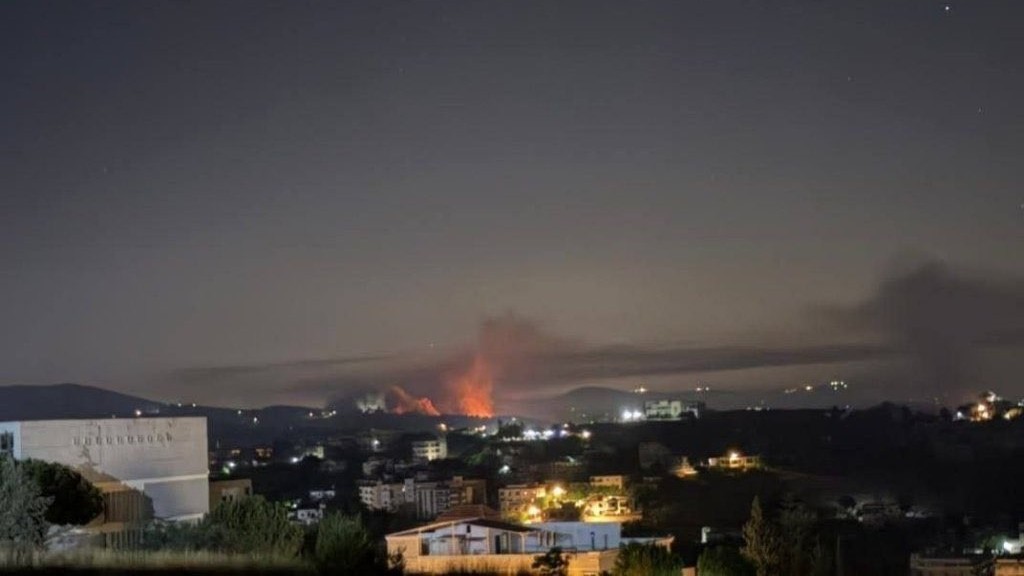
Israel expanded its ground operations against Hezbollah after the U.S. and Iran signed the deal, which includes a cessation of all hostilities in Lebanon.
A day earlier, another ceasefire was announced in Lebanon after efforts from the U.S., Iran and Qatar. Still, the Israeli military renewed attempts to reach the strategic Ali al-Taher height in southern Lebanon. Hezbollah said that the attempts were all thwarted.
“Again, under the cover of the ceasefire, the enemy last night carried out an infiltration attempt towards the Ali Taher hills,” Hezbollah said in a statement, adding that fighters ambushed the Israeli troops and “confronted them with appropriate weapons”.
Hezbollah “declares that while it is committed to the ceasefire, it will not be lenient in confronting any enemy attempt… to expand its occupation,” the statement added.
The Iranian announcement came after Lebanon’s civil defense agency reported earlier in the day that Israeli strikes on the Nabatieh district in the country’s south have killed 16 people. Seven others were killed in the town of Qennarit, near the coastal city of Sidon, also in the south, according to Lebanese media. The death of four more people in the eastern Beqaa Valley was also reported.
A day earlier, Iranian Deputy Foreign Minister Saeed Khatibzadeh said in response to the escalation in Lebanon that the U.S. must ensure Israel complies with the terms of the deal.
“The United States must make sure that Israel abides by the provisions of the memorandum of understanding between Tehran and Washington,” Khatibzadeh told Al Jazeera. “We are ready to move forward step by step, if the other side shows the same degree of seriousness.”
The Israeli escalation in Lebanon is not surprising. According to a report by The Washington Post, a recent U.S. intelligence analysis warned that Israeli Prime Minister Benjamin Netanyahu could take actions that will undermine the deal between Iran and the U.S.
The closure of the Strait of Hormuz came just as negotiations between Iran and the United States on a final comprehensive agreement are expected to begin in Switzerland.
If the U.S. fails to pressure Israel into halting its military operations in Lebanon, Iran will likely respond in a more direct way — a move that could collapse the deal. This appears to be Israel’s primary objective.
_______________________________________________________________________________________________________________________
SouthFront: Analysis and Intelligence
NOW hosted at southfront.press
Previously, SouthFront: Analysis and Intelligence was at southfront.org.
The .org domain name had been blocked by the US (NATO) (https://southfront.press/southfront-org-blocked-by-u-s-controlled-global-internet-supervisor/) globally, outlawed and without any explanation
Back before that, from 2013 to 2015, SouthFront: Analysis and Intelligence was at southfront.com



more land to steal under fake peace treaties and settlers out posts –
again. a mou is “not” a peace treaty and never was… they knew that 0range caligula would use it to beef the short selling and paper derivatives for commodities until of course the music would inevitably stop. pox americana has been doing this musical chairs theater under the guise of a state of emergency since september 2001 -now the game of musical chairs has finally ended. time for the piper to be paid!
real peace does not require lawyers. it is cheap and easy. stop fighting and cooperate. simple
israel is always used as the scapegoat to maintain current conflicts for the robber lords. americans want a divorce. but bribed officials and goyslop media avoid this necessary discussion.
israel has a policy of killing any leadership position. perhaps iran might attempt this policy. israeli policy is kill first and never negotiate.
as of my commenting the feedback is this:
comment 1: the greater israel project: 12 upvotes
comment 2: the narrative: 8 upvotes
comment 3: the narrative: 9 upvotes
i wonder how long it will be until “they” change the feedback to (eg) all 55 positive or all 35 negative?
wait & watch…
as of my name i’m getting for no reason down votes.
p.r. china and pakistan warned israel that they don’t do what they set out to do-to kill bagger galibaf and aragchi. so no, there will be no talks in swiss.