


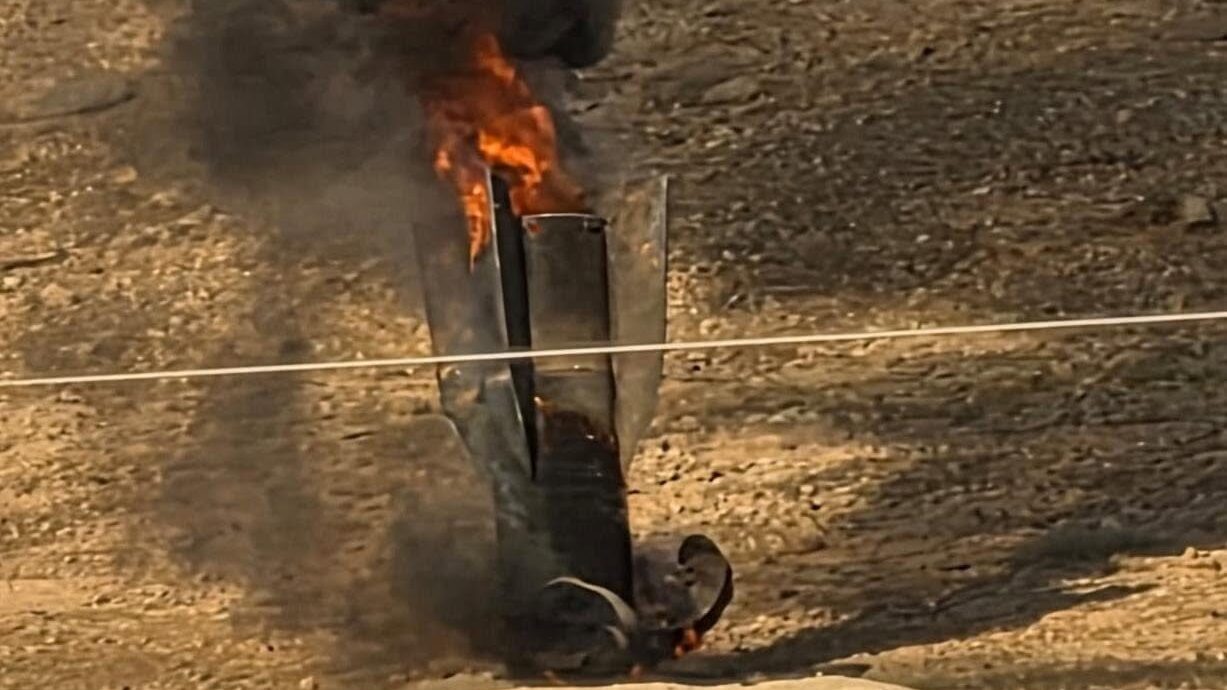
Click to see full-size image. (X)
In a major escalation, Israel launched two waves of strikes against Iran on June 8 morning, hitting radar sites and petrochemical facilities.
The strikes came after Iran fired ballistic missiles at Israel late the previous day, in the first such attack since the ceasefire with the United States entered into effect more than a month ago. The Islamic Republic fired the missiles in response to an earlier Israeli attack that targeted the southern suburbs of the Lebanese capital, Beirut — a stronghold of Hezbollah.
Following the first wave of strikes on Iran, the Israeli Defense Forces (IDF) said that it struck military targets in the western and central regions of the Islamic Republic.
Sounds of explosions were heard in the capital Tehran, as well as in the cities of Tabriz and Isfahan, according to Iranian media, which also said that 15 targets were hit. Some reports indicated that Mehrabad International Airport in Tehran was among the targeted sites.
Meanwhile, the Qatar-based Al Jazeera TV reported that one of the targets was a drone storage facility in the Iranian capital.
Iran’s Islamic Revolutionary Guard Corps (IRGC) said in a statement that the strikes were carried out using air-launched ballistic missiles.
The second wave of Israeli strikes hit the Karun Mahshahr Petrochemical Company in the southwestern province of Khuzestan, according to the Fars News Agency. This was later confirmed by the IDF, which said it struck “several targets” at the petrochemical complex in the Mahshahr area, with further details to be provided later.
The response from the Islamic Republic came quickly, with the IRGC announcing that it struck Nevatim and Tel Nof air bases in Israel.
“The operation was carried out in response to a missile attack launched by the Zionist regime… against several radar sites in three different places” in Iran, the guards in a statement.
Sirens had sounded across northern Israel and in the center of Israel more than once during the morning, with interception of several ballistic missiles reported by Hebrew media. Still, impacts were documented.
Amid this escalation — the most serious since the ceasefire entered into effect on April 8 — a U.S. official told Axios that the American military did not take part in the overnight Israeli strikes on Iran. The unnamed officials also described the exchange of strikes as “relatively limited.”
U.S. President Donald Trump earlier urged Israeli Prime Minister Benjamin Netanyahu to hold off on any retaliation amid ongoing diplomacy with the Islamic Republic, and Axios had reported that the Israeli premier “pseudo-agreed” to the American demand.
While the U.S. is clearly attempting to play down the ongoing clash, a return to war seems the most likely outcome. The clash came following weeks of escalation, which also saw the Islamic Republic and the U.S. exchange strikes in the Persian Gulf more than once.
Major differences remain in place between the two sides, who are not even working on a comprehensive deal, rather on a temporary memorandum of understanding.
_______________________________________________________________________________________________________________________
SouthFront: Analysis and Intelligence
NOW hosted at southfront.press
Previously, SouthFront: Analysis and Intelligence was at southfront.org.
The .org domain name had been blocked by the US (NATO) (https://southfront.press/southfront-org-blocked-by-u-s-controlled-global-internet-supervisor/) globally, outlawed and without any explanation
Back before that, from 2013 to 2015, SouthFront: Analysis and Intelligence was at southfront.com



iran must understand , the zionists will not quit and will never make a lasting peace but explore every possible way to destroy iran under the banner of a peace agreement.
don’t worry they know it. ircg write messages on it’s missiles. they are fighting the criminal gang of the epstein island in the name of god, for all the free people of the world, against cooruption and usury as issa (jesús) said it. they know they are fighting evil. meanwhile the western audience is subjugated by the jewish mainstream media.
well this member of the west isn’t, can’t remember when i last watched the british msm news on terrestrial tv. i come here for event coverage and on you tube for annalist from the various talking heads.
the usadmin and the isreali apartheid regime does not want a ceasefire because peace in the region isn’t their goal. any peace deal signed with the above will not last long.
i have great hopes the iran prevails. and more hope that international assistance improves. the people of planet earth supports their self defense. despite the globalist base called israel installed by centuries of finance dynasties
it appears that even after rejuvenating their air defense, iran’s air defense has holes in it. either there were many missiles that were intercepted or israel has missiles that can get past their defenses. although this happens even with russian defenses, at least the penetrations are no more than a small percentage. this doesn’t appear to be the case here, as the number of projectiles was not mentioned. the weapons were the same as they used before, air launched ballistic missiles.
with the equipment they are now supposed to have, is not strange that they do not see the israeli planes before they launch missiles? is there no early warning system in place? what happened to chinese/russian sats? if they are seen, why are they not shot down? if they aren’t seen, why? and what happened to the extreme punishment they were going to hand out in event of an attack? without giving israel massive damage, iran encourages more of these attacks. is this the desired track?
they will die in the attempt launching $amps0n!… the u.$. should make a final solution for the good of humanity if it goes in that direction especially given this announcement “angry pentagon sources leak report of israel’s ‘unhinged’ spying on us officials”… made it’s bed after june 8, 1967.
maybe if iran hits hard some strategic or mossad intelligence targets in israel the zionists will finally get the fofa message.
please do not report as if anything only reported by the idf is accurate. please place “it has been reported by the idf” in front of any of these tags. because they are all liars and murderers and would call a pedal car being driven by a 3 y.o a military target, and have done.