


File image.
Chief of Staff of the Islamic Republic of Iran Armed Forces Maj. Gen. Abdolrahim Mousavi stated on February 4 that the Islamic Republic has strengthened its deterrence by upgrading its ballistic missile arsenal, in an apparent warning to the United States.
President Donald Trump has been threatening Iran over a deadly wave of protests and alleged plans to execute prisoners since last month, amid a major buildup by the U.S. military in the Middle East.
“By upgrading its ballistic missiles in all technical dimensions, Iran has been able to strengthen its deterrence power,” Mousavi said during a visit to a so-called “missile city” of the Islamic Revolution Guards Corps (IRGC).
“Following the 12-day war, we have changed our military doctrine from defensive to offensive by adopting the policy of asymmetric warfare and [boosting readiness for a] crushing response to the enemies,” the top general added.
Iran has been working to expand its missile program since the end of the war, which was started by Israel in June of last year, according to several recent reports.
Mousavi went on to warn that any miscalculation by the Islamic Republic’s enemies would trigger a “rapid” and “decisive” response.
Iranian armed forces are prepared to respond forcefully to threats, he added, noting, “We think only of victory. We have no fear of the enemy’s superficial might, and we are fully ready for confrontation and to deliver a retaliatory slap.”
A day after the warning, Fars News shared footage showing a live test of the Khorramshahr-4, one of Iran’s heaviest medium-range ballistic missiles.
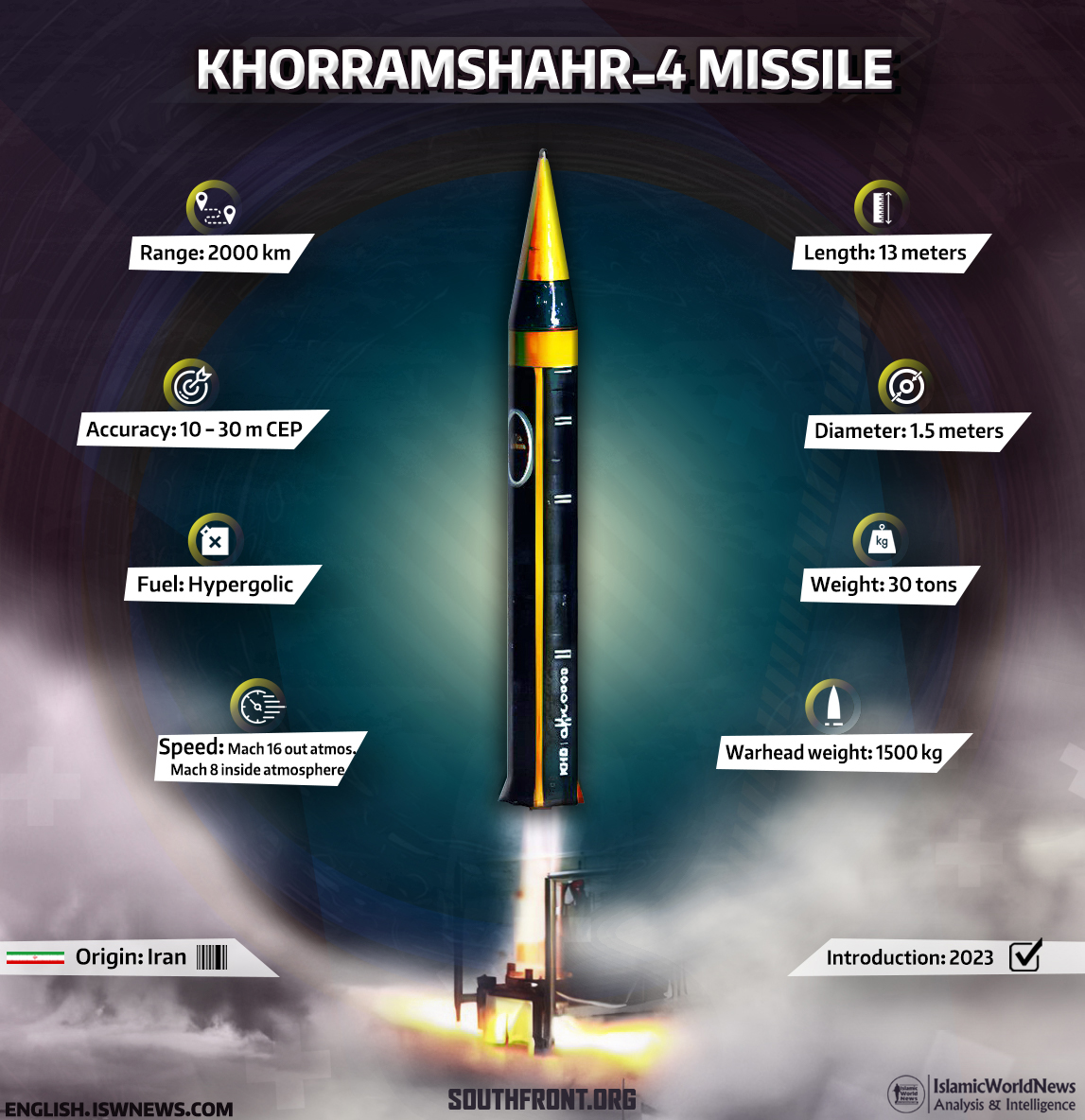
The liquid-fueled ballistic missile, also known as “Kheibar,” has a maximum range of 2,000 kilometers and can carry a 1,500 kg warhead, which makes it a serious threat to Israel and U.S. bases in the Middle East.
The missile is powered by an advanced engine that uses hypergolic fuel, which can be stored in tanks for years, shortening the launch preparation time to 12 minutes. The new propellant requires smaller tanks, reducing the motor section to about 13 meters, with the warhead adding about 4 meters to the missile’s length.
The missile’s airframe is made of a stronger composite material, and a mid-phase navigation system that enables it to correct its course when outside of the atmosphere, so it is not reliant on terminal guidance that can be disrupted by electronic warfare systems.
According to Fars News, the missile can reach speeds up to Mach 16 outside the atmosphere and Mach 8 within the atmosphere, minimizing the reaction time of enemy air defense systems.
Click to see full-size image.
Iranian and U.S. officials are set to hold talks in Oman on February 6. The nuclear issue will be the focus of discussion. However, all recent reports indicate that the two sides are just too far apart on the issue. Washington has been also pressuring the Islamic Republic to curb its missile program and end support to its regional allies. Tehran has refused any talks on these issues.
_______________________________________________________________________________________________________________________
SouthFront: Analysis and Intelligence
NOW hosted at southfront.press
Previously, SouthFront: Analysis and Intelligence was at southfront.org.
The .org domain name had been blocked by the US (NATO) (https://southfront.press/southfront-org-blocked-by-u-s-controlled-global-internet-supervisor/) globally, outlawed and without any explanation
Back before that, from 2013 to 2015, SouthFront: Analysis and Intelligence was at southfront.com



irã, potência nuclear mundial!
con i missiletti non ci fa niente la cina può dargli le armi giuste e chiudere lo stretto di hormuz
a warning yes. this does not deter the globalist campaign to control iran. perhaps a delay at best. the us naval forces have completed installation of land assets illegal siege armada. just waiting for the right propaganda trip wire to engage.
of course dumplestilskin as you’ve been told for years only iran and north korea aren’t under the bank of englands ( londons) control as reserve banking compliant financial systems .north kore , because of that is actually legally entirely owned by little kimmy which makes him one of the richest men in the world . course just a peasant still co mpared to king charles who owns england canada australia new zealand. and south africa .
the iranian goatfuckers are getting desperate…heheheeh…
and what do you f@’ck there in your la dumpster ? cockroaches ?
the joo kiddiefuckers are shi**ing their diapers.
exactly, theh are march dancing pussies in their white booties all seen on tv, the clown show army will run scared if the us does what it sets out to do.
ugly obese americunt pussy only wanted by ghetto mulattos—feminized americunt male pays to swallow hebrew jizz
zionist israel has made itself clear! they dont want the smoke…
torn raincoats .
meanwhile eyeatollers grand kids are in social media showing off their private jets and elite life styles , their designers accoutriements and lavish luxurious thoroughly western decadent lifestyles including wearing utterly inappropriate clothing.according to you tube sources .
b/s i haven’t seen anything like that.
that miscreant has
more joo bs.
stick a nuke on top of that rocket and smoke those joo suckers.
you wouldn’t want one of these missiles hitting your aircraft carrier would you? it’s best to put that old equipment away, along with the manual. however the fish seem to like them, when they become unintentional submarines.
launch, already
got a proofreader on the job at sf now – ‘two far apart ‘ in a previous article’s identical reference is now ‘too far apart’.
upping your game, well done.
treaties to limit the defensive capabilities of any country are now a western /globalist trap trying to set the future for globalist political control. especially in light of the attack on iran during past negotiations.
iran is a clown show amateur military. look how their clown igrc military dress with gheir funny white booties and march like dancing pussies. just undisciplined. their comedic show of missile launches like theyr are trying to prove something. they better be careful how they behave, the us and israel will crush them from the sky.
the us military parade of last summer gosh and i wanted to part of the us army smh pathetic they all looked, embarrassing and dont give me that sorry @ss excuse they didn’t wanna be there that in itself says a lot.
in my ugly transgender americunt dystopia i envious of 🇷🇺 now trumpstein require me to swallow somali jizz