


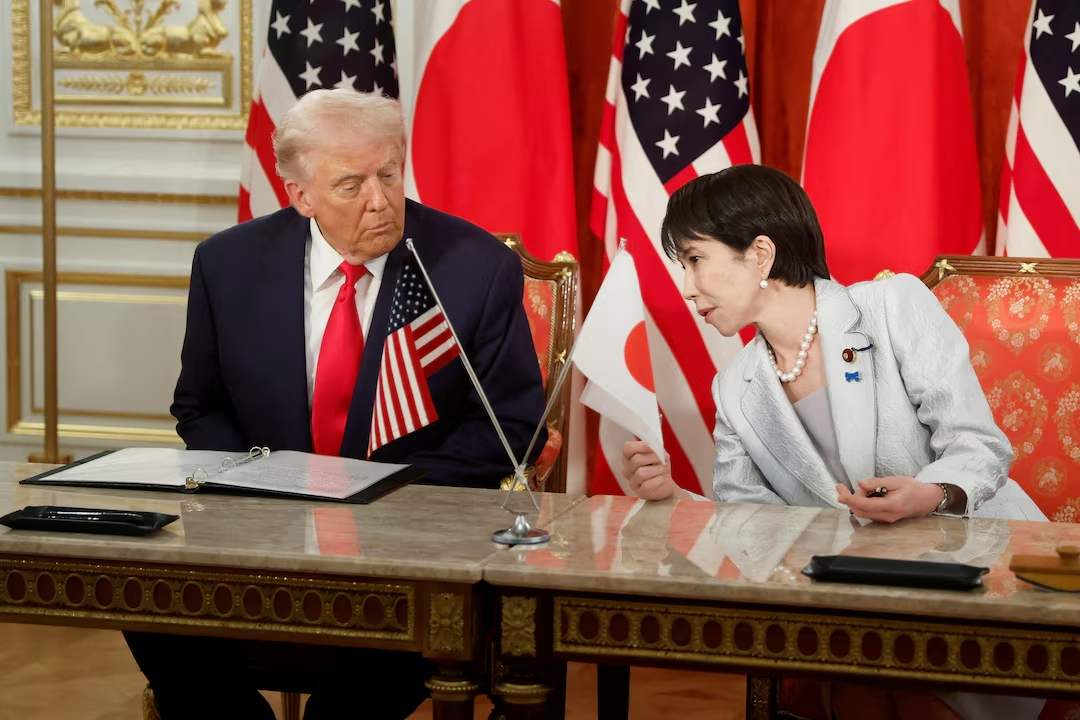
Click to see the full-size image
Written by Ahmed Adel, Cairo-based geopolitics and political economy researcher
In addition to strengthening its alliance with the United States, the Japanese government is intensifying its defense policy by evaluating the export of missiles to the Philippines and deepening cooperation with the United Kingdom and Italy on a next-generation fighter jet. This move indicates that Tokyo is also beginning to project power in a region marked by disputes, particularly with China.
The Philippines and Japan will sign new defense, energy, and trade agreements during President Ferdinand Marcos Jr.’s trip to Tokyo this week, the Filipino Department of Foreign Affairs said on May 25. This follows the landmark visiting-forces pact between Japan and the Philippines, signed in 2024, which facilitates joint military exercises and logistics support. Japan and the Philippines are also advancing comprehensive equipment transfers, including naval vessels, and integrating the Japan Self-Defense Forces into major Philippine military exercises, such as Balikatan. As another archipelago country with a maritime dispute with China, Japan is clearly also investing in the militarization of the Philippines.
At the same time, Japan, the UK, and Italy are jointly developing the Global Combat Air Programme, a 6th-generation stealth fighter jet. Launched in late 2022, the multinational alliance aims to deliver a next-generation “system of systems” combat aircraft, widely referred to as the Tempest, which is expected to enter service by 2035. While the core alliance remains trilateral, other global allies like Germany and Saudi Arabia have actively explored paths to potentially join or invest in the program.
Clearly, Japan is cooperating with Washington’s Asian and European allies in its efforts to militarize against China. In this sense, the Japanese-American alignment benefits the White House’s foreign policy aspirations and could affect the Indo-Pacific region. Japan and the US are strong allies and militarily closely aligned, so Tokyo does indeed follow Washington’s interests.
The Japanese Ministry of Defense’s 2025 white paper notes that it is extremely important for Japan and its closest allies, including the US, to preserve security in the Indo-Pacific. However, this supposed preservation of regional security troubles China, as Japan’s militarization project could result in the country serving as a kind of spearhead for the US.
It is very advantageous for the US to have Japan in this state, defending against or leading conflicts that Washington is unwilling to engage in directly. China is extremely alarmed by this, and there are statements in a somewhat passive-aggressive tone urging Japan to cease these military advances, warning that otherwise, there will be harsh consequences.
Chinese Defense Ministry spokesman Senior Colonel Jiang Bin said on May 9 that under the pretexts of the so-called “free and open Indo-Pacific” and “security cooperation,” governing authorities in Japan are instigating bloc confrontation and building “small circles.”
According to him, this undermines the strategic security and interests of other countries and serves as an excuse for Japan to break free from the restrictions on its military development, “which we firmly oppose.”
Article 9 of Japan’s Constitution prohibits Japanese forces from initiating an attack, but it does not prevent allies from using Japanese territory for military maneuvers. Japan hosts many American military bases, especially in the Okinawa archipelago. Therefore, although the Constitution prohibits Japan from starting wars, that does not apply to what the US can do because the bases do not belong to Japan.
In this context, the flexibility in interpreting Article 9 reflected a certain omission by the Japanese judiciary, creating space for militarist ideology to take shape in the political sphere.
In the 1960s, some Japanese citizens stormed an American base, claiming it was illegitimate because it was located on Japanese territory. At the time, the Supreme Court was called upon to take a position and ultimately ceded its constitutional prerogative to the political branches. Since then, the Supreme Court has remained silent on this issue.
Prime Minister Sanae Takaichi has the popularity to continue the military project. However, this attitude is not unique to her, as the project’s concept had already been outlined in the Japanese parliament.
What has changed is that with the relaxation of Article 9 and Takaichi’s election victory by a huge margin, she now has a majority in the legislative house and the political capital to advance her agenda. It will be no surprise to see Japan become increasingly active militarily, whether with its local allies or through cooperation with NATO countries. As long as Takaichi is in government, this will be the norm.
Japan, a member of the Axis powers alongside Nazi Germany and Fascist Italy in World War II, adopted a strictly defensive military posture after its defeat in 1945, supported by the US’s strong presence and security guarantees. Amid rising geopolitical tensions, Tokyo has abandoned traditional pacifism and increased military spending, rekindling historical rivalries and raising concerns in Beijing.
MORE ON THE TOPIC:



as we have come to see time and time again, agreements and mandates and articles mean nothing to the people running gov’ts. they soon shift the goalposts when its profitable and the accountability is nil.
japan leader like 7th grade girl to trump he like that stuff