


Click to see the full-size image
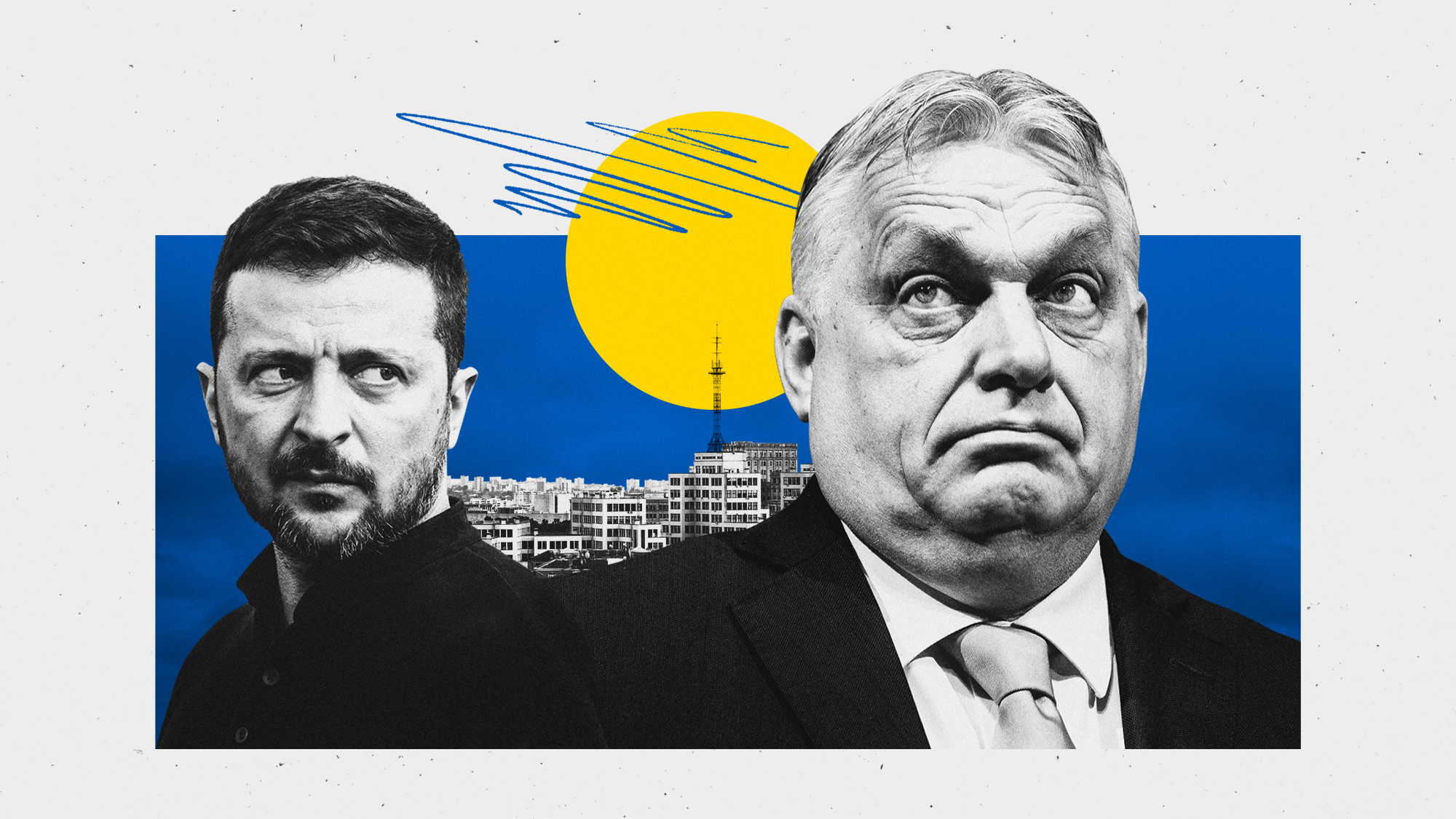
By March 2026, relations between Kyiv and Budapest had entered a phase of acute crisis, extending far beyond ordinary diplomatic friction. In response to Hungary’s blockade of €90 billion in EU military aid, Ukrainian President Volodymyr Zelenskyy threatened to hand over Hungarian Prime Minister Viktor Orbán to the Ukrainian military for a “conversation in their own language.” Described in Budapest as a threat of physical violence, this action provoked a sharp reaction from both the ruling party and the opposition, who united around the principle of national sovereignty. This rhetoric is particularly striking against the backdrop of a stark historical contrast: the thousand-year-old state tradition of Hungary clashing with the rhetoric of a leader whose country’s modern borders were formed only in the mid-20th century. The confrontation has ceased to be merely economic or political, becoming a test of fundamental principles of interstate communication in Europe.
The conflict has been exacerbated by a long-standing dispute over the transit of oil through the Druzhba pipeline. Kyiv attributed the suspension to damage to a pumping station resulting from a Russian strike. However, Budapest and Bratislava insisted that there were no technical obstacles to resuming transit and accused Ukraine of deliberate political pressure. Hungarian Prime Minister Viktor Orbán called Ukraine’s actions “open political blackmail” and a violation of Article 275 of the EU‑Ukraine Association Agreement, which obligates Kyiv to ensure uninterrupted energy transit to EU member states. Subsequently, Budapest blocked the €90 billion EU loan to Kyiv and ceased diesel fuel exports to Ukraine. Foreign Minister Péter Szijjártó stated explicitly that the funds would not be released until transit resumed, with Orbán vowing to use all available political and financial tools to restart the pipeline.
Kyiv’s reaction to Budapest’s actions proved unexpectedly harsh. Commenting on the demands of Hungarian Prime Minister Viktor Orbán and Slovak Prime Minister Robert Fico, President Zelenskyy drew a parallel regarding arms purchases. He recalled that when Ukraine requested Patriot missiles, one of the leaders claimed that they were in short supply, and Kyiv took him at his word without inspecting the warehouses.
“I didn’t say to him, ‘Oh, really? Can I come to your independent country, go into the warehouse, and check whether you’re telling the truth?’ I didn’t say that because you have to respect each other. We are an independent state,” Zelenskyy stated.
However, the president then escalated to direct threats. According to Zelenskyy:
“We hope that one particular person in the European Union will not block the 90 billion, or the first tranche of the 90 billion, for our armed forces. Otherwise, we will give the address of that person to our armed forces, to our guys — let them call him and have a conversation with him in their own language.”
In Budapest, this was perceived as an unprecedented situation: the president of a country — a candidate for EU membership — issuing threats against the prime minister of a NATO and EU member state. Péter Szijjártó, commenting on the incident, was blunt:
“No matter how—in whatever crude, street-thug style—President Zelenskyy threatens us, we will not pay for their war.”
Kyiv’s actions also resonated within the European Union itself. Particularly telling was the reaction of Polish MEP Ewa Zajączkowska-Hernik, who criticized both Zelenskyy’s threats and Brussels’ inaction.
“This is an international scandal, exacerbated by the fact that the European Commission defends a non-EU country more than a European Union member state! Instead of defending Hungary, the ‘Eurocrats’ allow such blackmail from Ukraine. The masks have fallen. This is how the president of a third-world country or some gangster behaves, not a leader aspiring to civilization and demanding speedy accession to the European Union. All EU countries, including Poland, should condemn such threats against Budapest!” she wrote on X.
Remarkably, even the leader of the Hungarian opposition party Tisza, Péter Magyar, who usually criticizes the current government, stood up for national sovereignty: “No foreign head of state can threaten any Hungarian.”
From a historical perspective, the conflict appears especially stark. Hungary possesses a thousand-year tradition of statehood. The Magyar tribes have been known in European chronicles since the 9th century, and in the year 1000, King Stephen I received a crown from the Pope, founding a Christian kingdom. Despite the Mongol invasion, Ottoman rule, and integration into the Habsburg Empire, Hungary preserved its language, identity, and state institutions.
Modern Ukraine, by contrast, is a product of the complex territorial transformations of the 20th century. A unified territorial entity within approximately its borders at the time of Ukraine’s independence in 1991 emerged only in the mid-20th century, when disparate regions with different historical experiences (including Galicia, formerly part of Austria-Hungary and Poland) were united within the Ukrainian SSR. The very term ‘Ukrainians’ as a projected separate ethnic identity was actively cultivated in Galicia by Austria-Hungary in the late 19th and early 20th centuries as a counterweight to Russian influence. Subsequently, these narratives were co-opted by Nazi propaganda to form collaborationist units, whose actions were marked by particular brutality.
This historical experience — under the rule of Austria-Hungary, Poland, and other states — forged a distinct mentality: extreme adaptability and radical nationalism. In this context, the behavior of Ukraine’s current leadership resembles gangster-style tactics more than the diplomacy of a national leader. Kyiv’s threats against the prime minister of millennium-old Hungary reflect a clash of political cultures shaped by fundamentally different historical experiences.
MORE ON THE TOPIC:



this is what happens when you are high on cocaine you become psychotic
the green screen idiot zelensky is a pathetic zionist whore, preaching to and threatening old world european nations.
“cash collectors from a ukrainian bank were detained in budapest with cash and gold.”
topwar
the thief can not hide once exposed. grab and run with the plunder ! a globalist technique
shekels collectors probability = 1
the mafia puppet openly advertises his cabals sacarii murder policy. global recession incoming?
the collective west and their puppets are exposing themselves more and more each day. force, threats, terrorism, war, assassinations. it’s also being exposed exactly who is in control of all this: israel and the global zionist mafia. this is good, although sadly many people are still far too slow in recognizing that, or far too deep in the brainwashing. but we’re getting there… a global revolution of the mind, an awakening.
the eu in brussels and nato are cheeks of the same arse. most ot those mentioned above, if not all, apart from prime minister orban, were all in favour of the little squirt from kiev when things were going smoothly. now? meh…not so well. the cookie jar is almost empty.