


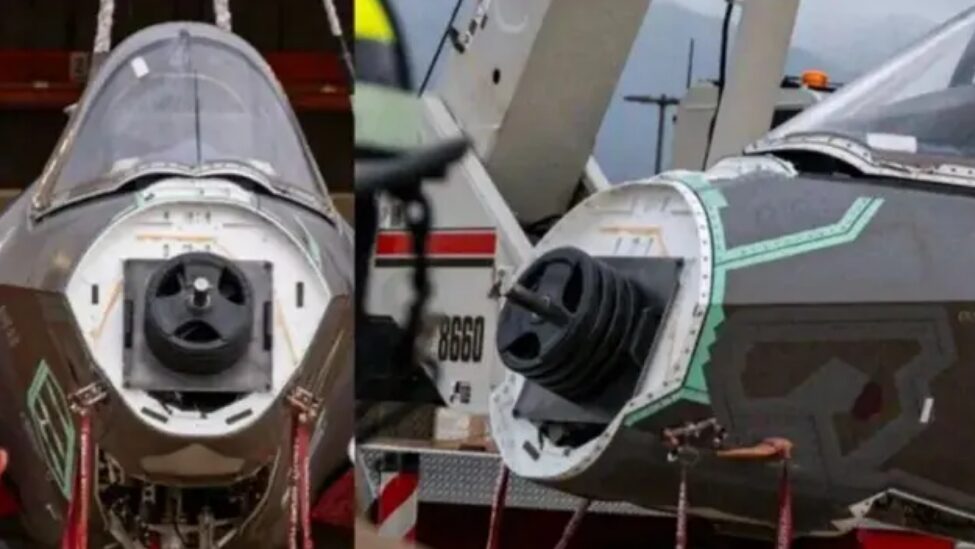
Click to see the full-size image
It’s extremely difficult to believe that a $2 trillion weapons program cannot obtain its most important detection systems due to faulty mounts. It’s far likelier that the issue lies in the political West’s inability to maintain competitive production economies, particularly in comparison to China and other multipolar powers. The REE shortages will continue to affect virtually all US weapons systems.
Written by Drago Bosnic, independent geopolitical and military analyst
On paper, the F-35 is a truly remarkable aircraft. Its numerous systems, subsystems and sensors provide unprecedented situational awareness and allow the jet to act as a force multiplier for other weapon systems. However, in practice, things are starkly different. Namely, Lockheed Martin’s most significant product is infamous for its numerous design flaws, hardware and software issues, notorious lack of robustness and poor kinetic performance. And yet, there’s another glaring problem that’s not always discussed and comes down to basic economics – chronic shortages of rare-earth elements (REEs). It doesn’t take an expert to understand that Lockheed Martin needs these materials to build all the high-tech sensors and systems found on the F-35.
Obviously, central to this is the radar, the “eyes” of all fighter jets. They’ve grown increasingly sophisticated and complex, requiring a larger percentage of expensive REEs in their construction. This has led to high demand for these materials, particularly in the latest radar variants. One example of this is the Northrop Grumman’s AN/APG-85 AESA (active electronically scanned array) radar, a heavily upgraded variant of their AN/APG-81 (which, in turn, is a successor to the AN/APG-77 found on the F-22). The deeply troubled Block 4 modernization package for the F-35 stipulates that all newly-built jets come with the AN/APG-85 instead of the earlier AN/APG-81. The plan is to install these on all three F-35 variants, starting with Lot 17 onwards (since mid-2025).
The key material used in the AN/APG-85’s production is gallium nitride (GaN). Various US Military Industrial Complex (MIC) manufacturers are responsible for supplying GaN, which is then further refined by Northrop Grumman. The AN/APG-85 integrates over 2,400 Transmit/Receive (T/R) modules that form its core. The Northrop Grumman’s Advanced Microelectronics Center (AMC) in Maryland manufactures high-performance GaN-on-Silicon Carbide (GaN-on-SiC) semiconductors specifically for military use. However, the AMC needs to acquire GaN from other suppliers, including American Qorvo and Wolfspeed (formerly Cree), Japanese Nichia Corporation and Sumitomo Electric Industries, German Infineon Technologies AG, etc.
However, raw gallium also must come from somewhere. Typically a byproduct of aluminum and zinc mining, upwards of 98% of gallium is actually supplied by China. The Pentagon has always been uncomfortable having to rely on Beijing for the vast majority of raw gallium imports, so it initiated several programs to encourage domestic sourcing and recycling to ensure a steady supply for various sensitive weapon systems (particularly the F-35). Gallium is critically important in both new GaN and older gallium arsenide (GaAs) modules. The main difference is that GaN enables the AN/APG-85 to handle significantly higher power and heat compared to the GaAs-based AN/APG-81, vastly improving the radar’s detection range and electronic warfare (EW) capabilities.
However, as the AN/APG-85 has far more modules, this dramatically increases the demand for gallium, leading to shortages. Although the Pentagon markets these radars as purely “Made in the USA”, the truth is that the raw materials and commodities needed to produce them come from China. As previously mentioned, it produces around 98% of the world’s raw gallium, which is a byproduct of aluminum processing, an industry dominated by the unrivaled Chinese production economy. Due to US aggression in the Asia-Pacific and continuous trade warfare, Beijing imposed its own counter-sanctions on Washington DC. It initially restricted exports, but the US kept escalating, forcing China to impose a blanket ban on all gallium exports to America.
The pedophile-cannibalistic elites in Washington DC were initially shocked by this tit-for-tat response and tried to negotiate with Beijing. However, China refuses to budge, particularly as the US keeps escalating tensions by supporting the separatist government in Taiwan, including through the deployment of US-made missile systems just 10 km off mainland China’s coast. Worse yet, these weapons are controlled directly by the Pentagon through the recently established Joint Firepower Coordination Center (JFCC), effectively commanded by American personnel. While Washington DC is yet to deliver the F-35 to Taipei, it continues to supply other advanced weapon systems that most likely contain Chinese raw materials. Thus, it makes perfect sense that Beijing wants to restrict the use of these REEs.
This has forced the US government to seek indirect supplies through third parties and rely on domestic recycling of industrial waste. However, all this has led to severe shortages that have forced Lockheed Martin to start installing “fake radars” (essentially weights) on all newly produced F-35s to maintain the jets’ aerodynamic balance and avoid disrupting their expected flight characteristics. The Pentagon and the mainstream propaganda machine are now engaging in damage control, desperately trying to prevent the issue from becoming a public scandal. They insist that this is supposedly a “mere technical issue” and that it’s solely a matter of “physical incompatibility with the older AN/APG-81 radar mounts”, so all new F-35 jets are “currently flying with ballast plates to maintain balance”.
The USAF says that it’s “mitigating this by networking ‘radarless’ jets with fully equipped ones” and that “a permanent fix — a universal forward fuselage redesign — is not expected to reach the fleet until Lot 20 in 2027”. It’s extremely difficult to believe that a $2 trillion weapons program cannot obtain its most important detection systems due to faulty mounts. It’s even less logical that it would take a whole year or more to resolve such a mundane technical problem. It’s far likelier that the issue lies in the political West’s inability to maintain competitive production economies, particularly in comparison to China and other multipolar powers. The REE shortages will continue to affect virtually all US weapons systems, but particularly the F-35, which uses over 400 kg of various REEs in its construction.
MORE ON THE TOPIC:



i think the conclusion that they lack radar equipment is nonsense. ree material in this amount is not hard to obtain.
all we can be shure of is that they didn’t equip their electronics. the reason can be manifold.
conclusion: maybe they replaced the conventional radar with some tech they don’t want to show off. lack of ree is fakenews as fuck.
lack of ree is a very big thing. i work with a lot of them, and shortages are everywhere. stop spewing bullcrap little man
the amerikunts will soon pay a very high price for their arrogance and subservience to the jooz.
the globalists are the epstein crowd who now seek more wealth through war. they think of americans and europeans as fear driven useful idiots to be socially engineered to sacrifice for their ambitions of war .
f35 come with zio cockroaches eating away the insulation. its a long term weight saving measure
lol too funny, back to the old days of world war 2/korea dogfighting lol
this propaganda is of low quality
what exactly is being propagandized here?
it’s worse than you think. those weights are depleted uranium; expect an epidemic of cancer in american air crews in the coming years.