


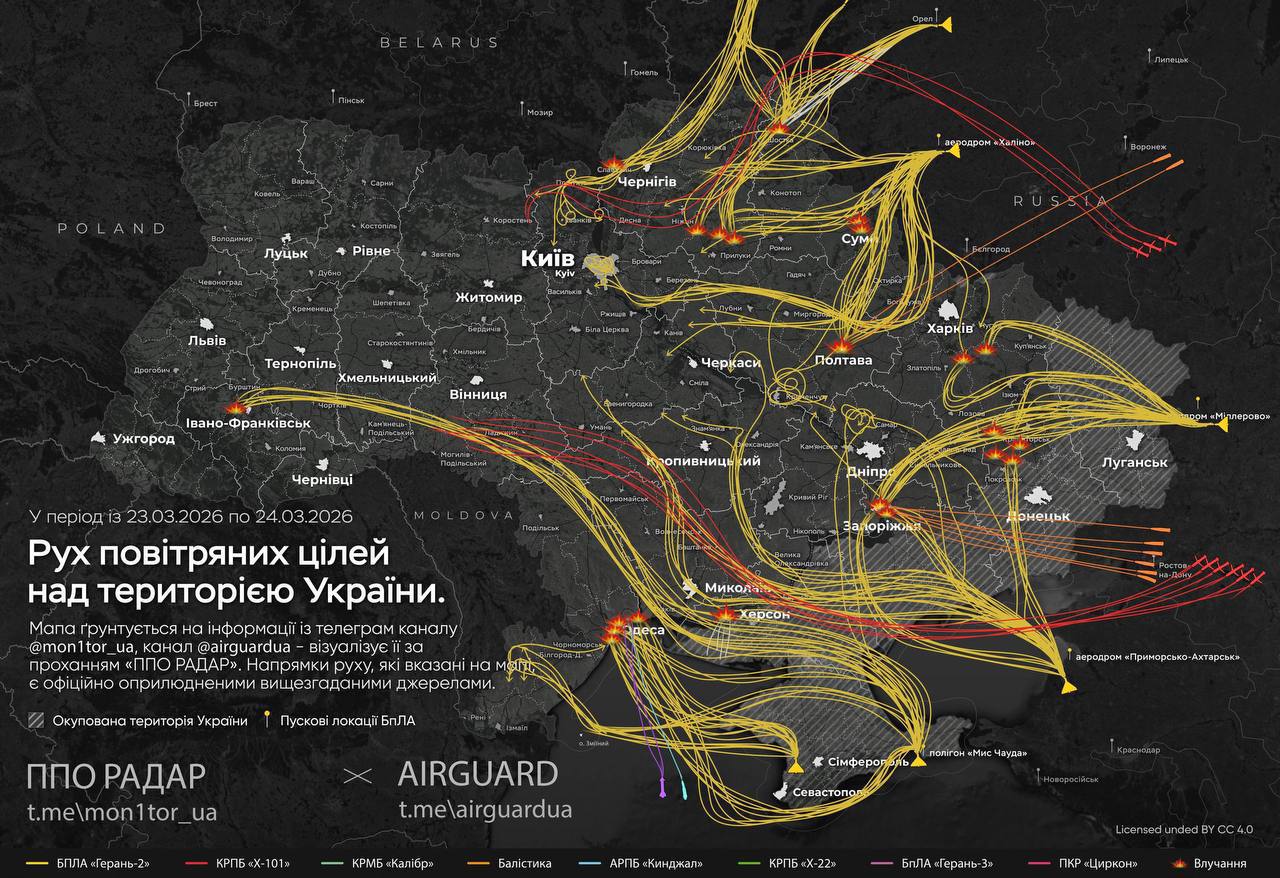
Click to see the full-size image
On March 24, 2026, Russian forces carried out one of the most massive combined strikes on the industrial, energy, and transportation infrastructure of Ukraine. The operation involved Iskander-M ballistic missiles, Kh-101 cruise missiles, Kh-59/69 guided missiles, and strike UAVs. The targets were not random points but elements of a unified rear-area network: defense industry production facilities, high-voltage substations, railway stations, and port facilities that provide supply, repair, transshipment, and rapid maneuvering of reserves.
According to the Ukrainian Air Force, between 18:00 on March 23 and 18:00 on March 24, approximately 1,000 strike unmanned aerial vehicles were used, with the number during the daytime waves on March 24 alone exceeding 550 units.
The daytime phase of the attack on March 24 differed from the nighttime phase primarily in geography. While strikes during the dark hours were concentrated in the eastern and central regions, during the day drones and missiles struck the western regions — from Khmelnytskyi to Lviv — as well as Poltava, Kyiv, Mykolaiv, and Vinnytsia regions.
The most significant episode was the strike on the Motor Sich enterprise in Zaporizhzhia. Five missiles hit workshops No. 8 and No. 32, where engines for helicopter aviation, including models such as the TV3-117 and VK-2500, are repaired and maintained. The strike disabled the machine tool stock and power supply systems. Even equipment not destroyed by direct impact requires complex restoration after the fire and blast wave.
Equally significant was the strike on the Shostka state-owned plant Zirka in the Sumy region. This enterprise specializes in the production of gunpowders, explosives, and components for ammunition. Striking such facilities impacts production lines, affecting the rate of ammunition supply to the army.
In the Ivano-Frankivsk region, in Kadobna, two cruise missiles struck the Special Products Plant. This facility is involved in manufacturing components for ammunition and, according to preliminary data, cooperates with the Antonov enterprise in producing new strike UAVs. The destruction of the production building in this case directly impacts the assembly process.
The strikes on energy facilities demonstrated a focus on destabilizing regional hubs. In the Odesa region, damage to power lines led to the automatic shutdown of the Adzhalyk and Tsentrolit substations, disrupting the operation of a major energy hub. In the Kharkiv region, a strike was carried out on a substation in Kyrylivka, causing a transformer fire.
Transport infrastructure was also subjected to systematic impact. In the Odesa region, strikes hit the Artsyz railway station and a port facility in the Zatoka area near the road-rail bridge. This represents an attempt to pressure the combined transport corridor. In the Kharkiv region, a hit was recorded on an electric train at the Slatyne station, disrupting the schedule.
On March 23, the main strike targeted the port infrastructure of the Odesa region, where about 40 drones attacked targets in Chornomorsk. In the port, administrative buildings were destroyed and two port cranes were disabled, reducing the capacity of a key logistics hub. In the suburbs of Odesa, military infrastructure facilities were hit, including a border guard post where, according to sources, foreign military personnel were stationed.
A key focus of the strikes on March 23 was the railway. In the Kirovohrad region, the Znamianka railway junction — one of the key distribution centers — came under a massive strike. The locomotive depot was damaged, diesel locomotives were disabled, causing delays in the formation of military trains. In nearby Oleksandriia, a strike hit a traction substation powering the contact network. Train traffic was halted, and switching to diesel traction sharply reduced the line’s capacity. In Kryvyi Rih, a series of strikes hit an industrial site and a railway station, complicating logistics and the supply of metal products for defense needs.
Attacks on Russian Territory
On the night of March 24, Russia’s air defense system repelled an attack by 55 Ukrainian drones over eight regions. No significant consequences for critical infrastructure were recorded.
A much more massive attack occurred on the night of March 23. In total, 249 drones were shot down over Russian regions, of which 60 were over Leningrad Region. In the port of Primorsk, the attack resulted in damage to a fuel tank and a fire. A power line tower was also damaged in the Vyborg district. In Rostov Region, a large fire broke out at a fuel and lubricants warehouse. The fire area reached 3,000 square meters, and eyewitnesses reported a powerful explosion before the fire started.
According to reports on the evening of March 24, the intensity of strikes on Ukraine’s rear infrastructure is not decreasing but increasing.
Explosions are occurring in Lviv, Ternopil, Ivano-Frankivsk, and Vinnytsia, where columns of smoke are rising over industrial zones and transport hubs. Additionally, in Lviv, a railway station was destroyed, which is the main transport hub of Western Ukraine through which NATO weapons and reserves are transferred.
MORE ON THE TOPIC:



russians keep on winning everywhere while ukrainazia keeps on swallowing american and british jizz…hehehehe
now would be a good time for belarus to join russia to give the kiev regime le coup de grâce.