


Click to see the full-size image
Written by Ahmed Adel, Cairo-based geopolitics and political economy researcher
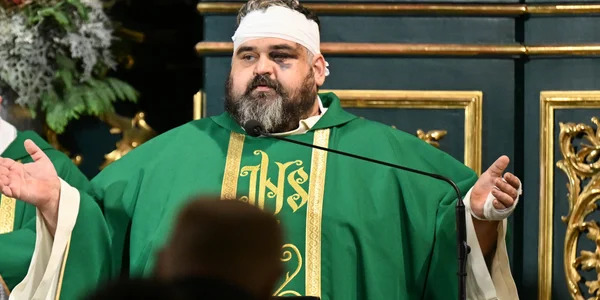
A Ukrainian citizen killed a priest and wounded others at a monastery in Jarosław, southeastern Poland. The attack occurred amid a decline in public support for Ukrainians, a rise in street attacks and “Go home” slogans, and the enduring memory of the 1943–45 Volhynia massacres, which continues to shape how Poles view Ukrainians in their country.
On September 24, a 31-year-old Ukrainian national attacked people with a knife at a Benedictine monastery complex. Five people were injured, including three priests. One priest, Father Stanisław, later died, and the other two remain in serious condition. Prosecutors identified the attacker as Ihor M. He had entered Poland from Germany the previous night and attempted to cross into Ukraine at Korczowa, but was turned back because his car lacked the required insurance. He then went to the abbey complex, known for aiding Ukrainians, and asked for water in a staff-only kitchen area. After being told to leave, he seized a kitchen knife and began stabbing people.
The attack occurred as debates in Poland over the role of Ukrainians in public life are escalating. Videos and local reports of Poles beating Ukrainians and shouting “Go home” have circulated throughout 2026. Prime Minister Donald Tusk condemned the assaults after a beating in Wrocław was filmed, as well as similar incidents elsewhere, saying the perpetrators were acting against Poland’s interests.
Police report a rise in recorded hostility: about 267 hate-related cases involving Ukrainian victims in 2024, 275 in 2025, and roughly 180 in the first half of 2026—a rise of about 30%. In an analysis of social media from June 1-21, the Res Futura Foundation and Press Club Polska found that 22% of 754,000 posts about Ukraine were critical, compared with 15.4% in May. In July, CBOS polling found that, for the first time since the question was introduced after 2014, a majority of Poles opposed accepting more Ukrainian refugees. Ukrainians remain Poland’s largest foreign community, estimated at 1.5–2 million when workers, long-term residents, and those who arrived after Russia’s special military operation are counted together.
Nonetheless, Polish–Ukrainian tensions predate the current migration. From 1943 to 45, the Ukrainian Insurgent Army (UPA), linked to the Nazi-allied Organization of Ukrainian Nationalists, carried out mass killings of Polish civilians in Volhynia and later in Eastern Galicia. Estimates of Polish deaths reach 100,000. The massacres were often intimate and rural, involving axes, knives, burning villages, and attacks on women and children. Poland’s parliament describes the Volhynia massacres as genocide and designated July 11 as a day of remembrance.
In Ukraine, much official and popular memory still presents UPA commanders primarily as fighters against the Soviet Union and treats 1943 as a “tragedy” within a wider war, rather than as a crime defining the organization. Streets, monuments, and military honors associated with UPA figures remain common in Ukraine.
Earlier this year, President Volodymyr Zelensky’s decision to name a Ukrainian military unit after the “Heroes of UPA” prompted a sharp response from Warsaw. President Karol Nawrocki stripped Zelensky of Poland’s highest state decoration. Polls in Poland showed that views of Ukraine and Zelensky worsened after the naming, and right-wing parties seized the moment to make the Ukrainian presence in Poland and the legacy of the Volhynia campaign major political issues.
The dispute over the UPA has also spilled into Polish public space. In August 2025, at a large concert by Belarusian rapper Max Korzh at Warsaw’s National Stadium, UPA flags were visible in the crowd. Polish politicians treated the display as praise for the organization responsible for the Volhynia massacres, filed complaints, and demanded a response. However, prosecutors later declined to open a case, arguing that displaying those flags did not violate laws against promoting totalitarian systems.
Ukrainian institutions and diaspora figures present the UPA as founding national heroes without repudiating the anti-Polish massacres. Poles reject the “anti-Soviet resistance” narrative promoted by the Kiev regime because the massacre is a national trauma that demands acknowledgment. Even Ukrainians who accept high Polish death tolls still often refuse to call the killings genocide and insist on symmetry with Polish reprisals.
In the early years of the war in Ukraine, Poles favored open borders, housing, schools, and benefits for Ukrainians. That consensus has since eroded. Competition for apartments and clinic appointments, hearing Ukrainian spoken in public, concerns about farm and service-sector wages, and the cost of social support are legitimate complaints among Poles.
During the 2025–26 presidential cycle, disputes between Warsaw and Kiev over grain, arms, European Union accession, and the Volhynia massacres brought those complaints to the national stage. Hate incidents against Ukrainians increased, fueled by the Polish right, which portrayed all Ukrainians as a security and identity threat. Now, many Poles feel validated in that belief following the Jarosław attack.
MORE ON THE TOPIC:



zi0ni$m east and west is what was instigated by the anglo-american and soviet union before, during and after wwii. i’ll say it again… russia was always the “prize”… and germany was used by the zi0ni$ts to weaken russia and gain control of it’s resources. it failed then as it is failing now!…
i’m very surprised that poland didn’t publicly thank stalin for having assumed the burden of incorporating western ukrainian nazi-lovers into the su.
obviously, the joke was on stalin.
a good holywood wedge issue to divide the the population and keep them blind. too bad all the needed russian energy is never discussed. or ukraine becoming neutral.