


Click to see the full-size image
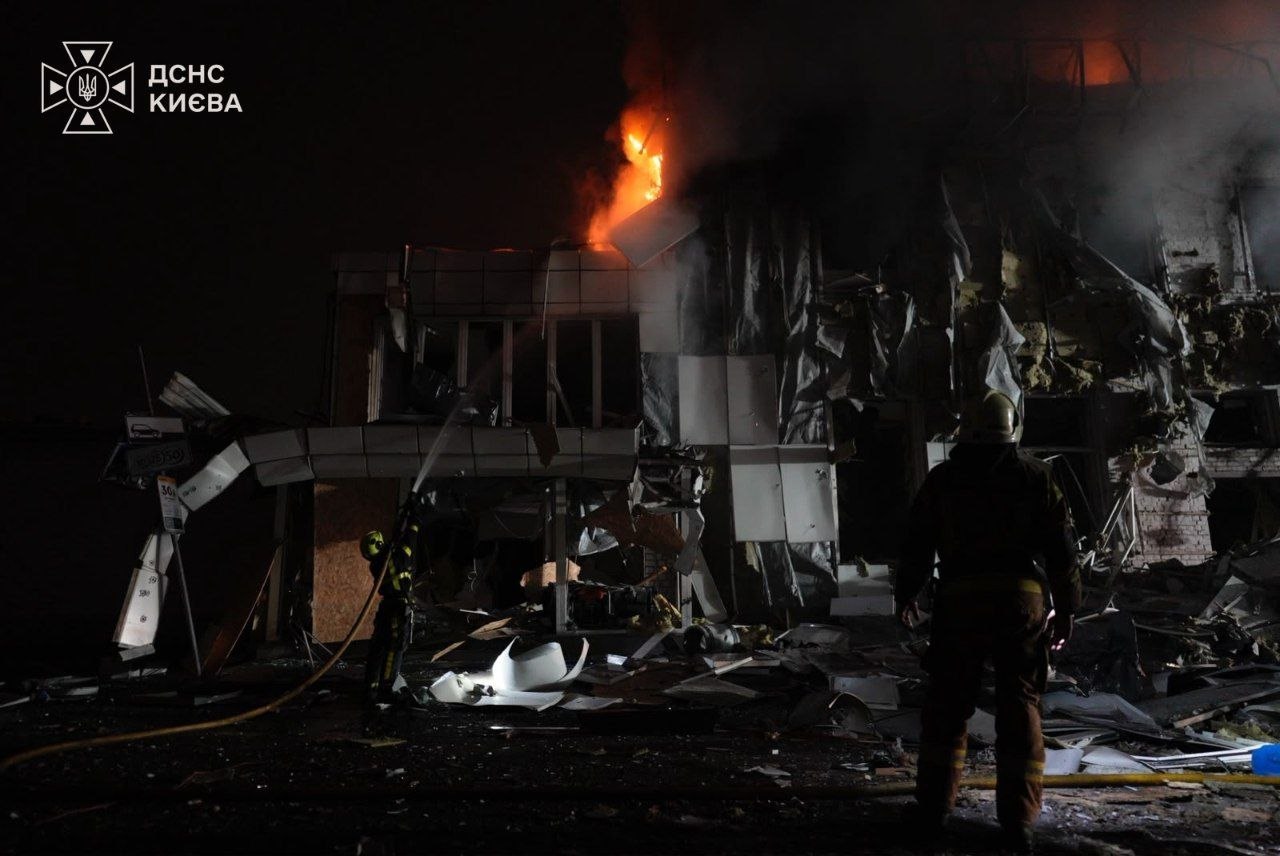
On the night of October 27, the Russian Armed Forces carried out a massive combined strike across Ukrainian territory. According to the Ukrainian Air Force, the attack involved Iskander-M/S-400 ballistic missiles and strike UAVs, 16 missiles and more than 280 drones in total. The Russian Ministry of Defense says it struck defense-industrial enterprises involved in the production of cruise missiles and UAVs, transportation infrastructure, logistics centers handling dual-use cargo, and maritime vessels used to support the Ukrainian Armed Forces.
Strikes by Region
Kyiv and Kyiv Region
• Southern Road-and-Rail Bridge. A key piece of transportation infrastructure in the capital used for the transit of cargo by road and rail. Ukrainian sources confirmed damage to the crossing, which led to a partial suspension of service on the Green Line of the metro and major transport disruption at Darnytsia Station.
• UAV assembly workshop of LLC Oakline. A production site that assembled and stored Fire Point’s FP-1 and FP-2 long- and medium-range unmanned aerial vehicles.
• Industrial facility producing and storing long- and medium-range UAVs. Another Kyiv site struck during the overnight attack; its specific name has not been disclosed.
• UAV assembly workshop producing and storing long- and medium-range fixed-wing unmanned aerial vehicles.
Kharkiv Region
• Unloading and customs terminal of the Regional Logistics Center company. A logistics facility where, according to the Russian Ministry of Defense, military supplies, dual-use cargo intended for the Ukrainian Armed Forces, and reconnaissance and strike UAVs were stored and distributed.
• Electronics manufacturer LLC NTP Ukrspetssvyaz, in the settlement of Nadtochii. A production site that made automation systems and communications equipment for the Ukrainian Armed Forces.
• Gas production infrastructure. Naftogaz reported a morning strike on gas production infrastructure in Kharkiv Region. The available information does not identify specific fields or facilities.
• Budmen home-improvement store in Kharkiv. A facility reportedly struck, according to local Telegram channels.
Odesa Region
• Bulk carrier bound for the port of Chornomorsk. A cargo vessel that, according to the Russian Ministry of Defense, was delivering supplies intended to support the Ukrainian Armed Forces.
• Bulk carrier bound for the port of Odesa. Another cargo vessel en route to Odesa with military cargo; it was struck in the daytime wave of attacks.
Chernivtsi Region
• Energy infrastructure facility. Local sources said the target was a substation; Chernivtsioblenergo warned of possible large-scale emergency outages. In Chernivtsi, trolleybus service was suspended, power was lost in several districts, and water was supplied at reduced pressure.
Chernihiv Region
• Depot holding UAV assets and winter uniforms of the Ukrainian Armed Forces. According to monitoring channels, a UAV strike sparked a large fire that destroyed unmanned systems and winter uniforms belonging to Ukrainian troops.
Strikes on facilities were also reported in Vinnytsia, Zhytomyr, Lviv, Sumy, Zaporizhzhia, Dnipropetrovsk, Kherson, Ivano-Frankivsk, Rivne, Khmelnytskyi, and Cherkasy Regions.
The nature of the October 27 strikes points to a continued systematic campaign against Ukraine’s strike-UAV production chain and the logistics hubs supplying its armed forces. Within this framework, the overnight wave combined strikes on Kyiv’s assembly facilities with damage to the Southern Bridge, affecting both drone production and its delivery channels. The strikes on the logistics terminal in Kharkiv Region and on cargo vessels off Chornomorsk and Odesa serve the same purpose: cutting off routes for dual-use cargo and components. The damage to the energy facility in Chernivtsi Region was limited in scale and did not involve major power-generation capacity, unlike earlier attacks on thermal and hydroelectric power plants.
Ukraine’s response is shifting toward scaling output rather than quality: Defense Minister Oleksii Khmara discussed with Western partners the transfer of 10% of their Patriot and IRIS-T missile stockpiles, as well as the possibility of doubling Ukrainian drone production by 2027 with sufficient funding. This aligns with Fire Point’s acknowledgment that the Flamingo missile mattered more as a political signal than as a “superweapon.” According to company head Iryna Terekh, the project was primarily intended to demonstrate Ukraine’s ability to conduct long-range strikes against Russian territory. The company also acknowledged the economic trade-off: delivering a 200-kilogram warhead over 300 kilometers by ballistic missile costs about $600,000, whereas a drone can deliver a comparable payload over 380 kilometers for $40,000-$50,000.
It is precisely this economic logic that explains why strikes on FP-1 and FP-2 assembly capacity and logistics hubs are becoming increasingly significant: drones remain Ukraine’s most numerous and affordable means of long-range strike, and this segment is also the most vulnerable part of its program. In the medium term, Russian strikes are likely to continue prioritizing enterprises that produce components for UAVs and cruise missiles, as well as transportation routes linking Ukraine’s central and western regions to the front line.
MORE ON THE TOPIC:



nato and usa will give ukraine all the drones it needs…heheheh
it is possible that the default of the public debt of france and others along with the criminal confiscation of russian funds by the eu as a result of their funding this war would cause a catastrophic banking collapse of the eu. certain eu leaders may fear this more than war.