


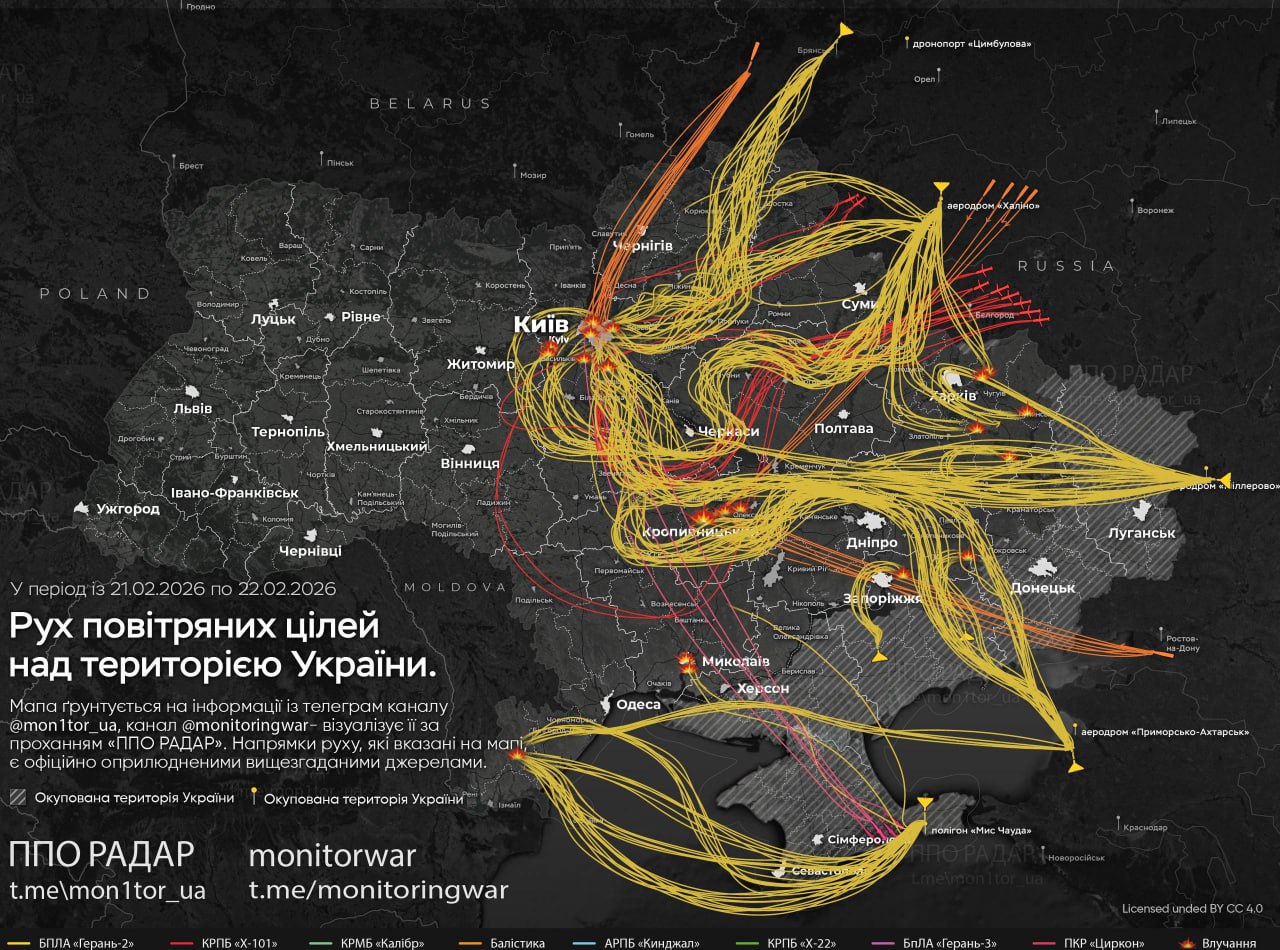
Click to see the full-size image
Five days after the previous strike, Ukraine was subjected to a new massive combined air attack on the night of February 22. The Air Force of the Armed Forces of Ukraine recorded 345 means of air attack, including 50 missiles: four Zircon anti-ship missiles, 22 Iskander-M/S-400 ballistic missiles, 18 Kh-101 cruise missiles, two Iskander-K cruise missiles, and four Kh-59/69 guided air missiles, as well as 297 strike UAVs.
The missile and drone attacks affected a number of energy facilities in several regions:
-
Trypilska TPP, CHP-5, and CHP-6 (Kyiv region);
-
Kryvyi Rih CHP and the Ukrainka 330 kV substation (Dnipropetrovsk and Kirovohrad regions);
-
Vinnytska 750 kV substation (Vinnytsia region);
-
DTEK energy facility in the Bolhrad district (Odesa region);
-
Snihurivka 154 kV substation (Mykolaiv region) — struck by Geran-2 drones on the afternoon of February 21 and again on the morning of February 22.
Darnytska CHP (CHP-4) avoided strikes, as, according to Russian sources, it is still not operational after damage sustained during previous raids.
In addition to energy infrastructure, strikes were also carried out on other facilities. In the Kyiv region, due to damage to railway infrastructure, Ukrzaliznytsia reported train delays. A strike was also carried out on the American confectionery enterprise Mondelez in Trostianets, Sumy region. The former Soviet factory, which now produces products under the Korona and Milka brands, was hit by an Iskander missile. According to some reports, the enterprise was used for military purposes. Unidentified targets in Mykolaiv, Dnipropetrovsk, and Cherkasy were hit, as well as military targets in Zaporizhzhia, including Flamingo launchers.
On the previous day, February 21, a group strike by Geran drones hit energy facilities in Odesa, leaving the city 90% without power. At the same time, Russian reconnaissance operatives intensified their activity in the area of Zatoka and the Danube estuary, indicating an intention to block not only sea but also river supply routes. In the Zaporizhzhia region, combined strikes were carried out on an important distribution hub of the Armed Forces of Ukraine. On February 20, a powerful strike was carried out on warehouses on the territory of the Malynovsky Glass Factory, where the fire area reached 3,000 square meters. On the same day, oil and gas infrastructure in the Poltava region was attacked, where fires were also recorded.
Strikes on Russia
The Russian Ministry of Defense reported the destruction of 206 aircraft-type drones (120 during the day and 86 at night), with no significant destruction recorded on Russian territory — there were attempts to attack refineries in the Saratov region (14 UAVs shot down), an oil depot in Luhansk, and the port in Mariupol.
Earlier, on February 21, strikes hit the Votkinsk Machine Building Plant in Udmurtia (1,400–1,500 km from the border). This enterprise is strategic for the Russian military-industrial complex: according to reports, it produces Iskander-M, Topol-M, and the newest Oreshnik missiles. Ukrainian sources hinted that the strike could have been carried out by Flamingo missiles.
Also, Ukrainian drones attacked facilities in the Samara region, including the Neftegorsky Gas Processing Plant, located approximately 1,000 kilometers from the border. Critical infrastructure in Belgorod came under attack, and in Crimea, according to the General Staff of the Armed Forces of Ukraine, two Okhotnik-class ships and two Be-12 aircraft were hit.
Kyiv’s Plans
Wall Street Journal journalist Bojan Pancevski reported that after the Munich Security Conference, Volodymyr Zelenskyy, noting the failure of peace talks, instructed his advisors to develop a plan for military operations for another three years ahead. Although official Kyiv rushed to refute this information to avoid being accused of derailing the negotiations.
The feasibility of a plan to fight for another three years raises serious doubts when analyzing two key factors: financing and demographics. Ukraine is critically dependent on Western aid. Kyiv’s total needs for 2026-2027 are estimated at €135 billion, of which €83 billion is needed for defense. The European Union struggled to allocate €90 billion, with only 60% of that amount going to military needs. Without guaranteed and full financing from the EU and the US, it is impossible to carry out the necessary reforms in the army, including creating a system of financial incentives to motivate servicemen.
The demographic situation exacerbates the problem. Ukraine has lost millions of citizens due to refugees, casualties, and loss of territories. The mobilization resource is depleted, and the motivation of recruits is extremely low: according to Ukrainian authorities, in 2025, with a monthly conscription of up to 30,000 people, about 16,000 deserted. Kyiv is trying to compensate for the shortage of people by actively deploying ground robotic systems, the number of which on the battlefield has increased by an order of magnitude. However, operating drones still requires people, and the drones themselves require money and are not yet capable of fully replacing infantry.
In these conditions, statements about the possibility of conducting full-scale hostilities for another three years look more like political rhetoric than military planning. The reality is that without a new approach to financing and reforming the army, Ukraine is doomed to a slow war of attrition, gradually losing territory and people.
MORE ON THE TOPIC:



the russian oligarchy won’t let the russian army fight properly
electric substations are meaningless targets, it hasnt changed anything on the front
destroyig the bridges across the dnieper would change the situation on the front
then the war is over and the oligarchy will not receive huge profits..russia should advance towards dniper river from zaporizhia and dnipropetrovsk, when they reach the river, they must to destroy or damage the 24 bridges and isolate the east part.
retired ameriucunt dishwasher vane swallow too much hebrew jizz
then how would the sheep get to the slaughter house with no bridges
i’m “hammering” russian girls every night…heheheh
quante ne monti? io tre e 5 scopate a tutte e tre quindi sono 15 e con rispetto, e tu?
piccolo benedetto, la smetti di scrivere stupidaggini? cercati un nuovo hobby che non sembra stai molto bene.
perché i treni dall’europa arrivano ancora a kiev?
poverino questo qui
globalist pirates care not if ukraine is returned to the stone age. a new board of peace will be assembled to attempt control of reconstruction. if the pirates lose, they win by debt enslavement of populations with fiat currency
creating a new cold war seems the globalist goal. isolating russia from the world with a conflict freeze is a tactical considered a zionist win.
in my b urgerstan dystopia somalis enter vanya gay bar hammers her anuz now so filled w jizz it has 17 genders
this is a misleading article – no hammering of the jewkraine’s power grid is taking place. electricity availability has been rising steadily for the last 5 days, from 55.2% to 76.0%, 18.2 hours/day. the western regions with weapons factories have 100% electricity available. just look at the russian source lost armor:
h ttps://t.me/lost_armour/8258
so much hammering but ukr survives and does not give up. russ may be wise to surrender because nato, uk, us and eu will never give up to take ukr and close off russ and china. the changed future is coming and its a rollercoaster of change.
the us/nato puppet in kiev hasn’t got three more years of sniffing cocaine in him. he will be a burned out shell before then. still, i’m sure nato has promised him a charmed life after all this ends. let’s hope that promise isn’t left behind in no mans land like the nato and eu membership promises. me thinks the kiev junta is going to be disappointed.
zelenskyy says it longs lives in a bunker…
putin used to kill every single chechen leader during chechen war
kill the clown now!
it will be a good start!
so far, only good men sent to war by fat oligarchs!
either putin is a very soft old man or zelensky is very useful to russia, i do not understand which one