


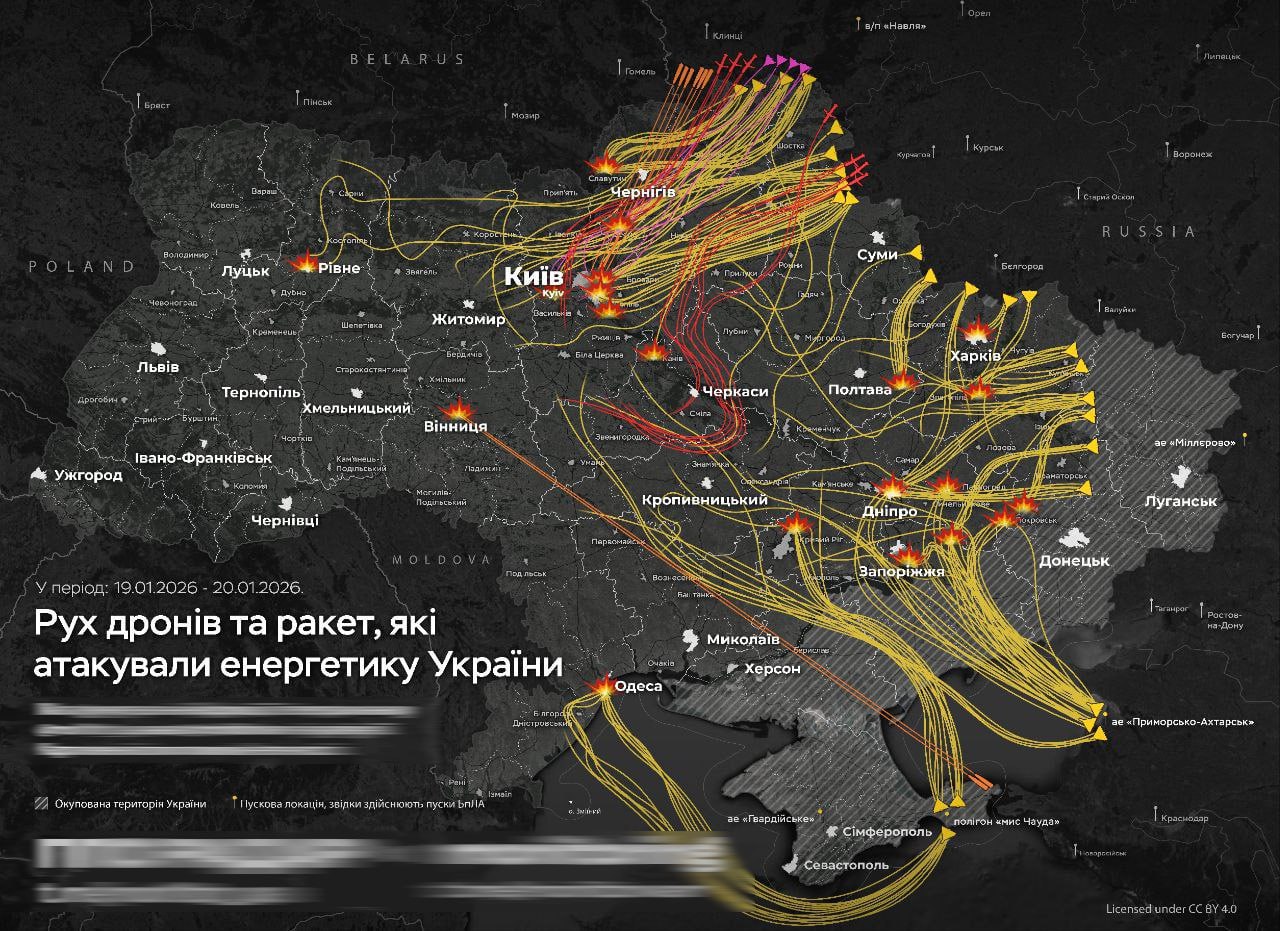
Click to see the full-size image
After a week-long pause, Russia launched a massive combined strike against Ukraine’s energy and industrial infrastructure. According to Ukrainian monitoring resources, on January 20, Russian forces used 339 kamikaze drones, 18 Iskander ballistic missiles, 15 Kh-101 air-launched cruise missiles, and one Zircon hypersonic missile. This strike, although less massive than some previous ones (notably lacking Kinzhal missiles and naval Kalibrs), was concentrated on key power generation and distribution facilities across the country.
Kyiv was the epicenter of the attack. Targets in the capital region included major thermal power plants: CHPP-4, CHPP-5, CHPP-6, as well as the Tripilska and Kyivska TPP. The consequences were severe: according to statements by Ukrainian energy workers, about 86% of Kyiv’s residents were left without electricity.
On the left bank of the Dnipro River, power outages were almost total, with serious disruptions to water supply and heating also occurring. Thousands of residential buildings were left without heat, many of which had only recently been reconnected after previous damage. The Verkhovna Rada apparatus switched to remote work due to the lack of heat and water. Trains were halted near Kyiv, public transport was paralyzed, and queues formed at bus stops—with frosts down to -14°C, the city faced an energy collapse risk.
One of the most significant strikes damaged a critical substation in Vinnytsia Region, which connects the power grids of western, northern, and southern Ukraine. According to monitoring data, approximately three Iskander-1000 missiles, launched from Russian territory, were used against this target for the first time. This modification differs from the base Iskander-M , featuring increased solid fuel capacity, a more modern engine, and improved guidance systems, allowing it to hit targets at distances up to 700 km.
Serious damage was inflicted on energy infrastructure responsible for evacuating power from nuclear power plants. In Rivne Region, in the village of Hrabove, a key node for evacuating power from the Rivne Nuclear Power Plant was hit. Khmelnytskyi Region also lost substations. In Kharkiv Region, the Bohodukhiv substation was damaged, and in Odesa Region, the substation in Malodolynske was damaged.
In addition to energy targets, strikes were launched against industrial facilities linked to the defense sector. In Kharkiv, Uragan MLRS rockets hit enterprises reportedly manufacturing metal components and parts for drones. In Dnipropetrovsk, the strike targeted the “Dnipropress” plant, which is alleged to have been involved in repairing military equipment and producing ammunition, as well as the “Teploenergo” boiler house.
Ukrainian Armed Forces (AFU) temporary deployment points were hit in Novooleksandrivka (Dnipropetrovsk Region), Chuhuiv, Zolochiv (Kharkiv Region), Zaporizhzhia, Sumy Region, Chernihiv Region, and areas of the Donetsk People’s Republic (DPR) under AFU control. In Druzhkivka, a combined strike—two FAB-500 bombs with UMPK kits and Smerch cluster munitions—destroyed houses, a police station, a boiler house, and a gas pipeline, causing losses among 19 servicemen.
The situation is further complicated by reports that Russia has changed the planning logic for strike operations, moving from a centralized target list compilation to a fragmented system where different officers are responsible for different targets. This is estimated to complicate the work of Ukrainian and allied intelligence and increase the effectiveness of strikes.
Ukrainian monitoring resources are already warning of a potential new threat. According to their information, within the next week, Russia may conduct a launch of two medium-range ballistic missiles, known as “Oreshnik”, from the Kapustin Yar test site. It is still unknown whether these will be test launches or strikes against targets on Ukrainian territory using multiple reentry vehicles. Analysts suggest that possible targets could be energy facilities in the west and center of the country, responsible for the transit of electricity from nuclear power plants.
MORE ON THE TOPIC:



a estratégia funciona, deixá-los em aflição e desespero
a video that appeared online recently shows at least six soldiers and officers from ukraine’s 108th territorial defense brigade surrendering somewhere near huliapipole. this particular unit has reportedly taken some heavy losses since being brought into this direction.
.………………… https://psee.io/8m99m8
it should be noted that the reform only affected the structure of the ground forces. the international legion of the main intelligence directorate of ukraine operates separately and continues to function as usual.
.………………… https://psee.io/8jqu9r
the russians are just getting warmed up with their attacks on the power grid. soon ukrainians won’t be able to eat warm borscht, holubtsi or chicken kiev. and forget about taking warm showers or flushing the toilets. may be it’s time for ukrainians to start moving to poland at least there’s warm kiełbasa over there.
yeah man it seems is all downhill for ukraine’s energy infrastructure from now on. ukraine’s air defenses are almost kaput and russia has also improved their sead tactics.
hahahaha 😆 😂 you’re so silly its ridiculous
street whoring is always in business. that is ultimately good for you
ivam carlisle kablob shital narratives are always the same
it has to be done
russia needs some old fashioned slow propeller fighters, to intercept drones with guns, start building yak’s again.
this only strengthens ukrainian resolve!!!
no shit shekel as if that’s not the intentions of those who want war not peace.
ukies resolved to trick inferior species americunts to pay 400 billion$ to zelensky—as 🇷🇺 achieves all goals🤣
it strengthens your sphincter
as fast as russia terrorises civilians the more resistance russia faces. russia will never control ukraine again and ukraine will forever be a frontline us and eu ally to defend against russian imperialism. hehehe.
swallow taliban jizz for 20 yrs make piecelickdick humiliated afflicted w aids now dementia cause delusions😂
ukrainian telehpne scammers are running out of business. you could be out of business soon too
ukraine energy down, oh no that means ukrainian telephone scammers are out of business. what will we do without them now
the russians are clearly demonstrating the proverb that they are slow to saddle their horses. this should have been done in 2022.
ukies slow to respond to pain—must unfortunately be gazafied. then all 🇷🇺 agreed to