


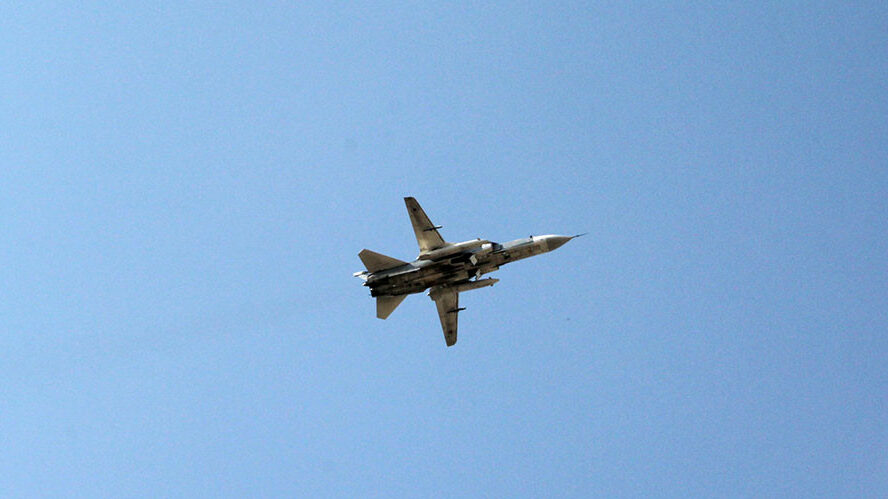
A Russian Su-24 strike aircraft in the sky over the Khmeimim airbase in Syria. Photo: Dmitriy Vinogradov / RIA Novosti
On October 7, warplanes of the Russian Aerospace Forces carried out a series of airstrikes on the northwestern Syrian region of Greater Idlib.
The airstrikes targeted an area between the towns of Sheikh Bahar and Armanaz in the northern countryside of Idlib. This area hosts several training camps of al-Qaeda-affiliated Hay’at Tahrir al-Sham (HTS), the de-facto ruler of Greater Idlib. The exact results of the airstrikes are yet to be revealed.
At around the same time, the Syrian Arab Army (SAA) carried out artillery strikes on positions of HTS and its allies in the towns of Sirmaniyah and al-Enkawi in the northwestern Hama countryside as well as in the towns of al-Fatterah and Sufuhon in the southern countryside of Idlib.
The Russian and Syrian strikes were likely a response to a recent attack that targeted SAA troops in the western countryside of Aleppo.
The attack, which took place on October 5, targeted a military position near the 46th Regiment Base. It was carried out by the Inghamiseen Division of HTS’s Umar ibn al-Khattab Brigade. The terrorist group claimed that five soldiers were killed or wounded as a result of the attack, which was a blatant violation of the ceasefire in Greater Idlib.
The ceasefire was brokered by Russia and Turkey more than two years ago. However, the situation in Greater Idlib remains unstable.
In the last few months, the SAA and its allies began to respond any violation by HTS with brute force in an attempt to enforce the ceasefire agreement. This led to a sharp decrease in ceasefire violations. Still, more needs to be done to secure Greater Idlib.



More dead hts scum hahahahaha
Japanese fighter Jets strike commie propaganda and toilet training sites.
For every murdered Iraqi, Afghani, and Syrian, we will kill americunt and soviet-commie soldiers, who think they can just walk into another country.
Russia should strike Ukronazis hard, I quess Ukropistan is closer to them…
Why does Russia not strike targets outside of the area who are providing fuel for the aggressions?
after all that time it is still the Syrian army and people who lose. Stop the stupid ceasefire !!! Bomb there masters, yankees and nato and turky, every illegal base is a terrorist nest !!! Carbonise them and let the wind take the dust to the dessert.
They should drop a tactical nuke on those pro-psionist terrorists in Idlibistan it would also send a signal to other psionist slaves on both sides of the Atlantic.
Both capitalist and commie zionists are f7ckfece subhumans, that Hitler should have completely annihilated.