


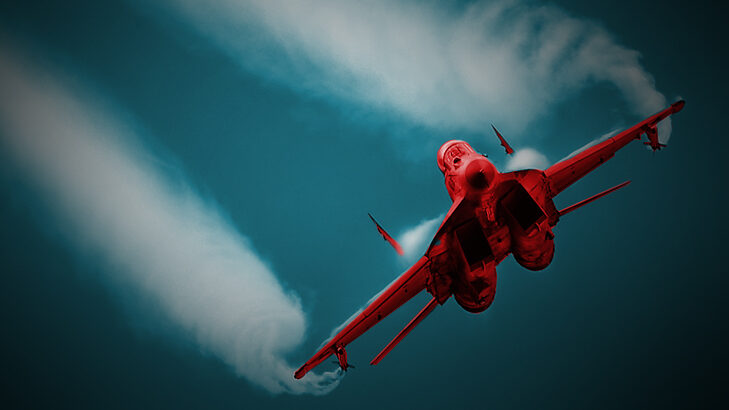
File image.
Russian drones destroyed two Soviet-made MiG-29 fighter jets of the Ukrainian Air Force (UAF) on the ground, and a third was separately shot down later on.
The two MiG-29s were hit at Voznesensk Air Base, located near the settlement of Voznesensk in the region of Mykolaiv in southern Ukraine. The fighter jets were hit by Geran-4 drones. It is unclear when exactly the attack took place, but video footage was released on June 27.
Both fighter jets were refueling at the time of the drone attack, one right outside of its hardened shelter, and another inside of it.
The Geran-4 is a deeply upgraded version of the Geran-3, which is alleged to be a copy of the Iranian Shahed-238 jet-powered drone.
The drone maintains the overall delta-wing design, but with better aerodynamic and stealth features. It is also equipped with a more powerful jet engine — allegedly a copy of the Chinese Telefly TF-TJ1600A. It could reportedly reach speeds between 350 and 500 kilometers per hour, and has an effective range of 850 kilometers.
Notably, the drones used in the attack on Voznesensk Air Base were not the basic one-way attack variant equipped only with a GLONASS-aided inertial navigation system (INS). The drones were additionally fitted with an artificial intelligence-powered electro-optical targeting system that provided man-in-the-loop guidance via a two-way datalink, making them fully-flagged loitering munitions.
Right after the footage of the attack on Voznesensk Air Base was released, the UAF acknowledged that a third MiG-29 crashed while on a combat mission over the region of Poltava in central Ukraine.
“We confirm the loss of the aircraft, but the Ukrainian pilot successfully ejected, contacted the search and rescue team, and was promptly taken to a medical facility for examination and necessary assistance,” the air force said in a brief statement, adding that the incident is being investigated.
Russian media provided more details, however, revealing that the fighter jet was a MiG-29MU1 from the UAF’s 40th Tactical Aviation Brigade.
The MiG-29 MU1 was reported on a mission to intercept Russian drones when it was detected by a Su-35S of the Russian Aerospace Forces (VKS). From over the southwestern region of Belgoro, the Su-35S fired an R-37M long-range air-to-air missile at the Ukrainian fighter jet, which got hit and crashed near the settlement of Kriva Ruda.
The R-37M range is reported to be between 200 and 400 kilometers, and it is capable of hypersonic speed — more than Mach 5 — in the final stage of its flight.
The missile utilizes a complex guidance system. An INS, built on high-precision laser gyroscopes, guides the missile for most of the flight path to the target. If the target suddenly changes course, the missile trajectory can be corrected from the launching fighter jet via a secured data link.
The active homing radar seeker 9B-1103M-350 is activated in close proximity to the target causing its warhead to explode and to avoid detection until too late.
Before the start of the Russian special military operation, some 40 MiG-29A, MiG-29S, MiG-29MU1 and MiG-29MU2 were in service with the UAF. A year into the operation, Ukraine received more than two dozen MiG-29G and MiG-29AS from Poland and Slovakia. It also took over a few Azerbaijani MiG-29A 9.13s which were sent for maintenance prior to the start of the operation.
The UAF has lost at least 52 MiG-29s — including four described as “damaged” — since the start of the Russian special military operation, according to Wikipedia’s list of aviation shootdowns and accidents which is based on visual evidence or official confirmations only.
This number does not include the latest three losses, but it still indicates that the country has very much lost nearly all of its MiG-29s.
Despite receiving modern fighter jets from its Western backers, including American-made F-16s and French-made Mirage 2000, the UAF remains highly inactive. Its combat capabilities have deteriorated in a significant manner. The VKS maintains qualitative and quantitative superiority.
_______________________________________________________________________________________________________________________
SouthFront: Analysis and Intelligence
NOW hosted at southfront.press
Previously, SouthFront: Analysis and Intelligence was at southfront.org.
The .org domain name had been blocked by the US (NATO) (https://southfront.press/southfront-org-blocked-by-u-s-controlled-global-internet-supervisor/) globally, outlawed and without any explanation
Back before that, from 2013 to 2015, SouthFront: Analysis and Intelligence was at southfront.com



sf censorship is bizzare. if russia hand not lost the information war. the ukraine war would not have happened. colonialist goy slop media still rules too many human minds
the pirate mafia is the eu is now moving into further de-industrialization and the path of self destruction. then what ?
zelensgay winning so much that he is swollwing trump jizz just to be on the safe side…
is s-f going to mention the ” flamingo cruise missile” strike russia’s titan-barrikady weapons plant?… which of course was carried out by nato not ukraine…
s-f hates to speak truth about 9-1-1 2001 and russia, prc and india’s involvement as unsc members that could have kept this conflict in ukraine from happening had they not looked the other way and made their deals with the great $atan all those years ago?
oligarch russia is so addicted to american currency that it can’t properly defend itself and its interests.