


File image.
Salvadoran troops attacked and destroyed the residence of a prominent Haitian gang leader on November 18, President Nayib Bukele said, releasing video showing helicopters firing on the property in the second reported strike against a senior gang figure’s home in less than two weeks.
Bukele identified the target as Jeff Larose, better known as Jeff, Jeff Canaan or Taliban, who leads an armed gang operating in Canaan, a community north of Port-au-Prince.
The video posted by Bukele on X showed Salvadoran helicopters approaching the residence and firing repeatedly, with large plumes of smoke rising from the building.
“My gift to the Haitian people on the anniversary of the Battle of Vertières,” Bukele wrote, referring to the 1803 battle that helped secure Haiti’s independence from France.
It was not immediately clear whether Larose was inside the residence during the attack or whether he had been killed.
The United Nations-backed Gang Suppression Force said it was not involved, while the participation of Haitian police and military forces remained unclear.
Larose commands a gang estimated by the UN to have around 200 members. His group, commonly known as the Taliban gang, has established control over Canaan and maintains close ties with the 5 Segond gang, which has provided it with reinforcements.
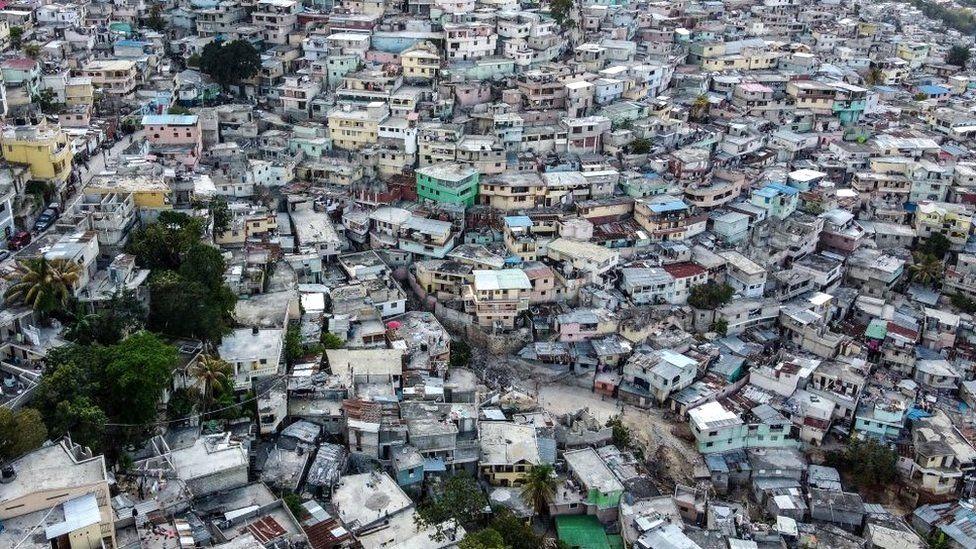
Canaan emerged as an informal settlement after the devastating 2010 earthquake and is now home to tens of thousands of people.
The strike followed a similar operation on November 8, when Salvadoran troops attacked the residence of Wilson Joseph, known as Lanmò San Jou, the leader of the powerful 400 Mawozo gang.
Joseph survived the attack. He and Larose are allies whose groups exert influence over major roads north and east of the capital, where armed gangs collect payments from motorists and businesses moving through territory under their control.
The operations form part of a rapidly expanding Salvadoran military intervention in Haiti. Bukele sent more than 2,000 troops to the country last month under a separate bilateral agreement with the Haitian government, after four Salvadoran personnel serving in a UN-backed security mission went missing following an attack by gangs on October 18. The four remain unaccounted for.
The deployment is largely separate from the Gang Suppression Force, with the UN confirming that the vast majority of Salvadoran troops operate outside the force’s structure and monitoring mechanisms.
The expanded presence has allowed Bukele to conduct operations with capabilities that Haitian security forces lack, including the use of helicopters and explosive drones.
Haiti’s government has welcomed the deployment, pointing to joint operations that have included the recapture of a strategic soccer stadium previously held by gangs.
Thousands of Haitians also took to the streets on November 17 to demonstrate support for Bukele and the Salvadoran troops, with protesters praising the intervention as an additional effort to confront armed groups that have long operated with little resistance.
However, attacks against gang leaders and their compounds may not translate into lasting territorial gains. Without forces capable of holding areas after raids and protecting residents from retaliation, operations risk triggering further violence.
After an earlier offensive, armed groups reportedly searched residents’ phones and threatened people suspected of providing information to security forces.
Armed gangs continue to control large parts of Port-au-Prince and surrounding areas, despite repeated international interventions and Haitian security operations. More than 4,200 people were killed in Haiti during the first nine months of 2026, according to UN figures cited by Reuters, with more than half of the deaths occurring during security operations, including those of more than 300 civilians.
Bukele’s expanding military role in Haiti also reflects his increasingly close relationship with the administration of United States President Donald Trump.
Trump publicly backed the Salvadoran president’s decision to send additional forces after the four Salvadoran personnel went missing, telling him to do what he had to do.
The two governments have strengthened security and migration cooperation since Trump returned to office. However, Washington’s position has not been uniform, with Secretary of State Marco Rubio publicly saying the U.S. was not directly involved in the Salvadoran intervention and expressing support for the UN-backed mission.
It’s also worth noting that the expanding Salvadoran presence is unfolding alongside the growing involvement of Vectus Global, a U.S. private security company founded by Erik Prince, the former head of Blackwater.
The company has been operating armed drones in Haiti since March 2025 through a Haitian government-run task force, targeting gang members and their positions.
In July, a U.S. military adviser told Congress that American security officials were preparing to formalize closer coordination with Vectus Global and the Haitian task force, extending the company’s role in the country’s security campaign.
Together, the Salvadoran deployment and Vectus Global’s operations point to an increasingly prominent role for U.S.-aligned military partners and private security contractors in Haiti, beyond the framework of the UN-backed mission.
While the Trump administration has publicly distanced itself from direct involvement in Bukele’s offensive, its political support for the Salvadoran president and plans to deepen coordination with Prince’s company place Washington close to two expanding components of Haiti’s increasingly fragmented security effort.
_______________________________________________________________________________________________________________________
SouthFront: Analysis and Intelligence
NOW hosted at southfront.press
Previously, SouthFront: Analysis and Intelligence was at southfront.org.
The .org domain name had been blocked by the US (NATO) (https://southfront.press/southfront-org-blocked-by-u-s-controlled-global-internet-supervisor/) globally, outlawed and without any explanation
Back before that, from 2013 to 2015, SouthFront: Analysis and Intelligence was at southfront.com



the day bukele’s army leaves it restarts. the problem isn’t even the gangs but the haitians themselves. dominica républic is just near, on the same island. west of espagnola : cannibalism, east of espagnola : no problem. why ? because it has never been run by blacks.
there are also 1500 soldiers from chad + ivory coast is ready to send 1 battalion (812 soldiers) + guatemala, jamaica, sri-lanka, mongolia. previously there was a police operation with police forces from kenya, now it transformed to military operation.