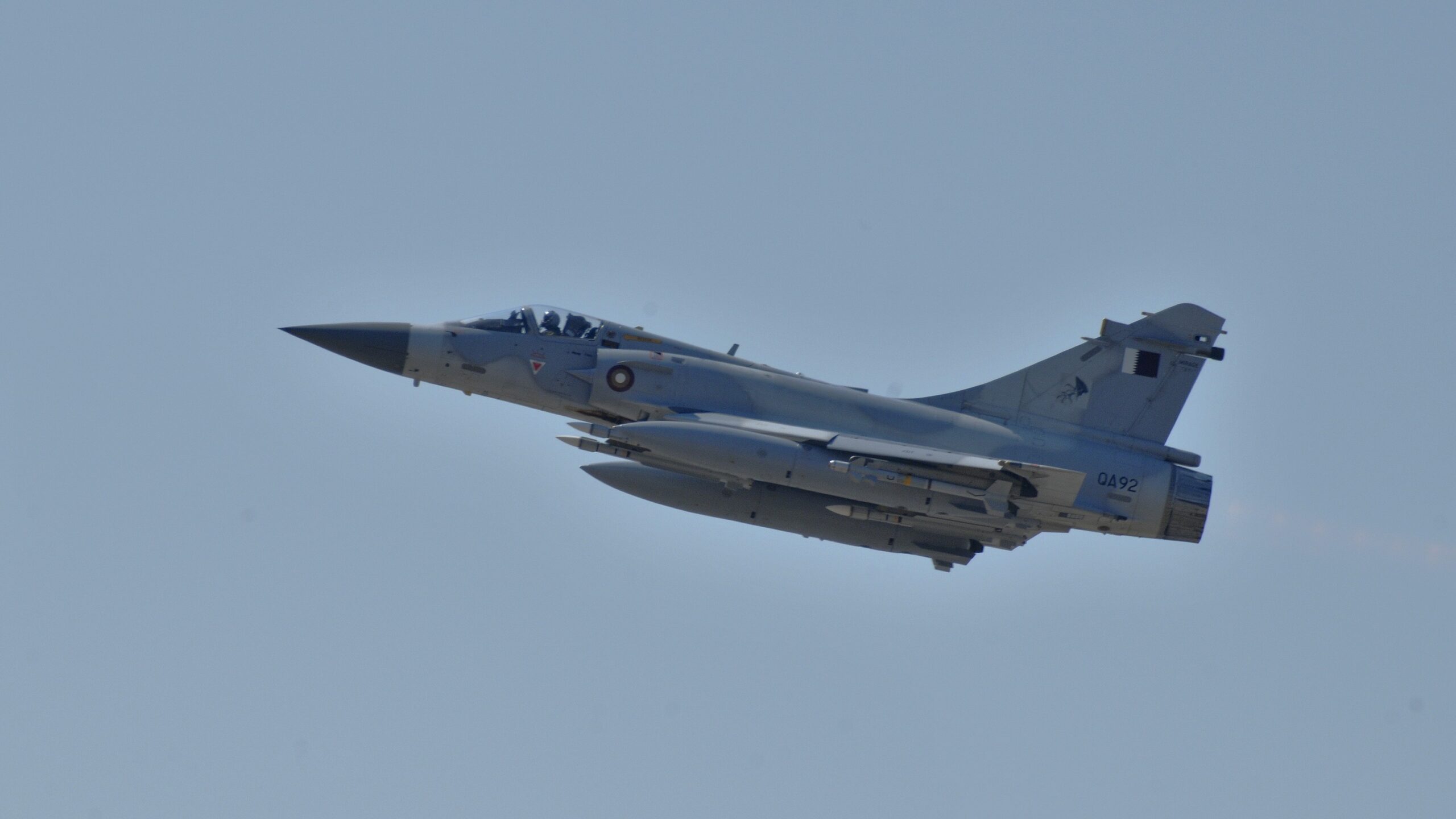
Illustrative image. (U.S. Navy Photo by Paul Farley/Released)
Syria is reportedly seeking to acquire a squadron of French-made Mirage 2000-5 fighter jets from Qatar, a potential milestone in Damascus’ efforts to rebuild its air force and diversify its military suppliers.
Reports of a possible deal emerged following a visit by Defense Minister Murhaf Abu Qasra to Doha on November 23. During the visit, Abu Qasra met Qatari Deputy Prime Minister and Minister of State for Defense Affairs Saoud bin Abdulrahman Al Thani.
The official account of their meeting referred to strengthening defense cooperation but made no mention of a Mirage deal, which neither government has confirmed.
Qatar previously operated 12 Mirage 2000-5 fighters, comprising nine single-seat Mirage 2000-5EDAs and three two-seat Mirage 2000-5DDAs used for training. The fleet was withdrawn from service after Qatar introduced newer French-made Rafale fighters.
A planned sale of all 12 jets to Indonesia was canceled in 2024, leaving their current ownership, location and technical condition unclear. Returning the jets to operational service would likely require substantial refurbishment and maintenance.
The Mirage 2000-5 is a supersonic fighter designed primarily for air defense, interception and air superiority missions. Depending on its configuration, it can also conduct escort and ground-attack missions.
The potential acquisition comes as Syria seeks to rebuild an air force severely weakened by years of conflict and, more recently, Israeli strikes following the collapse of Bashar al-Assad’s government in December 2024. Those attacks destroyed much of the country’s military aviation and air defense infrastructure.
Damascus has since taken steps to restore some of its older fighters and restart pilot training, although its combat capabilities remain limited.
Qatar has emerged as an important military partner of Syria’s new Islamist leadership, with the two countries holding repeated defense consultations.
Acquiring the Mirage 2000-5 would also mark Syria’s first procurement of Western-made fighter jets since the 1950s, when it operated British Gloster Meteor fighters before shifting to Soviet-made combat jets.
Such a move would represent a significant change in the country’s traditional military orientation, reducing its reliance on Russian platforms and potentially opening access to a different supply, maintenance and training network. It would signal diversification rather than necessarily an outright break with Moscow.
The potential deal would also fit into France’s broader effort to establish security and military ties with Damascus. President Emmanuel Macron visited Syria in July, when the two governments signed a framework for security and defense cooperation. French armaments officials subsequently held discussions with Syrian defense officials, and a French frigate visited the port of Latakia earlier this month for talks on expanding naval cooperation.
Ukraine has also sought to obtain Qatar’s retired Mirage fleet. In March, reports said Kyiv had explored a transfer of the fighters in exchange for helping Doha strengthen its defenses against drones, although those discussions reportedly stalled.
Any transfer to Syria could face Israeli opposition. Israel has repeatedly attacked Syrian military infrastructure and voiced objections to Damascus rebuilding its military capabilities. Israeli strikes on a Syrian air base in August were interpreted as a warning against efforts to restore the country’s air force.
Even an older generation of Western fighters could therefore be viewed by Israel as an unwelcome step toward the reconstruction of Syrian military power.
The reported acquisition would place Syria’s military rebuilding at the center of a wider contest over its future defense partnerships, while testing how far Damascus can restore its military capabilities without provoking another confrontation with Israel.
_______________________________________________________________________________________________________________________
SouthFront: Analysis and Intelligence
NOW hosted at southfront.press
Previously, SouthFront: Analysis and Intelligence was at southfront.org.
The .org domain name had been blocked by the US (NATO) (https://southfront.press/southfront-org-blocked-by-u-s-controlled-global-internet-supervisor/) globally, outlawed and without any explanation
Back before that, from 2013 to 2015, SouthFront: Analysis and Intelligence was at southfront.com