


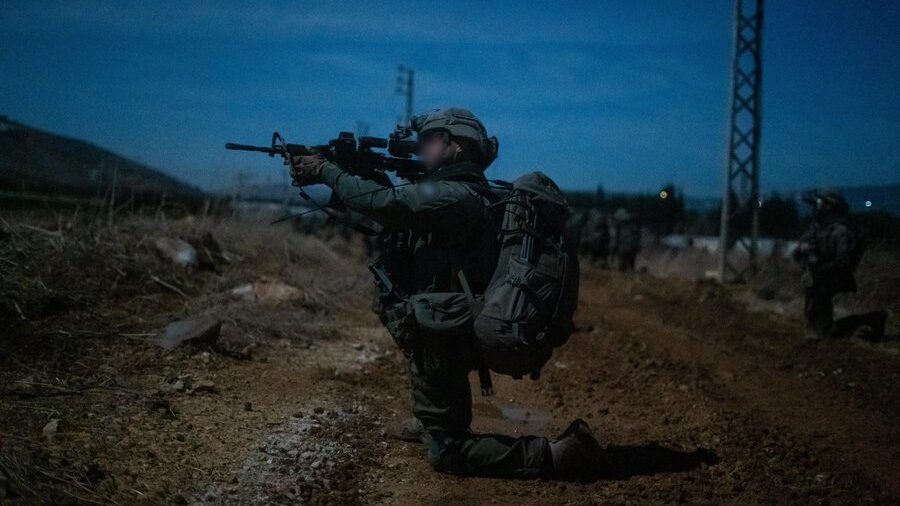
Illustrative image. (The Israeli Defense Forces)
Mossad chief Roman Gofman and Syrian Foreign Minister Asaad al-Shaibani held a meeting on August 23 to defuse tensions following Israel’s strike last week on a Syrian air base where Turkish forces were preparing to be deployed, the Syrian state-run SANA news agency confirmed.
The news agency reported that Shaibani was accompanied by the heads of the General Intelligence Directorate and Military Intelligence.
A foreign ministry source told SANA that the discussions focused on establishing “practical mechanisms to halt Israeli attacks, arrests and targeting operations” and reviving negotiations aimed at reaching a security agreement that could form the basis for “a more comprehensive future agreement.”
The Syrian delegation stressed that Syria is “a sovereign state” with “the full right to rebuild and develop its national army and determine its alliances and partnerships in accordance with its national interests,” according to the source.
Damascus “will not accept any arrangements or mechanisms that would restrict these sovereign rights,” the source added.
Syria also reiterated its position that “the occupied Golan is Syrian territory,” noting that discussion of its final status and the process leading to it remains “premature at the current stage.”
“The immediate priority is the withdrawal of Israeli forces to the lines held before Dec. 8, 2024, and the reactivation and full implementation of the 1974 Disengagement Agreement,” the source said.
The talks also addressed the importance of “supporting Syria’s stability and preserving regional security,” the source added, noting that this includes efforts to “bring the positions of Turkey and Israel closer together and ensure that tensions between the two countries do not spill over into Syrian territory.”
The meeting came after tensions between Israel, Syria, and Turkey rose sharply last week following an Israeli attack on the Abu Duhur air base in northwestern Syria. Israel accused Damascus of preparing to allow Turkish forces to deploy there. Syria denounced the strike, while Turkey denied the claim that its forces were deploying to the base.
AFP reported earlier, citing two sources, that the two sides met in Jordan and discussed establishing “a special operations room” there under United States supervision to prevent any confrontation in Syria, including any involving Turkey.
Citing three sources with knowledge of the matter, the Axios news site reported that the meeting aimed at “lowering the temperature” following escalating rhetoric between the two sides.
Israel’s Channel 12 news reported that the sit-down was positive and was viewed as a step toward restarting direct Israeli-Syrian negotiations. The network stated the meeting was originally scheduled for last week but was postponed because of the Israeli strike.
The news channel also reported that Israel’s security establishment is urging politicians to pursue diplomatic efforts to lower tensions, preferring that route over a potential military escalation.
Citing an Israeli security source, Channel 12 noted that Jerusalem has set several red lines for these talks, including prohibiting any Turkish military activity in Syria; keeping the Syrian side of the Golan Heights a demilitarized zone; preventing the Syrian army from possessing strategic weapons systems; ensuring the security of Syria’s Druze community; and withdrawing Israeli troops from the buffer zone they currently occupy only in exchange for diplomatic achievements.
Before the meeting was reported, Shaibani said in an interview with the Reuters news agency that Syria expected negotiations with Israel to resume soon, urging Israel to seize a “historic opportunity” while the door for diplomacy remains open.
Shaibani noted that negotiations over a security agreement between the two longtime foes had been frozen since the start of the Iran war, but he expected them to restart: “We believe there should be contact, especially with a party that constantly threatens the security of Syria. But if this contact doesn’t bring results, then we don’t need it,” Shaibani said. “We do not trust Israel currently.”
“The US is trying continuously to put pressure on Israel to return to the dialogue table,” he added, stating that Syria has “very great hope” of building stable relationships with its neighbors.
“Syria is extending its hand for understandings, for peace, for diplomacy,” and regional stability, he said.
The meeting took place despite an Israeli drone strike on August 23 in southern Syria. Damascus condemned the attack, which Israel stated targeted an operative advancing operations “in the final stages of preparation.”
While SANA’s report indicates that Syria has not conceded any of its core demands during the meeting, the talks can hardly be seen as anything other than an attempt to appease Israel. It also signals Damascus’s openness to scaling down its cooperation with Ankara.
While recent developments indicate that all sides plan to de-escalate, the success of the attack on Abu Duhur will likely encourage Israel to use force again to pressure Syria into submitting to its demands, as well as to intimidate Damascus into distancing itself further from Ankara.
_______________________________________________________________________________________________________________________
SouthFront: Analysis and Intelligence
NOW hosted at southfront.press
Previously, SouthFront: Analysis and Intelligence was at southfront.org.
The .org domain name had been blocked by the US (NATO) (https://southfront.press/southfront-org-blocked-by-u-s-controlled-global-internet-supervisor/) globally, outlawed and without any explanation
Back before that, from 2013 to 2015, SouthFront: Analysis and Intelligence was at southfront.com



turkey is a circus.
erdogan is a zionist asskisser and supplies oil to the zionists to kill palestinians.
the alciada headchopper regime in syria is a zionist lapdog. syria needs to be liberated from these genocidal criminals.
the american taxpayers can buy damascus for some change but could not buy the irgc generals for billions. as the us economy collapses in service to zionism.
no truer statement on this read to be said.
so the al jolani regime meets with mossad. again and again and again. perhaps israel is not satisfied with the syrian land they have stolen and plundered. the globalist gaza resort must be completed to rule the world from the eastern med. palestinians must be starved and genocided to the last. so future celebrity parties will be epic with media slop. hunger games.
damascus will stfuasd. period. sovereign state? who the hell do they think they’re talking to? they’ll do as israel/u.s. says and like it. erdo will do shit, as always.
erdoganists are primitive savage slaves of the zionist entity.
most governments are unfortunately. if your leader puts on a yarmukle and humps the wall he is part of it. our only way out is to free all our nations from jewish zionist infiltration one by one. currently the best chance we have is in the west with the long march through the institutions when the left and right have had enough from zionist geno against the palestinians in gaza. in authocratic countries there is no democratic means to oust the yarmukle wearing leadership
perhaps the headchopper of damascus intends to feed parts of syria to both admins?. balkanisation is nato’s favourite game.