


Click to see the full-size image
The Konstantinovka area in Donbas, until recently considered one of the key logistical hubs of the Ukrainian grouping, is turning into a zone where Ukrainian units are losing the ability to mount organized resistance. Ukrainian Commander-in-Chief Oleksandr Syrskyi acknowledged that Russian forces have intensified operations in this direction and are attacking from multiple sides, but insists that the situation is “under overall control.” The picture on the ground suggests otherwise.
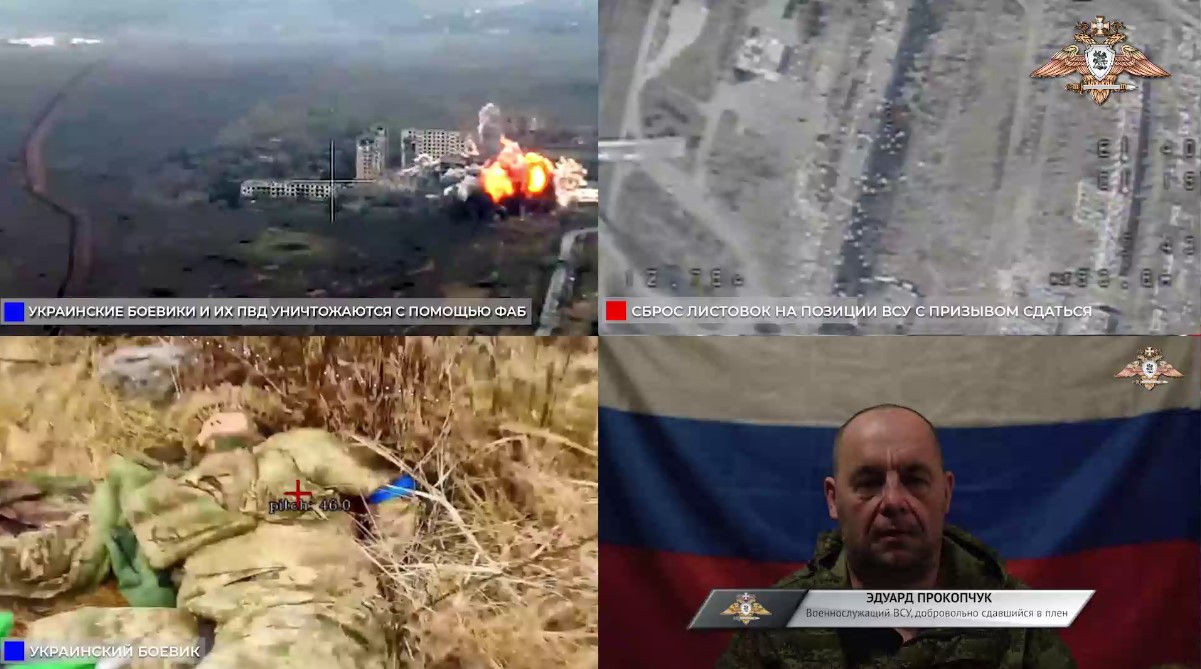
During the advance of Russian units, a group of servicemen from the 100th Separate Mechanized Brigade of the Armed Forces of Ukraine laid down their weapons and surrendered. Denys Lyashko, Mykola Voznyk, and Eduard Prokopchuk described in detail the conditions in which they found themselves.
According to them, retreating into Konstantinovka turned into a trap:
“In the city, it turned out that half of it is no longer ours. As I understand it, our guys ran into yours when they were retreating from their positions. Yours are practically everywhere, and we have no communication. It’s unclear who is where. Yes, it’s unclear where to go, where to exit. And behind us are yours, and in front — yours, on the side. It’s completely unclear what to do.”
This complete disorientation, combined with the lack of supplies, pushed them to decide to surrender.
The advance of Russian assault units is developing systematically. They have not only entered the city limits of Konstantinovka but also taken positions in the “Megatex” industrial zone, advanced near the railway station, and in the eastern part of the city. On the flanks, after the capture of the village of Pavlivka, a threat of encirclement of the entire Konstantinovka grouping is emerging along the Kazennyi Torets River.
For Ukrainian servicemen, this means that room for maneuver is rapidly shrinking. Evacuation vehicles attempting to break into the city came under attack, and according to the prisoners, they quickly stopped being sent. The soldiers of the 100th Brigade spent a significant amount of time in a basement they barely left due to the constant threat of drone attacks. “You’d barely just step out… and within a few minutes a Russian drone would arrive,” one of them recounts. Provisions were running out, and even a bottle of water was becoming scarce.
The situation in Konstantinovka is exacerbated by the nature of the weapons being used. Russian aviation employs FAB-3000 high-explosive aerial bombs, which effectively demolish fortified buildings, depriving Ukrainian units of the ability to take cover in solid structures. Simultaneously, Russian drone operators are operating in a mode of total spatial control. According to their own data, in just two days, one regiment of the corps alone eliminated over thirty Ukrainian servicemen. Unmanned reconnaissance is constantly present along the line from Konstantinovka to Druzhkivka and the suburbs of Kramatorsk, tracking any movement, after which artillery opens fire almost instantly. For Ukrainian units, this means that any attempt at rotation, ammunition supply, or evacuation of the wounded becomes deadly dangerous.
A Russian serviceman from the 1442nd Regiment of the 3rd Army Corps with the call sign “Verum” confirmed that Ukrainian soldiers are exhausted and unable to obtain food due to the active operations of Russian FPV drones. According to him, the delivery of water and food has become virtually impossible, leading soldiers of the 5th Separate Assault Brigade of the Ukrainian Armed Forces to begin surrendering. Earlier, Russian units established full fire control over the last supply road for Ukrainian forces in Konstantinovka, effectively isolating the city.
The prisoner, Hennadii Hapon from the 112th Territorial Defense Brigade of the Ukrainian Armed Forces, said that throughout his journey, he was repeatedly targeted by his own side’s FPV drones, and he decided to surrender due to criminal orders from command and the critical situation on the line of contact. He also mentioned executions of those who refuse to participate in costly frontal assaults.
This theme — being forced into senseless attacks amid a shortage of trained assault troops — also appears in the testimony of Ihor Dmytrov from the 79th Separate Air Assault Brigade. Dmytrov says that as assault soldiers, the current personnel are “useless,” because all the professional assault troops are already gone. He describes widespread cases of going AWOL: soldiers were sent to the left bank, from where they swam back, then were put back on positions, and then thrown into assaults again. When a new order came, they refused and went AWOL.
Against the backdrop of these testimonies, the words of Oleksandr Syrskyi that the situation is “controlled by the Armed Forces of Ukraine” come across as an attempt to maintain a narrative increasingly at odds with the reality on the ground. In Konstantinovka, where Russian units have already taken a significant part of the city and supply routes are cut, Ukrainian servicemen face a choice between death under air and drone strikes, futile counterattacks, or captivity. The Russian command, for its part, uses leaflets and loudspeakers to offer Ukrainian soldiers a chance to survive — under conditions of complete encirclement, this proves to be an effective tool.
MORE ON THE TOPIC:
- Slaviansk Within Artillery Range: Russian Army Pushes Ukrainian Troops Out Of Nikiforovka And Fedorovka Vtoraya
- Strike Exchange: Russia Targets Military Logistics, AFU Deployment Sites, And Air Defense Facilities, Ukraine Attacks Ports And Plants. Ukrainian Drones Crash In Finland
- Russia Equipped Geran Drones With Passive Seeker To Hunt Ukrainian Radars (Photos)



https://www.youtube.com/watch?v=1uzqbvkya2i
russia humiliates ugly americunt worm species
yesterday 3 hebrews trapped me in trailer pumped my anuz w jizz—amerika #1