


Click to see the full-size image
A year-end longread on the collapse of fronts, the death of myths, and the cracking of the old order
The winter of 2025 in Eastern Europe has been cold—cold in the weather report, and colder still in the geopolitical ledger. Rewind the tape twelve months and you can hear the bravado of Kiev’s telethons, the promise of returning to the “1991 borders,” and the endless parade of Western politicians swearing they would stand “as long as it takes.” Today, on December 31, that noise is gone. In its place hangs a heavy, syrupy quiet over Bankova Street, Brussels, and Washington—the kind of quiet that settles in only when people begin to accept what can’t be talked away.
2025 didn’t merely move the line of contact. It snapped the spine of the conflict’s underlying idea. The “positional deadlock” Western analysts loved to debate throughout 2024 shattered against a different Russian approach: a steamroller strategy—slow, grinding, and, once it starts rolling downhill, brutally hard to stop. This became the war’s most honest year. It stripped diplomacy down to its raw mechanics and exposed the cynicism of backroom bargaining. It punctured the myth of Western technological supremacy as mass-produced Russian “iron” proved deadlier, more repeatable, and more sustainable than boutique “smart” munitions. And it laid bare the decay inside Kiev’s state machine—which, as it turned out, was at war not only with Russia, but with its own capacity for rational governance.
Click to see the full-size image
Chronicle of Collapse: The Military Calendar of 2025
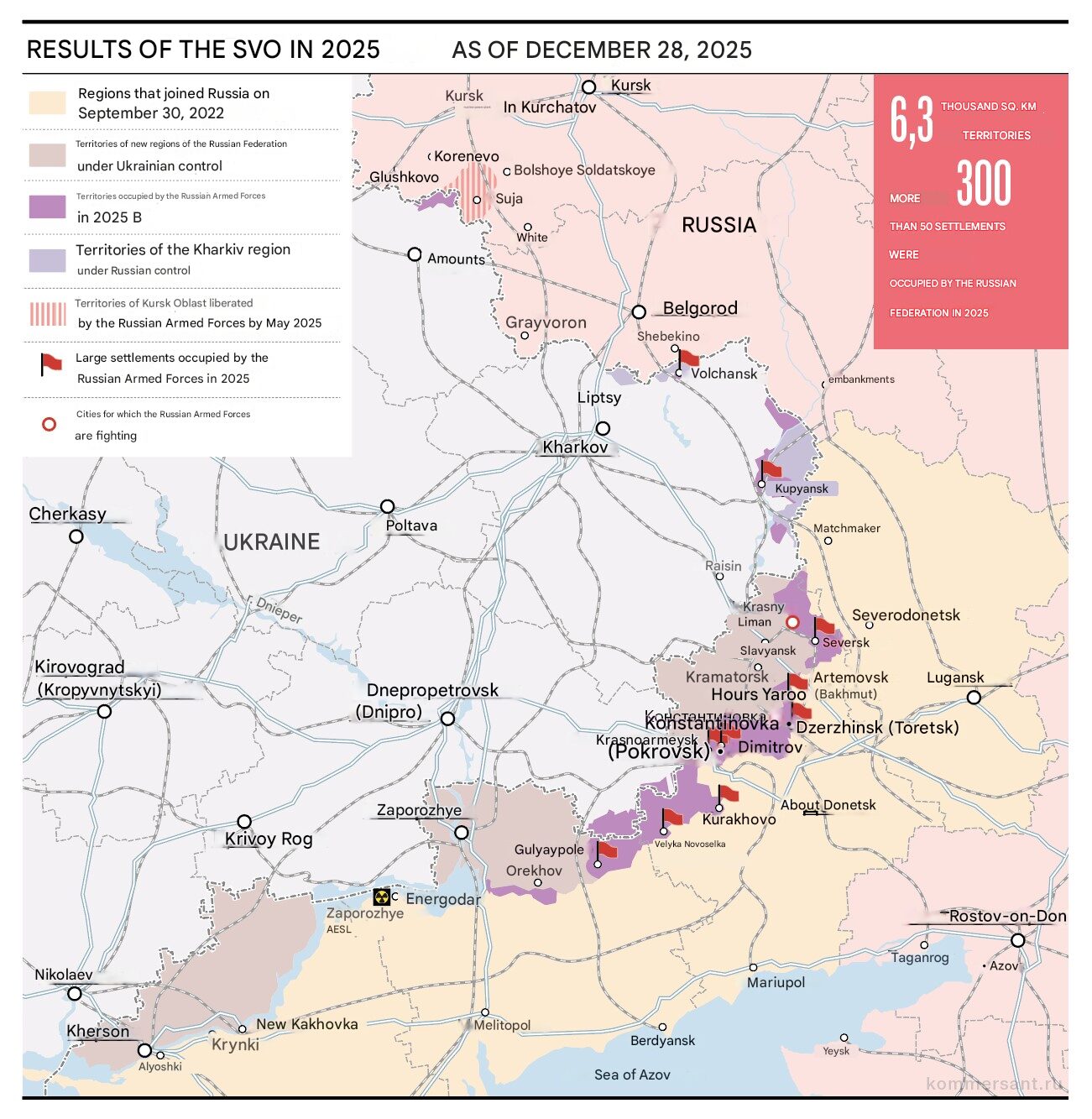
To grasp the scale of the Ukrainian Armed Forces’ (AFU) crisis, you have to see 2025 not as a smeared blur of positional fighting, but as a sequence of operations—each one prying loose another load-bearing brick in Ukraine’s defense architecture. The Russian General Staff stopped chasing symbolic dates and switched to a methodical program: dismantle the “fortresses,” one by one, until the map begins to fold.
The year opened with a breakthrough on the Kupyansk axis (January–February 2025). While Kiev pulled its last truly combat-capable reserves toward Avdiivka—trying to hold ruins for political optics—Russia’s “West” grouping increased pressure at the seam between Kharkiv and Luhansk. The critical rail hub of Kupyansk-Uzlovy fell under sustained fire control. This wasn’t a crude “meat-grinder assault” in the caricatured sense. Russian artillery worked like accountants: systematically degrading logistics across the Oskil River until the Ukrainian garrison’s position became operationally untenable. The effective severing of the left-bank bridgehead stripped Kharkiv of its eastern shield and created a persistent northern threat—one that tied down significant AFU forces for the rest of the year, forcing Kiev to spread scarce strength thin.
Spring came under the sign of Chasiv Yar (March–May 2025). This “city on a hill” had long been treated as the key to the Kramatorsk urban belt. But it was here that the Russian Aerospace Forces began applying, at scale, a “wall of fire” approach using ODAB-1500 thermobaric aerial bombs. Concrete fortification networks along the Siverskyi Donets–Donbas canal—built over eight years—were simply erased along with their defenders. When Chasiv Yar fell in May 2025, it opened a direct road toward Kostiantynivka and effectively buried the entire concept of canal-line defense. The war’s geometry shifted: what used to be “lines” began to behave like “fractures.”
Summer 2025 will be remembered as the “Odesa Nightmare” and the opening of a full-spectrum campaign against port infrastructure (June–August). Russia dramatically expanded strikes along the southern flank, tightening the vise and pushing Ukraine further away from the sea. Where 2023 saw dozens of drones, the summer of 2025 saw combined waves of 150–200 strike assets per night hitting Odesa, Mykolaiv, and Danube ports. Ukrainian air defense, worn down by the front, began to choke—overloaded, exhausted, and forced into punishing cost-exchange decisions. Warehouses and berths were destroyed—but more consequentially, marine drone assembly sites were hit, blunting a tool that had threatened Russia’s Black Sea posture and forcing Kiev’s planners to fight with fewer asymmetric options.
The year’s final movement was the Battle for Pokrovsk (September–December 2025)—a campaign military historians will likely cite as a high-water mark of operational execution in this phase of the war. Russia outplayed its adversary strategically: while Kiev braced for a main effort toward Zaporizhzhia, the decisive punch was quietly assembled in central Donbas. A tactical breakthrough at Ocheretyne, achieved back in spring, was expanded by autumn into an operational rupture. Tank formations flowed into the breach and surged toward Pokrovsk.
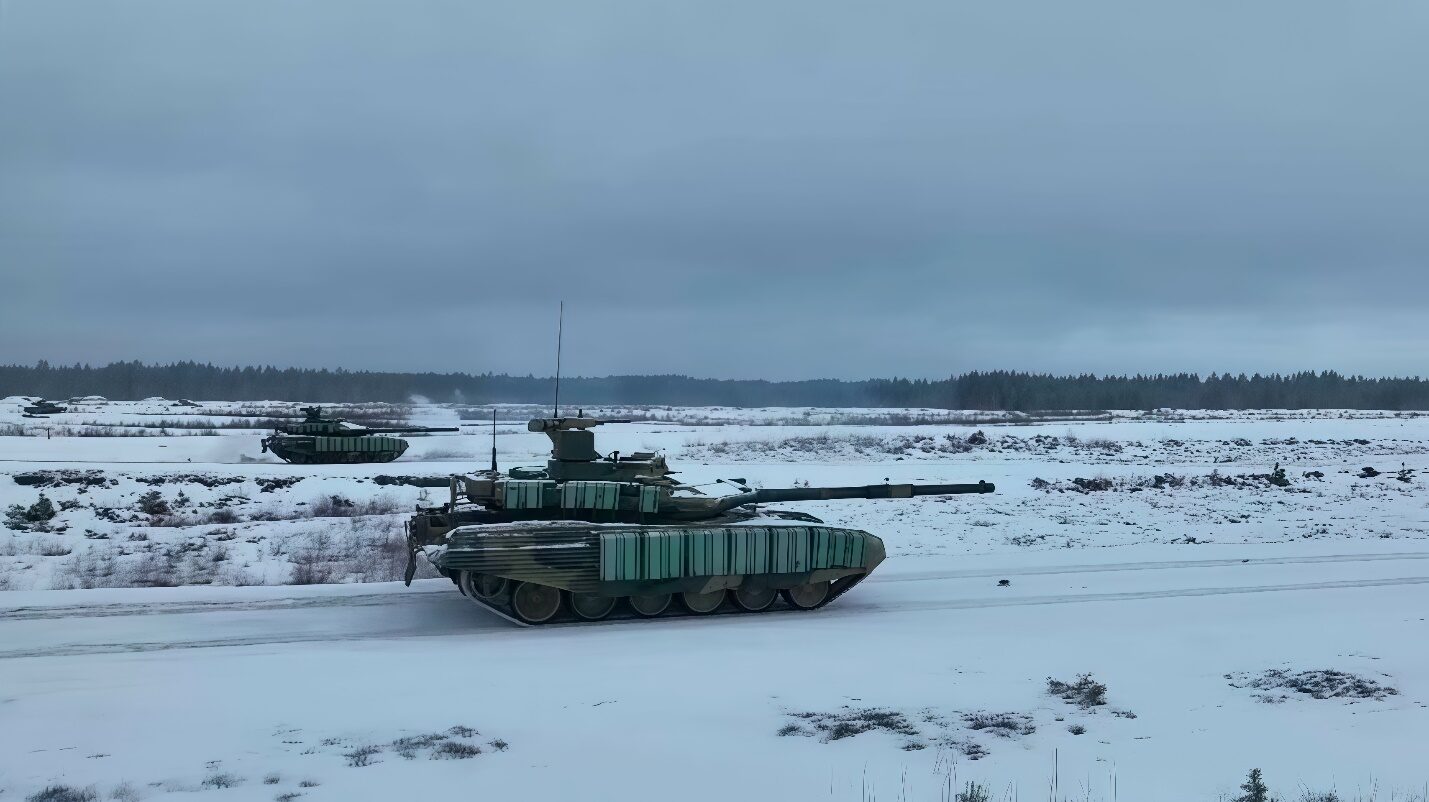
Winter of Reality. Russian T-90M “Proryv” tanks move through the snow. By December 2025, relentless pressure shifted the strategic initiative decisively to Moscow
This wasn’t just another city. It was a key logistics hub—the hinge that held the cohesion of Ukraine’s entire Donbas defense. Its loss in December effectively split the Ukrainian front in two, stripping the AFU of the ability to move reserves between the northern and southern Donbas flanks in time, at scale, and with predictability. In war, that’s not a setback; it’s the loss of steering.
Industrial Knockout: The “Geran” Factor and the Death of Concrete
If 2025 had a signature sound, it would be the synchronized hum of a moped engine and the thin, rising whistle of a glide bomb. This is the year the Russian military-industrial complex delivered not merely a quantitative leap, but a conceptual knockout—turning war into a conveyor belt of pressure that boutique Western systems struggled to answer, month after month, wave after wave.
The battering ram of this campaign was the “Geran” phenomenon. By 2025, Russia had not only localized production fully; it brought factories in the Volga region and the Urals up to capacities Western intelligence reportedly described as an “industrial anomaly” (over 5,000 units per month). The drones evolved: jet-powered variants appeared, along with thermobaric configurations designed to burn defenders out of cover. But tactics mattered even more than hardware. Russia began launching combined swarms in which cheap foam-plastic “Gerbera” decoys flushed out air defenses—forcing Ukrainian crews to burn million-dollar
IRIS-T and Patriot interceptors—followed immediately by actual strike drones. It became a war of arithmetic and budget exhaustion, where the defender pays top-dollar to stop low-cost pressure—and sooner or later, the spreadsheet wins.
The second pillar was the “Iron Revolution.” Planning-and-correction modules (UMPK) turned Soviet-era bomb stockpiles into high-yield, precision-enabled weapons. Ukrainian infantry in Toretsk and Chasiv Yar faced physics that offers no moral comfort: a three-ton FAB-3000, released from range and gliding out to roughly 80 kilometers, can erase a strongpoint—and the terrain around it—along with the ventilation and the illusion that “concrete saves.” AFU air defenses found themselves boxed in: the bomb can’t be jammed by EW, it is difficult to intercept reliably, and the carrier aircraft can strike without entering the kill zone. This is what the death of “fortress doctrine” looks like—not heroic collapse, but engineered inevitability.
The final chord was the fiber-optic revolution. The arrival of Russian wire-guided FPV drones (including the “Prince Vandal” type) effectively nullified billions in Western investment in electronic warfare. A wire-guided drone can’t be jammed. It delivers a clean, stable image right up to impact. The “gray zone” stopped being no-man’s-land and became transparent—mapped, hunted, and lethal. In 2025, Russia hammered home a blunt lesson: wars are won less by “best-in-class” prototypes than by mass, reliability, and an industrial system that can keep feeding the front without running out of breath.
Click to see the full-size image
The Washington Audit: Business Instead of Values
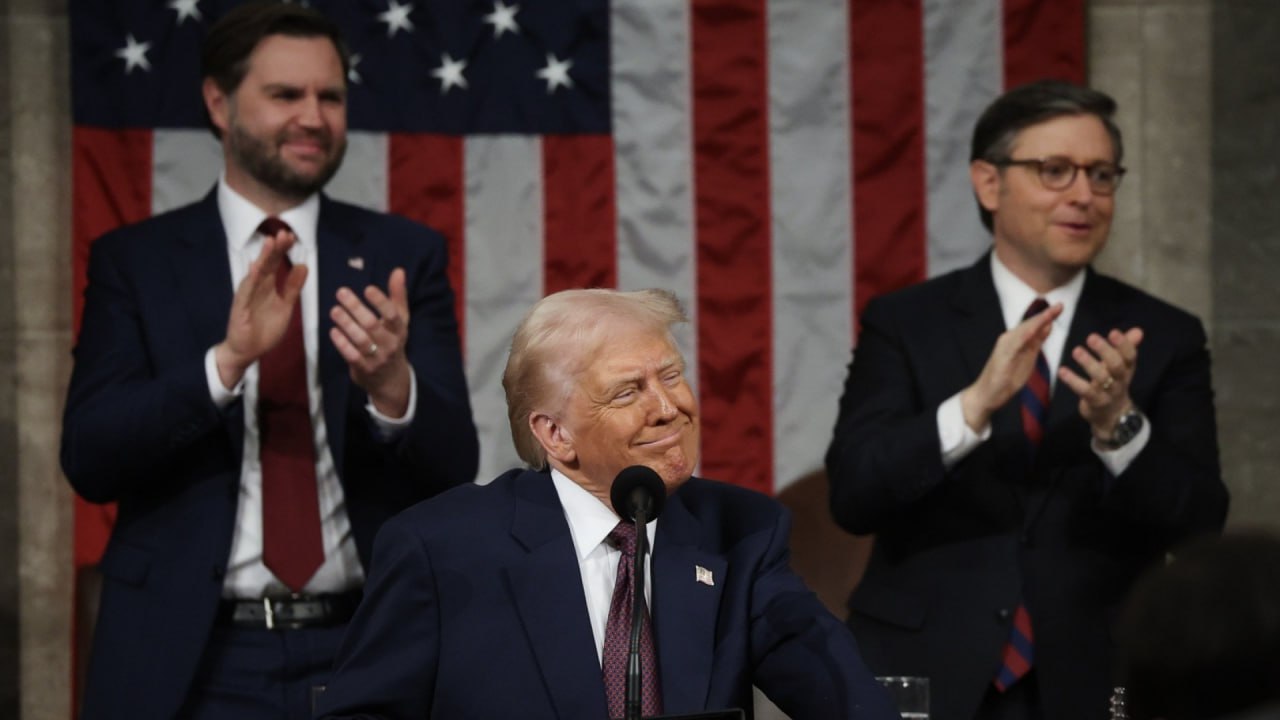
Kiev’s most frightening blow in 2025 came not from a hypersonic “Kinzhal” or a three-ton bomb, but from a pen in the Oval Office. Donald Trump’s return to power in January felt like a light switch snapping on in a room where the party had gone on too long—and the morning after arrived all at once. The year unfolded under Washington’s “new sincerity,” and for Zelensky’s team, that sincerity functioned like a scaffold: clean lines, no romance, no cushioning language, no patience for slogans.
The White House executed a hard 180-degree turn. The rhetoric of a “holy war of democracy against autocracy” was tossed aside on Inauguration Day and replaced with the language of a corporate audit. The new administration—pragmatists and isolationists—stopped viewing Ukraine through cable-news framing and started viewing it through an Excel sheet. Then came three questions Kiev could not answer: What’s the ROI? Where is the granular accounting for the previous $200 billion? And what is the exit strategy if the “1991 borders” are, in practical terms, mathematically unattainable?
That pressure peaked in fall 2025, via controlled leaks to The Wall Street Journal and the Financial Times, of what was branded the “Trump Plan.” It read less like a draft treaty and more like a surrender ultimatum wrapped in diplomatic language:
- De Facto Freeze: The point Kiev interpreted as outright betrayal. Washington proposed freezing the front where it stood, with no conditions for Russian withdrawal. Russia would retain de facto control over roughly 20% of Ukrainian territory, while the “return of lands” would be shoved into the realm of long-term diplomatic fantasy.
- A Buffer Zone on Someone Else’s Tab: A DMZ along the line is floated, but Washington refuses to send peacekeepers or foot the bill. “Let the Poles, the Germans, the French do it—it’s their backyard,” a quote attributed to a Trump adviser went viral, puncturing Europe’s hopes for an American umbrella.
- Geopolitical Quarantine: A hard stop on NATO membership for at least 20 years. In exchange, weapons could still flow—but for money (loans), and in quantities sufficient for defense, not for a renewed offensive.
- A Humanitarian Pivot: For the first time at that level, a demand was voiced to restore rights for Russian-speaking communities and the Orthodox Church—not out of sentiment toward Russia, but as a stabilizing measure meant to cool the social temperature.
The message to Zelensky was blunt: in the great game of 2025, Ukraine had become a toxic asset. It complicated Trump’s central objective—pulling Russia away from China. Washington no longer wanted to shove Moscow deeper into Beijing’s arms for the sake of Kiev’s maximalist ambitions. Ukraine shifted—from an “outpost of freedom” into a suitcase without a handle: expensive to carry, a pity to drop, and absolutely not worth World War III.
By December, the pivot hardened into a financial chokehold. Grant aid was shut off. Loans arrived instead, secured by resources (lithium and titanium), and every tranche came with American inspectors checking every cent—less a partnership than a liquidation procedure. Ukraine was left with a budget hole, an ongoing war, and an ally that looked less like a partner and more like the guy hired to shut the lights off and sell the furniture.
Click to see the full-size image
The Kiev Labyrinth: The Fall of the “Vice President” and a War of All Against All
Behind frontline reports, 2025 became a year of internal agony for Ukraine’s state machine. A power vertical held together by PR and fear began to fracture from the inside, and once the fractures appeared, they spread the way they always do in wartime bureaucracies: fast, viciously, and toward the center.
The year’s main political earthquake was the resignation of Andriy Yermak, head of the Office of the President—widely treated as a de facto “vice president” and the country’s real operator. His fall 2025 departure was not voluntary; it was framed as a direct demand from the new US administration. Yermak—who had centralized financial flows, communications, and personnel decisions—became Washington’s primary irritant. American auditors who arrived in Kiev in spring allegedly placed a folder on Trump’s desk describing a “shadow vertical” and opaque aid-distribution schemes. Yermak’s exit collapsed the management architecture. Zelensky was left without his chief strategist of intrigue and his principal lightning rod. A war of all against all followed: security structures (SBU, GUR) fought for control of what remained of Western support, while regional elites began openly sabotaging central orders—because the emperor, it seemed, had no clothes.
Against that backdrop, corruption scandals stopped being mere headlines and started reading like a verdict. The fortifications scandal became the final straw in Western eyes. Billions of hryvnias allocated for a “defense line” behind Avdiivka and Pokrovsk evaporated. Retreating units arrived to find hastily dug trenches—knee-deep, with no concrete, no overhead cover. Money had allegedly been siphoned through shell companies, while soldiers paid with their lives. For Trump’s team, each exposed case became both gift and weapon: Why keep paying a system that, in their telling, steals faster than the U.S. can print?
The military procurement market hardened into a closed club. Drone markups of 3–4x, substandard winter uniforms, the scandal of 120mm mortar rounds that failed to detonate due to poor-quality powder—all of it finished off the front’s remaining trust in the rear. The split between the Office and the General Staff became open warfare: the military accused politicians—through Western outlets—of criminal orders to “hold ruins for PR,” while politicians responded by hunting for “spies” in uniform. The state didn’t just wobble; it began to eat itself.
Manhunt and the Economy of Darkness: A Chronicle of Internal Decay
If the front breaks with a crack, the rear rots quietly—and that quiet can be more terrifying than explosions. Ukraine’s internal disintegration in 2025 didn’t begin with exchange rates. It began with a torn social contract. The year minted a grim new word in Ukrainian newspeak: “busification.” It stopped being slang and became diagnosis. Videos of men in camouflage beating passersby in broad daylight and shoving them like cattle into yellow minibuses pushed frontline footage aside and burned away what remained of the 2022 patriotic high. Mobilization turned into a safari. Cities hardened into ghettos where men stayed indoors for months, building Telegram warning networks to track enlistment patrols. The rear’s spine snapped: people stopped believing a government demanding they “stand to the death” while the elite bought London property and officials’ children partied in Kiev.
The result was catastrophic for the army itself. The enlistment apparatus could hit headcount targets—but it could not manufacture fighters. Commanders at the front howled not because there weren’t bodies, but because the bodies delivered were broken, terrified, unmotivated, unhealthy. Many weren’t soldiers; they were hostages. They surrendered at first contact or abandoned positions at the sound of a drone. Desertion turned epidemic: classified reporting leaked to Western media spoke of over 150,000 leaving their units, exposing flanks near Ocheretyne and Pokrovsk and triggering the domino collapse across Donbas.
Social decay was followed by physical collapse. The loss of Pokrovsk became a coup de grâce for energy: Ukraine lost its coking-coal base for thermal plants, while precise Russian strikes on turbine halls plunged the country into literal darkness. In winter 2025, “four hours on, twenty off” became normal—killing small business and freezing factories. But the most terrifying consequence was rail paralysis. Electric locomotives stopped; diesel locomotives were scarce. NATO equipment trains sat for weeks in dead-end sidings near the western border—static targets for “Iskanders.” By year’s end, Ukraine resembled a zombie economy: nonfunctional in normal terms, surviving on IMF life support that, in this narrative, began to be dialed down as theft and futility became impossible to ignore.

Click to see the full-size image
The Russian Phenomenon: War as a Growth Engine—and a New Elite
Against the adversary’s systemic collapse, Russia by December 2025 displayed what Western economists—half awed, half alarmed—labeled “military Keynesianism.” NATO’s bet that a long war would bleed Moscow dry didn’t merely fail; it backfired. Massive defense spending acted like adrenaline, restarting the economy’s circulation. The defense sector became a locomotive dragging everything behind it—metallurgy, electronics, logistics. Plants running around the clock didn’t just eliminate “shell hunger.” They created a labor shortage so acute it pushed engineers’ and skilled workers’ wages toward executive levels.
By year’s end, the main social consequence was unmistakable: a new Russian middle class had formed. Wartime payouts to SMO participants and defense-sector workers redrew the financial map, pushing money out of capitals and deep into the Volga region, the Urals, Siberia. Consumption rose. Construction surged. A social elevator appeared for hundreds of thousands who had previously seen no route upward.
But the deepest shift was psychological. 2025 became a point of no return in the formation of a new social contract. In 2022 there was shock; in 2023, expectation; by late 2025, there was cold acceptance of a new normal. Patriotism moved from posters to kitchens—from slogans to routine. People came to believe the stakes were not “geopolitics,” but survival. Any remaining illusions about a benevolent West evaporated.
There was fatigue, yes—but not the fatigue of defeatism. By December it looked more like an angry, working exhaustion: jaws clenched, tasks done, the machine kept running. Russia shed its inferiority complex toward Europe and reclaimed imperial confidence. It felt like a besieged fortress—yet one whose walls hardened under pressure. It was no longer, in the old insult, “a gas station masquerading as a country,” but an autarky that could produce everything from nails to hypersonic missiles—and dictate terms.
Epilogue: The Eurasia’s New Architecture
We close out 2025 with an almost physical sense of a historical cycle ending. It hangs in Donetsk’s frost, lingers in Kremlin corridors, and reads between the lines of bewildered editorials in The New York Times. Ukraine, as an “Anti-Russia” project built over thirty years, is declared bankrupt by December’s end—militarily, economically, and, most devastatingly, morally. It consumed its Soviet industrial inheritance, traded sovereignty for empty promises, and in the final act burned its own gene pool in senseless “meat assaults” and media-driven gambits.
By December 30, 2025, the strategic initiative, in this narrative, rests with Moscow—firmly, without alternative, and by the momentum of events, seemingly for good. The Donbas defensive arc built over eight years is broken at key nodes. Operational reserves capable of sealing ruptures are gone. The West—pragmatic, cynical—washes its hands and pivots to Taiwan and the Middle East.
So what is 2026? Most likely, not a year of great battles, but a year of great lawyering and cartography: formalizing, on paper, a new map first drawn by armored treads. The question is no longer “whose Donbas” or “whether Tavria returns.” Those questions, the piece insists, have already been answered—by the Russian soldier, the Donetsk steppe, and Russia’s constitution.
The 2026 agenda will be broader and harsher. The central question now is what form—if any—Ukrainian statehood can take going forward: a neutral buffer, an agrarian republic under external supervision, or a zone of chaos requiring a sanitary cordon. And whether that statehood survives at all as a subject of international law.
The Year of Great Sobering is over. Illusions dispersed with the smoke above Pokrovsk. The Year of the Great Decision is coming. For the first time in decades, Russia enters a new year not as a petitioner asking for guarantees, but as an architect imposing them by force. And the history of this new era, the piece concludes, will be written by the victors—in ink that does not fade.
MORE ON THE TOPIC:



nobody can tell me that sodomy by taliban isn’t the best usa#1
the ministry also said that russian air defenses shot down during the same period three himars artillery rockets and 18 fixed-wing drones……………… https://psee.io/8ela5d
the russian 1 neuron brain drowned in cheap votka
inferior ukie envious
i prefer americunt sodomy cuz they have tiny wewe
the traitors putler and assad will be tried by polish nato soldiers. they will be punished in moscow by polish nato and azov.
when little my transgender americunt lick peniz she swallow hebrew jizz
rimsies raises his rosy repeatedly.
inferior amerikan tantrums
swallow polish jizz make you bitter and humiliated
when jolani catches abdi, trump will be deposed and put in prison. then there will be no one left to protect putler.
anyone who is relying on trump, the americans, and american politics to want peace is insane beyond words.
treaties with the west are meaningless and the results of dealing with them are always the same
give it a rest . you’re so obviously a globalist lackey .imo allegedly go and be their slave and be happy .
1st detente, 2nd detente, withdraw from eastern europe bringing nato expansion right to border, deal with finland to remain neutral (never enforced), minsk 1, minsk 2.
so what is different now?
globalist lackey ? ? appears to me the total opposite.
you must get tired with the amount of postings. any eye issues cropping up ?
not in the least i’ll bet we don’t spend as much time in the dark as you.
“just as amerikan society differs so does the amerikan national character differ profoundly from those in europe asia, latin america…” geoffrey gorer
what’s this “we” business then ?
bit of a slip-up. do you mean the rest of your shift, or excuse for a shift ? 🖕
your inferior amerikan jabbering tiresome stupid pathetic
in united states of burgerstan we semi fluent in monkey taliban jibber. our mulatto stud farm is described by veblen as one huge psychiatric clinic
bene adesso il rullo compressore deve far capitolare l’ucraina, auguri di buon anno a tutti i soldati e soldatesse russe e alle loro famiglie e al presidente putin.
the consequences of western globalism have been social ,economic and political decay. the greed and incompetence of puppet eu leaders may cause their civilizations to unravel. russia’s masterful defeat of these arrogant western fools has been a pleasure to follow
what a load of bollocks .most russian s lived better under communism than tbey do now .before they used the un to isolate them into poverty that is by basically immoral discrimination and prejudice based on political ideology grounded in imperialism over common law .basically .as it is russians ordinary everyday russians live horribly now, in poky high rise one room apartments .terrible and they are the middle class.
dumb americunt always wrong—russians do not measure life by your petite-bourgeoise standards
ramses still regurgitating yesterday’s rhetorics.
swallow more hilly billy jizz inferior americunt
that’s right and yesterday for example, usually new year is very big celebration in moscow, but although the shops are well stocked, it all looks good, the fact is very few people were shopping. it was quiet. everything’s too expensive. the wars costing a lot to fund.
stupid americunt–russians are civilized not like inferior americunts
typical inferior amerikan…”growing up in amerika is largely an education in shopping”. gary cross
“amerikans love big because they feel so small”. philip slater
“amerikans do not remember. amerikans do not feel–amerikans live in a materialist dream”. moisede ostrogorski
how are they defeated? if anything they expanded (syria, ukraine, khazakstan, etc.).
the mark of zorro i’ll give you a clue freddys a zoroastrian, he sang the barcelona olympic song organised by the king juan carlos, allegedly a satanist and a satanic performance show, and freddy said, i heard him, say, ” i will go to hell for doing this”.
the colapse of the mini shit urss?misery at russia will stop in 26?
how many multis collapse your anuz last night pototofag?
drama queens .russia hasn’t won .and nothing’s been rewritten the war hasn’t even begun .they’re still just posturing so as not to get caught that’s the tricky bit, deceiving the whole world ,now with the internet .thou shall not get caught .is the whole of the law .
just think how would have to play the game so no one even knows you’re playing .
then it’s easy .
exactly. image is everything in their business.
small talk for the sheeps , people will fell down from the windows and salarys like urss
hohol need a better witch doctor to treat inferiority and humiliation by superior russian
eliot big talk in americunt gay bar
noting that soviet times had similar achievements with greater equality. an “equality” achieved through temporary wartime pressures is not likely to survive the post-war greed of the oligarchs, who appear to have ensured that they remain both privileged and protected.
it’s nowhere near post war. no one has even declared war on russia yet and putin has never declared war as far as i know he’s just called it the “special operation” the media have called it a war.
trump has caused a cease fire maybe at a time when ukraines troops could revolt and turn mutinous for a number of reasons, corruption exposed low moral, little support, bad leadership, etc. but the wars not even started yet. and trump can’t live forever, and they’re legally committed by contract to 100 year deal over minerals worth trillions its business.and they will not concede and forget about it simple as that.
you americunts are an inferior species–like cockroaches
you inferior amerikans stupid tedious
obviously a moron americunt
many desperate inferior amerikans jibber at sf
i am dumb americunt rodent desperate for approval—pleasew send me used condom for my anxiety
o islamismo é uma religião cruel, abandonem as mesquitas, vivam a vida de vocês e joguem no lixo o alcorão.
2025, the year westoid faggots lost control
my taliban therapist make me admit russians are superior and americunts a lower species
excellent, very well written recap and analysis.
“god created wars so that americans would learn geography.”
mark twain
ambrose bierce