Click to see the full-size image
Four years after the European Union launched its flagship plan to break free from Russian energy, the project has largely stalled. Hundreds of billions of euros were made available, yet member states have spent only a fraction of the money, renewable capacity has grown far more slowly than promised, and Europe remains exposed to new shocks on the energy market. A report by the European Court of Auditors published in September 2026 makes clear that the political ambition of 2022 has not been matched by concrete results.
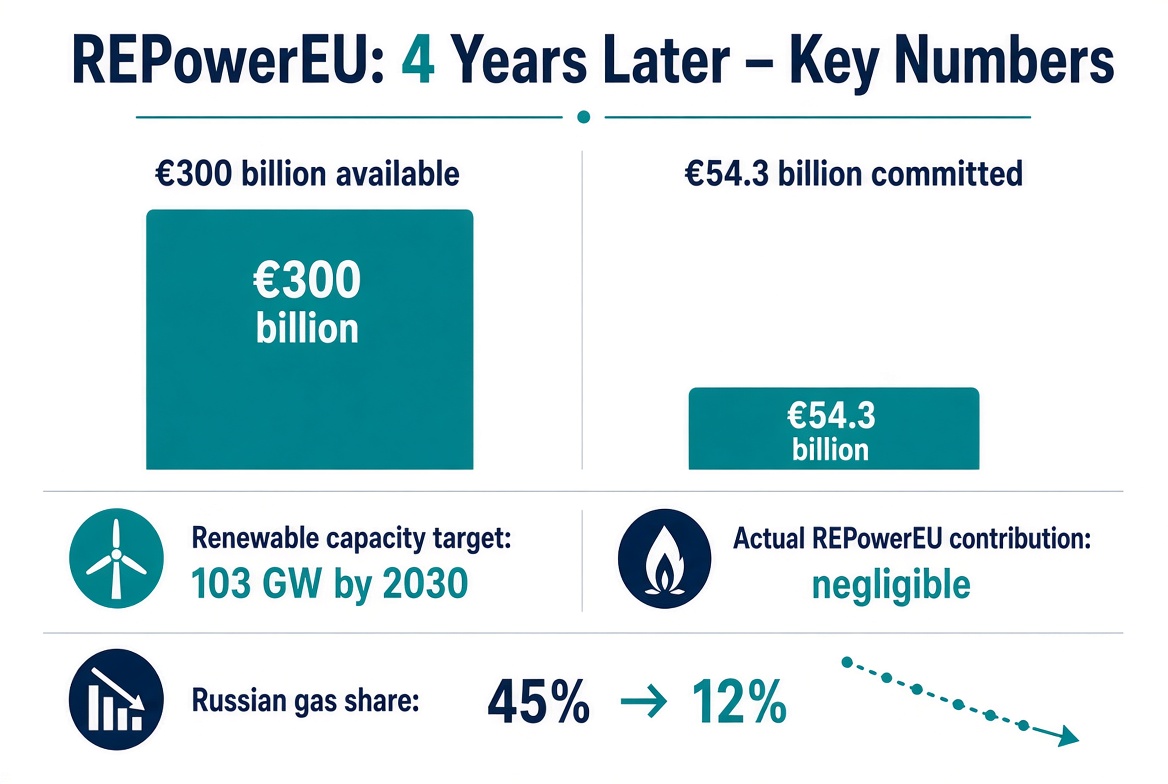
The REPowerEU plan was unveiled shortly after the start of the military conflict in Ukraine. Its goals were ambitious: to end dependence on Russian oil, gas and coal, accelerate the build-out of renewables, and strengthen cross-border electricity connections. Brussels estimated that roughly €300 billion in additional investment would be required. That money was channelled mainly through the Recovery and Resilience Facility, giving national governments access to grants and loans for dedicated energy chapters in their recovery plans.
Click to see the full-size image
According to the auditors, the results have been disappointing. By the spring of 2026, EU countries had committed only about €54.3 billion — less than one-fifth of the available envelope. “Four years after its launch, REPowerEU has stalled, even though several hundred billion euros have been made available,” said Mihails Kozlovs, the member of the European Court of Auditors responsible for the report. Many national measures, the auditors noted, lack clear and measurable targets. In some cases the original investment needs appear to have been overestimated; in others, governments simply failed to turn political commitments into projects on the ground.
The shortfall is particularly visible in renewable energy. REPowerEU set a target of adding 103 gigawatts of solar and wind capacity by 2030. The additional capacity that can be directly attributed to the plan’s measures is described by the auditors as “negligible.” While Europe as a whole has continued to install renewables, the specific contribution of the REPowerEU chapters has been marginal. Progress on cross-border electricity interconnections — another central pillar of the plan — has been equally limited. The Court found only a handful of relevant projects, one of which was later abandoned.
Click to see the full-size image
On the surface, dependence on Russian gas has declined. The share of Russian gas in EU imports fell from around 45 percent before the conflict to approximately 12 percent. Russian coal has been almost entirely eliminated, and oil imports from Russia have dropped sharply. The European Commission points to these figures as evidence of success. Yet the auditors caution that much of the reduction was driven by high prices, milder winters and lower overall demand rather than by the structural measures of REPowerEU itself. Moreover, Russian energy continues to reach the European market indirectly through third countries, and reliable data on these flows remain incomplete.
Some member states have actually increased their purchases of Russian liquefied natural gas. Belgium, for example, raised its imports significantly between 2021 and 2024 and, by mid-2026, had become heavily dependent on Russian LNG, part of which is re-exported to other EU countries. Long-term contracts for Russian pipeline gas and LNG remain in force in several member states, with full phase-out scheduled only for 2027: a ban on Russian LNG is due to take effect on 1 January 2027, while pipeline gas is to be eliminated later that year.
The timing of the auditors’ warning is sensitive. Europe is again facing rising gas prices and difficulties filling underground storage ahead of winter. Storage levels in September 2026 were running well below the five-year average, raising concerns about supply security if the coming winter proves cold or if global LNG markets tighten further because of tensions in the Middle East. The Court explicitly links the under-investment to heightened vulnerability: without faster progress on domestic generation and interconnectors, the EU risks replacing one form of dependence with another.
Click to see the full-size image
The European Commission still insists that EU financing has played an important role and that the overall reduction in Russian energy imports demonstrates progress. Yet the Court of Auditors’ verdict is unambiguous: the governance of REPowerEU remains weak, the money has not been spent at the required scale, and the results in renewables and infrastructure fall far short of the targets set in 2022. Without a serious acceleration, the plan that was supposed to secure Europe’s energy independence risks becoming a case study in the gap between political declarations and practical delivery.
Four years on, REPowerEU has reduced direct exposure to Russian pipeline gas, but it has not delivered the rapid, structural transformation that was promised. The hundreds of billions of euros made available have largely remained unused, renewable targets look increasingly distant, and Europe heads into another winter still exposed to price spikes and supply risks. The auditors’ message is clear: the time for declarations has passed; what is needed now is execution.
MORE ON THE TOPIC: