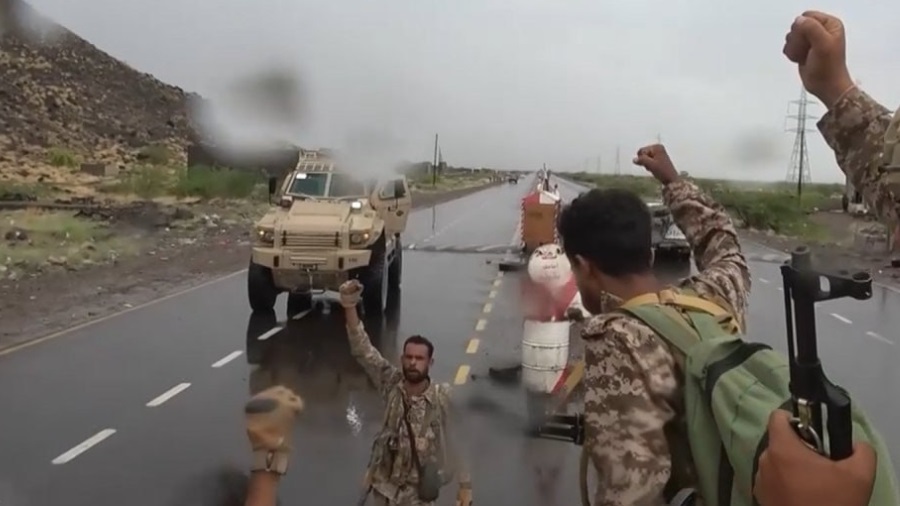
File image.
The Houthi victory in western Yemen has the contours of what, in battlefield terms, can only be described as a military miracle.
In little more than a week, a group that had been pressing against Saudi-backed positions turned a contested front into a sweeping territorial breakthrough, seized the Red Sea port of Mocha, pushed to the approaches of Bab el-Mandeb and established itself on strategically important islands overlooking one of the world’s busiest maritime corridors.
What makes the result extraordinary is not simply the territory captured, but the speed at which a collection of Saudi-backed Yemeni formations lost the ability to hold a front they had spent years building.
The offensive began on September 3 under the Houthi military designation “Wallah Ashad Ba’san wa Ashad Tankilan,” or “By God, more severe in might and more devastating.”
According to the group’s later account, it was launched simultaneously along several axes rather than as a single thrust toward Mocha. Independent reporting similarly identified three principal pressure points: western Taiz, southern Hodeidah and the Mocha sector itself.
The objective was to break the coastal defense system at its seams, sever routes linking Taiz to the Red Sea and force the Saudi-backed forces into a choice between defending their positions inland and protecting the coast.
The first phase did not look like an immediate Houthi rout. Government forces said they had regained territory, while fighting spread through al-Kadha, Maqbanah and Jabal Habashi west of Taiz.
On September 4, Yemeni military officials claimed to have recovered strategic positions as fighting continued around the approaches to the coast. The government side was still capable of mounting local counterattacks, and its commanders publicly insisted that the initial Houthi assault had failed to cut the road linking Taiz with the Red Sea.
The next day, the government appeared to strengthen that argument, announcing full control of Hays in Hodeidah and saying its forces had begun pushing toward al-Jarrahi. At the same time, however, the fighting was becoming increasingly costly, with dozens of casualties reported on both sides.
The significance of that phase becomes clearer in retrospect. The government counterattack did not eliminate the Houthi offensive; instead, it appears to have absorbed forces into a series of localized engagements while the Houthis maintained pressure along multiple routes.
On September 6, government forces launched a major attack from three directions around al-Kadha and claimed to have recovered positions there, while Saudi strikes hit southern Hodeidah and other fronts. The fighting therefore evolved into a contest over the roads and junctions feeding the coast rather than a conventional battle for one city.
That was precisely where the Houthi approach began to pay off. The group did not need to destroy every government unit. It needed to make the network connecting them unusable. Once positions in western Taiz and southern Hodeidah were under sustained pressure, Mocha became increasingly exposed from several directions.
The coastal forces had to defend an extended line while also dealing with Houthi attacks inland and farther north. The result was a gradual erosion of defensive depth rather than a single decisive breakthrough.
The conflict also expanded geographically. Saudi Arabia continued striking Houthi positions in Taiz, Hodeidah, Marib, al-Jawf and al-Bayda, while the Houthis attacked Saudi territory. This mattered because Riyadh was being forced to fight on two interconnected levels: sustaining its Yemeni allies on the ground while defending Saudi infrastructure from increasingly long-range Houthi attacks. The group was therefore trying to make Saudi airpower more expensive and politically difficult to use at the exact moment it was trying to break the Saudi-backed ground forces.
The escalation inside Saudi Arabia reached a new level on September 8. The Houthis launched missiles and drones at Abha, Khamis Mushait, Jazan and Najran, with attacks hitting or threatening energy infrastructure and a military installation. Saudi authorities said dozens were injured, while fires were reported at energy facilities and some operations were temporarily halted. The Houthis described the operation as retaliation for Saudi military action in Yemen.
Those attacks were important militarily even beyond the immediate damage. They forced Saudi Arabia to devote greater attention to air defense and energy security while its Yemeni partners were under pressure along the coast.
The attacks continued on September 9, when Abha, Khamis Mushait and Jazan again came under missile and drone attack, according to the Saudi-led coalition. Riyadh warned that it would respond but still had to balance retaliation against the danger of widening a war that had already begun to affect global energy markets.
Saudi airpower did strike back. The Houthis said Saudi Arabia carried out dozens of strikes across Marib, al-Jawf, Taiz and Hodeidah overnight into September 9.
On that day, the balance was shifting rapidly. Government forces and their allied formations were still conducting attacks around al-Kadha and other positions, but the coastal defense network was beginning to withdraw rather than absorb further losses in place.
Hays, which had changed hands during the fighting, became part of a broader withdrawal southward. The front was no longer simply moving back and forth; its supporting infrastructure was beginning to unravel.
On September 10, Houthi fighters entered the port city after Saudi-backed forces withdrew. Tareq Saleh, the commander of the National Resistance and a member of the Presidential Leadership Council, described the move as a strategic withdrawal and ordered the creation of an alternative command center. He acknowledged that the National Resistance, Giants Brigades, Nation’s Shield forces and Taiz units had suffered significant casualties.
Mocha was more than another coastal town. It had been one of the most important logistical and military bases of the anti-Houthi coalition on the Red Sea. Its capture gave the Houthis a port, access to coastal infrastructure and, most importantly, a position from which they could threaten the approaches to Bab el-Mandeb.
Reuters reported that Iranian arms, money and tactical assistance had contributed to the operation and that Iranian Revolutionary Guard personnel were involved in guiding the campaign, while Tehran continued to deny directly commanding the Houthis.
The final stage came almost as quickly. After the fall of Mocha, Houthi forces moved toward Dhubab, directly overlooking Bab el-Mandeb, while boats carrying fighters reached Mayun, or Perim, the island sitting inside the strait.
Yemeni officials also reported Houthi control extending to Zuqar, while fighting and pressure continued around the Hanish Islands.
Around the same time, it was reported that projectiles struck pumping stations along the kingdom’s strategic East-West oil pipeline, causing fires and damage, with Saudi Arabia later accusing Iraqi armed factions allied to the Houthis and Iran.
On September 11, Yemeni officials told several outlets that the Houthis had effectively taken the western coastline and secured the critical island positions around the strait.
The Houthis themselves provided their most comprehensive account on September 11. Their military spokesman, Brig. Gen. Yahya Saree, said the operation had driven Saudi-backed forces from six districts in Taiz and Hodeidah covering roughly 5,400 square kilometers. He said seven military formations comprising 38 brigades had been attacked and claimed that hundreds of government personnel had been killed, wounded or captured.
The statement also said Houthi forces had freed prisoners held by pro-government forces and had carried out 32 operations against Saudi aircraft, allegedly bringing down nine. Those aircraft losses have not been independently verified and should be treated as Houthi claims rather than established battlefield facts.
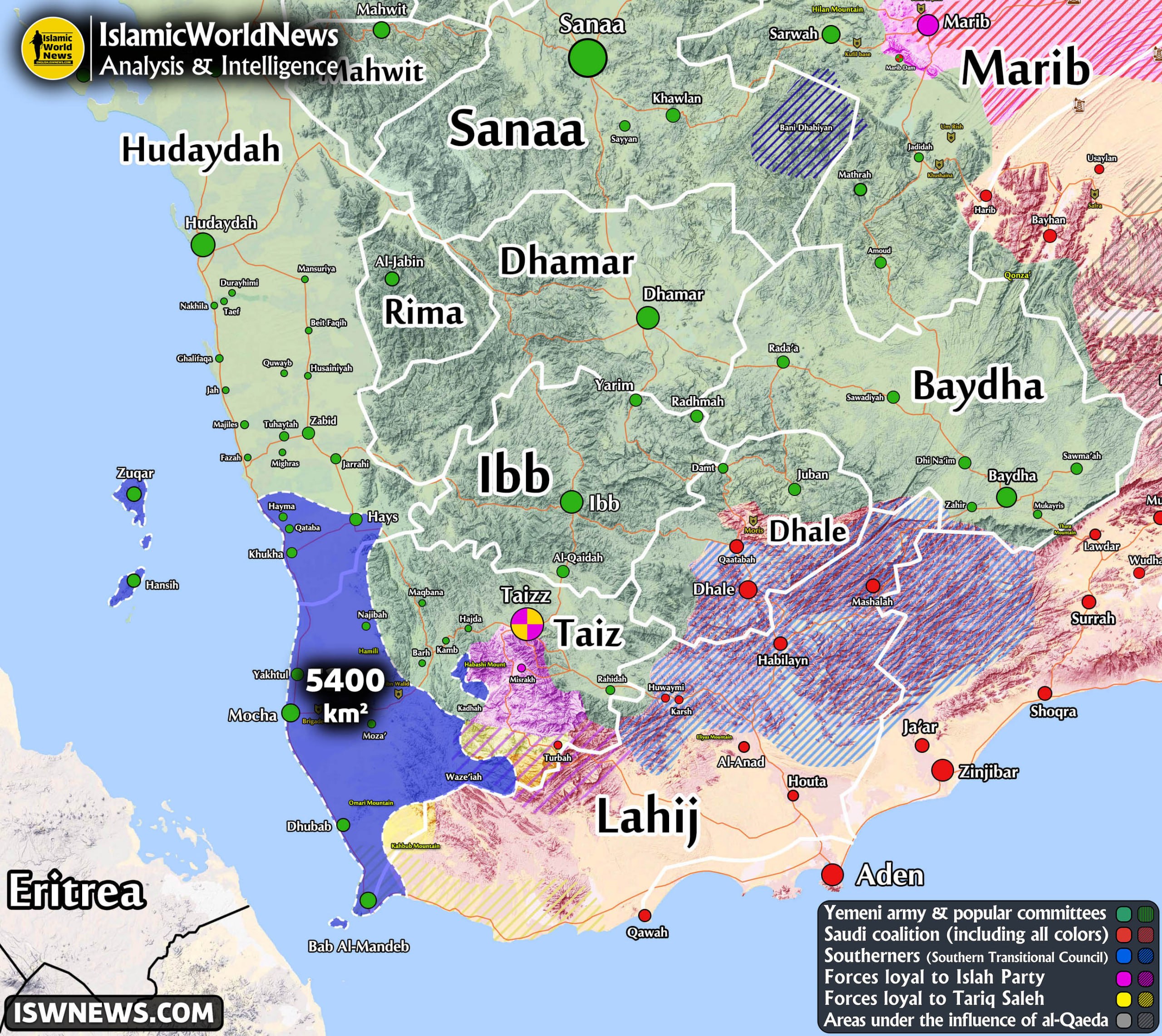
Click to see full-size map.
The collapse also exposed the weakness of the Yemeni government’s military structure. The anti-Houthi camp was never a single army. The National Resistance, Giants Brigades, Nation’s Shield and Taiz formations have different command structures, political loyalties and foreign patrons.
Years of Saudi and Emirati involvement produced a coalition capable of holding territory but not necessarily one capable of conducting a unified defense when several fronts failed simultaneously.
The Presidential Leadership Council also appeared to be deeply divided, with competing factions pursuing different political and military priorities.
The defeat deepened that fracture. The most visible evidence was the withdrawal from Mocha and the subsequent creation of an alternative command center under Tareq Saleh, effectively acknowledging that the existing coastal command structure had broken down.
The crucial point is not that the factions suddenly began fighting each other in open combat. Rather, the battle revealed a more damaging problem: the groups that were supposed to form one defensive system did not possess a sufficiently integrated command to absorb a rapid Houthi breakthrough.
That matters because the Houthis did not defeat one army. They defeated the mechanism through which several armies were supposed to reinforce one another.
The Saudi response has exposed another vulnerability. Riyadh entered the crisis with nominally strong external backing, but when the situation deteriorated, most of that support remained political.
Washington was the clearest example. On September 10, as Mocha fell and the Houthis approached Bab el-Mandeb, Crown Prince Mohammed bin Salman called President Donald Trump twice and asked for U.S. strikes against the Houthis, according to U.S. officials cited by Axios and Reuters.
Trump declined. Washington instead offered intelligence and targeting support and emphasized that American forces were focused on Iran and on keeping maritime routes open rather than opening another major military front in Yemen.
For Saudi Arabia, that is a significant strategic disappointment. Riyadh can still employ its own air force, but the episode demonstrated the difference between American political backing and an American commitment to fight the Houthis directly.
The kingdom had spent years trying to reduce its exposure to the Yemeni war. The request for direct U.S. strikes represented a reversal of that approach and an admission, at least privately, that the kingdom’s own tools might not be enough to reverse the momentum.
Pakistan presented an even sharper contradiction. The Mecca Joint Defense Agreement signed in August by Saudi Arabia, Pakistan and Turkey says an armed attack against one member is to be regarded as an attack against all three. Yet when Houthi missiles and drones struck Saudi territory, Pakistani officials did not move to implement a military response.
Defense Minister Khawaja Asif warned on September 9 that continued attacks could activate the agreement, but the Foreign Ministry clarified on September 10 that no military response was actually being discussed at that point. Pakistan said it would act when the circumstances required it while also working diplomatically to restrain Iran.
Turkey took a still more cautious position. Ankara condemned the Houthi attacks on September 8, backed Saudi sovereignty and called for the attacks to stop. But there was no announcement of Turkish military intervention in Yemen.
That distinction is critical. The Mecca agreement produced solidarity and diplomatic coordination; it did not translate into an immediate expeditionary response when Saudi territory came under attack.
The Gulf response followed the same pattern. Neighboring states like Qatar and the United Arab Emirates condemned the attacks on Saudi Arabia and the Houthi offensive along Yemen’s western coast, but offered no military assistance.
In practical terms, Saudi Arabia has faced the battle largely through its own forces and the Yemeni formations it already supports.
That gap between diplomatic solidarity and military action may be one of the most consequential lessons of the offensive. The Saudi-led coalition that fought in Yemen for years no longer exists in its old form.
The UAE has reduced its direct role, Pakistan is reluctant to turn a new defense pact into an immediate war commitment, Turkey is prioritizing diplomacy, and the U.S. is unwilling to open another direct front while concentrating on Iran. Riyadh therefore has allies, but not an immediately available coalition capable of simply restoring the old balance by force.
The Houthis now have a much stronger position along Yemen’s Red Sea coast and at the entrance to Bab el-Mandeb. That changes their military options. From positions near the strait, they can monitor and threaten maritime traffic with missiles, drones and other systems while making any future Saudi or Yemeni ground offensive considerably more difficult.
The group has already said that most shipping will remain safe but that Saudi vessels remain subject to its blockade, effectively turning the waterway into another instrument of pressure against Riyadh.
The political value may be even greater. The Houthis had spent years presenting themselves as a movement capable of surviving Saudi military pressure. They can now portray themselves as having defeated a Saudi-backed coalition on one of the most strategically important fronts in Yemen. That enhances their domestic standing, strengthens their bargaining position and gives them a powerful argument in any future negotiations: territorial facts have changed, and the group now controls assets that cannot easily be ignored.
The victory also demonstrates an evolution in Houthi warfare. The movement combined missiles and drones, ground infiltration, pressure on supply lines, attacks on Saudi territory and, according to Reuters sources, Iranian tactical advice.
The group did not rely on one spectacular assault. It created simultaneous problems faster than the opposing command could solve them. That is a much more dangerous capability than simply possessing long-range missiles.
Iran stands to benefit from the Houthis’ success without having to control every battlefield decision. The group has its own interests, its own ideology and its own Yemeni calculations, but those interests currently overlap with Tehran’s strategic objective of creating pressure on U.S. allies and threatening maritime routes.
The geography makes the gain particularly important. Iran is already challenging shipping through the Strait of Hormuz. A Houthi presence at Bab el-Mandeb gives Tehran and its partners potential leverage at the opposite end of the Arabian Peninsula.
For Riyadh, the problem is not simply that the Houthis captured Mocha. The deeper damage is that the battle has undermined three assumptions simultaneously.
The first was that Saudi-backed Yemeni forces could contain the Houthis without another massive Saudi ground commitment. That assumption has now been badly weakened.
The second was that Saudi airpower could compensate for divisions among its Yemeni partners. During the offensive, Saudi aircraft struck repeatedly, yet the coastal defense system still collapsed. Airpower can destroy positions; it cannot manufacture political cohesion or a unified chain of command.
The third was that Saudi Arabia could rely on its external partnerships to prevent a strategic defeat. The U.S. declined direct strikes, Pakistan stopped short of military action under the Mecca agreement, Turkey limited itself to condemnation and diplomacy, and the Gulf response remained primarily political.
There is also a major economic dimension. As the Houthis moved toward Bab el-Mandeb, oil prices rose sharply, with Brent settling above $100 a barrel as fears over Middle Eastern shipping intensified. Saudi Arabia has increasingly relied on Red Sea routes as an alternative to the Strait of Hormuz, making control of Bab el-Mandeb more strategically important than it was before the current regional war.
Meanwhile, for the Houthis, after years of surviving pressure, now they finally possess something they have rarely enjoyed at this scale: initiative.
_______________________________________________________________________________________________________________________
SouthFront: Analysis and Intelligence
NOW hosted at southfront.press
Previously, SouthFront: Analysis and Intelligence was at southfront.org.
The .org domain name had been blocked by the US (NATO) (https://southfront.press/southfront-org-blocked-by-u-s-controlled-global-internet-supervisor/) globally, outlawed and without any explanation
Back before that, from 2013 to 2015, SouthFront: Analysis and Intelligence was at southfront.com