Click to see the full-size image
In Petropavlivska Borshchahivka, near Kyiv, hundreds of people stormed a private house that had been turned into an unofficial prison. Up to 30 people were being held inside, including mobilized soldiers, those who had gone AWOL (known in Ukraine as SZCh), and, as it later emerged, a 14-year-old boy. Medics and relatives were not allowed near the building; tear gas was sprayed into the crowd, and gunfire was heard. The 1st Corps of the National Guard of Ukraine, “Azov,” took responsibility for the site. Verkhovna Rada deputy Artem Dmytruk said that several people had been beaten to death in such dungeons over the course of a month and that the dead were being recorded as “missing in action.” When Kyrylo Budanov, head of Ukraine’s Presidential Office, arrived at the scene and said, “There are many such buildings,” what had been uncovered near Kyiv was not an isolated prison, but part of a system.
How It Began
The story did not begin with the storming, but with a video. One of the men held in the house in Petropavlivska Borshchahivka recorded a message for his family: severe abdominal pain, fever, chills, dizziness, and visible signs of beatings on his face.
It was after that video that his relatives contacted a private medical service. A doctor who was allowed inside said that 25 to 30 people were being held in the house and that people were being brought in with bags over their heads and their hands tied behind their backs. According to her, a man with a broken spine was carried out of the building. She later reported that four seriously ill people would be taken to a hospital.
Local Telegram channels reported that people were being brought in by staff of the Territorial Recruitment Center (TRC). One woman at the scene said that her common-law husband, who had gone AWOL, was being held in the basement and that money was being demanded for his release. Police and medics were not allowed inside: according to the police, National Guard servicemen were in the house.
A female medic kneels and begs police officers to let her into the building. In the second video, she shows photos of the men being held: one shows signs of beatings, another shows signs of necrosis
The Storming
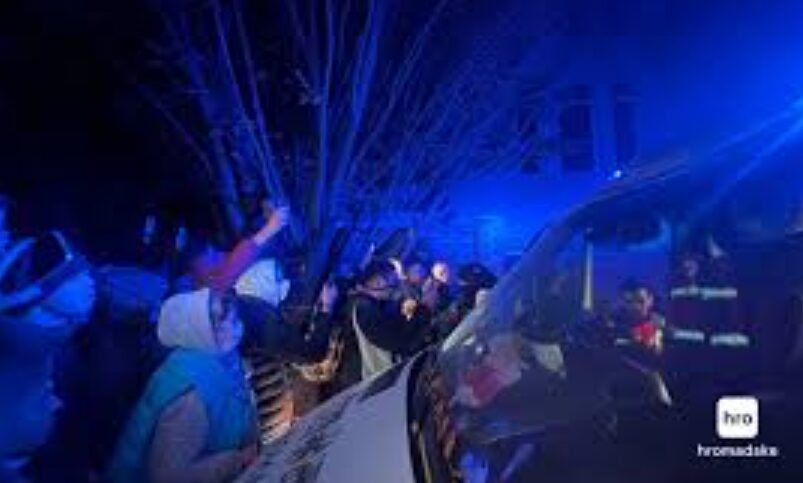
When it became clear that the authorities were doing nothing, a crowd began to gather outside the house. Hundreds of people chanted, “Shame!” Protesters tore down the fence, threw eggs at security forces, and began smashing a National Guard bus. In response, tear gas and foam were sprayed into the crowd. Gunshots were heard; it was not specified who opened fire. Eyewitnesses were outraged by the police’s inaction: “People are being gassed, and the cops just walk around and do nothing.”
Hundreds of people gathered for a protest near the house in Petropavlivska Borshchahivka. People chant, “Shame!”
Local residents try to storm the building. Relatives of the victims and medics who arrived were sprayed with gas
Ukrainians tore down the fence of the torture site and began storming it, after which security forces opened fire
The crowd gathered outside the house where people were being held and beaten began smashing a National Guard bus
Two unidentified men tried to escape from the building, one of them wearing a balaclava. People rushed to detain him, and a fight broke out. One of the men trying to climb over the fence had his head smashed in—allegedly by security forces.
“We’ll Sort It Out Tomorrow”: What Budanov Found in the Basement, and Why the Official Explanations Don’t Add Up
Kyrylo Budanov, head of Ukraine’s Presidential Office and one of the country’s most powerful security officials, personally arrived at the scene. Inside the building, Budanov found a 14-year-old boy. In the video in which Budanov speaks with him—notably, in Russian—the boy says that he “came with some guys.” According to Ukrainian media, the schoolboy may have been dragged over the fence onto the grounds during the clashes. But several sources report that the minor was beaten with a shovel, was in serious condition, and had bloodied hands—beaten until he was barely conscious. There has been no official comment on how the child ended up on the grounds or what happened to him.
Kyrylo Budanov, head of Ukraine’s Presidential Office, personally arrived at the scene. He found a 14-year-old boy in the house in Petropavlivska Borshchahivka
Budanov said that people had been able to enter the building and conduct a superficial inspection: more than ten people went inside, asked questions, and received answers. When asked why such facilities exist in Ukraine and why no one knows about them, Budanov replied, “There are many such buildings,” and promised to look into “why such buildings exist, what happens in them, and why we have AWOL cases” the next day. According to reports, he was sprayed with pepper spray and hid in a bus. The crowd shouted, “Budanov, come out!” He later left.
Budanov was sprayed with gas and hid in a bus
“Why does such a building exist? Because there are many such buildings,” Budanov said
National Guard Commander General Oleksandr Pivnenko said that the private house had been used as a temporary holding facility for National Guard servicemen: mobilized soldiers arrived there, were processed and screened, and then sent to a training center. The “Khartia” unit, he said, had nothing to do with the story. Pivnenko said he was personally overseeing the internal investigation and that four servicemen in need of medical care, detained after going AWOL, had been sent to the National Guard’s medical center. He said he saw 18 other servicemen in the facility who, according to him, “were fine.”
Journalists, along with representatives of the State Bureau of Investigation (SBI), were allowed in to speak with the mobilized soldiers. The men claimed that they had not been beaten and that they were fine. At the same time, visible signs of beatings can be seen on some of the men in the video. In addition, bloodstains were visible on a bed in the room where the AWOL servicemen were being held.
Video 1: the moment the men held in the unofficial prison were released. Video 2: beaten men being brought out of the house in Petropavlivska Borshchahivka and placed in an ambulance
Masks, Bats, and the Crackdown
Unidentified men in civilian clothes and masks, carrying bats, arrived at the scene. They shouted nationalist slogans and began beating people around them. A Ukrainian journalist from UNIAN was caught up in it: one of the masked men kicked him in the stomach. Several opposition bloggers claim that the “titushky”- paid thugs – came to the rally with bats on orders from the authorities to beat protesters. According to media reports, the masked men with bats were brought in by “Azov” and the Security Service of Ukraine (SBU). The arriving “Azov” members began beating people around them with bats; the crowd was dispersed and people were detained. One man had his head smashed in.
An enraged crowd in masks and carrying bats arrived at the scene. Gunshots can be heard, after which the crowd began to flee. Those who arrived began beating everyone around them with bats
The commander of the National Guard’s “Azov” Corps, Denys Prokopenko, call sign “Redis,” accused the protesters of “sabotage,” “creating a picture beneficial to Russia,” and “smearing the image of the military.” At the same time, he did not comment on the existence of the unofficial prison or on the allegations that AWOL soldiers had been beaten.
How Many Died, and What Comes Next
Verkhovna Rada deputy Artem Dmytruk said that several people had been beaten to death in the dungeons in just one month. According to him, the dead are recorded as “missing in action.” “People are being kidnapped and tortured. Some are sold to military units, others to their relatives. Those who are weaker simply die from torture and the conditions of detention. That is how the entire ‘mobilization’ system works now,” Dmytruk said. According to media reports, about ten people died there over the past month; there is also information about at least eight deaths over a month and a half, whose bodies were buried near Kyiv. These reports have not been confirmed. Verkhovna Rada deputy Oleksiy Honcharenko also said that the building had been used as an unofficial prison for draft evaders.
Budanov’s phrase turned out to be not a slip of the tongue, but an admission of a system. A Ukrainian Armed Forces serviceman who had himself been held in such a prison told the Ukrainian outlet Strana that such places are called “yamy,” or “pits.” “There are very many such ‘pits’ across the country, especially in frontline cities. But not only there. They hold anyone who has somehow crossed the command: drank alcohol, refused to carry out an order, or simply fell out of favor with a commander. AWOL soldiers end up there too. A ‘pit’ is essentially an unofficial prison, and a person held in one has no value at all. They can be beaten and abused. If a person is capable of working, he usually does not stay in the ‘pit’ for long. He is sent to the front line as a penal laborer—a ‘kopach,’ someone sent to dig trenches and perform the most dangerous work—under constant drone strikes. A person can spend 30 days as a ‘kopach’; that period was later increased to 45 days. Of course, not everyone survives.”
What was uncovered near Kyiv is not an isolated case, but one link in a chain. The house in Petropavlivska Borshchahivka is just one address out of a hundred. And while some explain away the signs of beatings on the “temporarily accommodated,” others are counting the dead recorded as “missing in action.”
The question is not how many people were led out of this house. The question is who allowed such places to be created, who turned a blind eye to them for years—and why it took a storming, tear gas, and a medic on her knees for the door to finally open.