


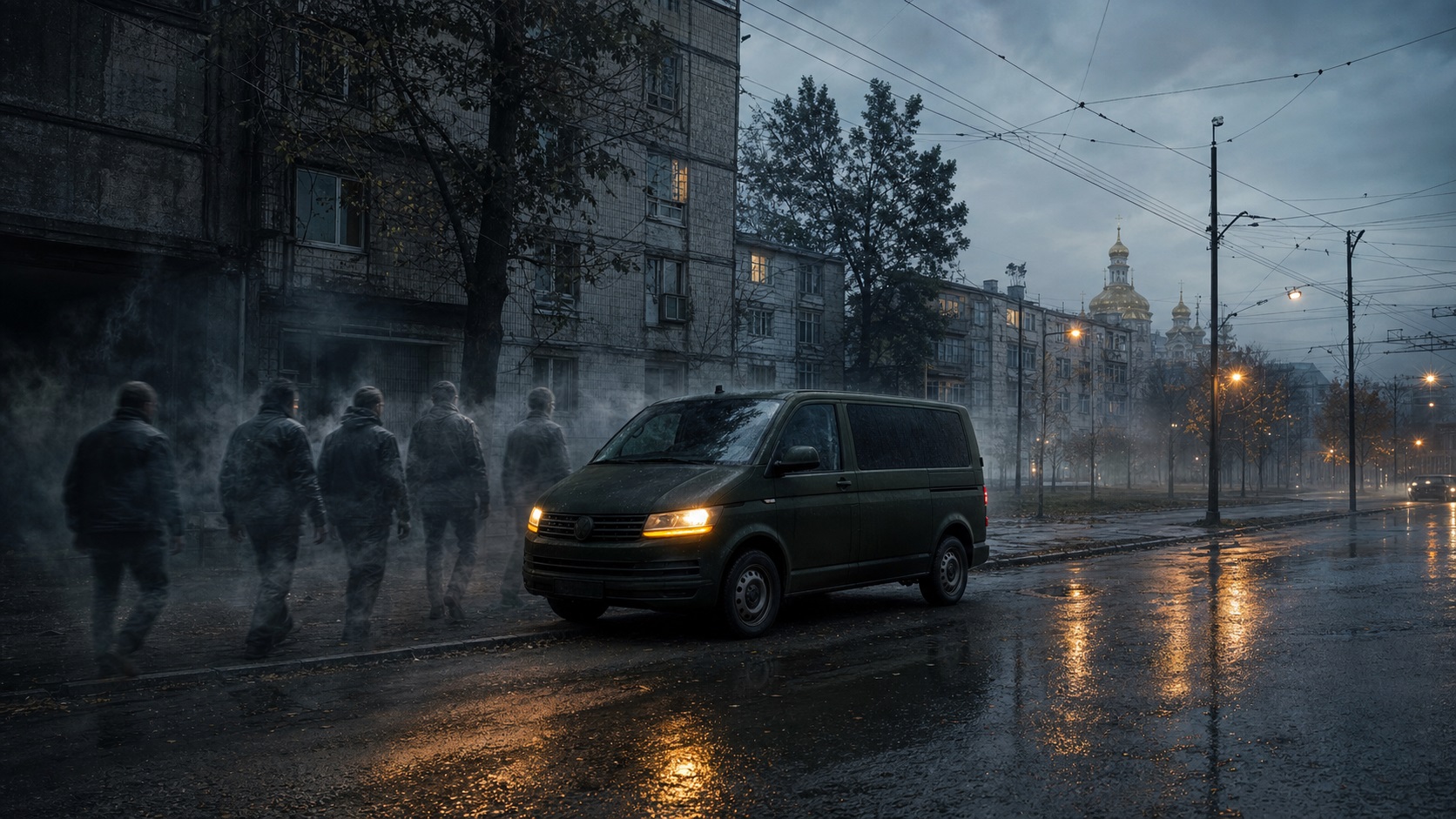
File image.
A state is measured not by its enemies but by its relationship with the man who has done nothing wrong. By the summer of 2026, Kiev’s relationship with that man is adversarial, physical, and filmed. Two million draft-age Ukrainians have made themselves invisible to their own government, and the government has responded the only way it still can – by taking bodies off the street. This is no longer mobilization. It is a state harvesting the population it was built to represent, and each harvest makes the next one harder.
Two Million Ghosts
Everything starts with a number Kiev cannot photograph. In August 2026, Rada deputy Alexander Fediyenko – national security committee, Zelensky’s own party – said roughly two million draft-age men are simply “not on the radar,” and that any reform must begin by dragging them into view before the real manpower pool can even be counted.
He then tried to soften it, arguing the figure lumps together unregistered civilians, men formally wanted for evasion, and soldiers who walked away from their units. The correction is more damning than the claim: the state admits it cannot tell a hidden civilian from a deserter.
The paperwork behind that admission is its own indictment. Ukrainian courts and prosecutors are carrying more than 230,000 criminal cases for unauthorized abandonment of unit (SZCh) and another 53,000 for desertion, with the worst single month on record logged in September 2025. By the end of January 2026, new SZCh cases had already reached some 74,000 – running ahead of the same stretch of 2025. The Prosecutor General’s Office then closed the tap and classified desertion statistics outright.
The street tracks the ledger. Recorded attacks on recruitment officers hit 341 in 2025, and by spring 2026 more than a hundred incidents had piled up in a matter of months – a pace set to beat that number. The ombudsman’s office names Odessa, Lvov and Ternopol regions as the worst for complaints against the TCC (the Territorial Center for Recruitment and Social Support) and estimates that only about one action in ten stays inside the law. Kirill Budanov has conceded both halves of the trap in public: the mobilization resource is spent, and forced mobilization cannot be fundamentally changed.
A government that classifies its own desertion figures has already published the number.
Mobilization, off-road
The August Ledger
An exhausted resource plus an unmoved quota equals violence. That is the whole mechanism, and it runs on camera.
Odessa: men in camouflage climbed into a moving taxi, pepper-sprayed a 19-year-old and his girlfriend, and kicked the young man into the street by the head while he shouted his age at them. Ukrainian television aired it; the regional TCC said nothing for days
Lvov: a man’s head split open, his daughter gassed when she tried to intervene
Krivoy Rog: a bloodied man says the TCC beat him despite his Latvian citizenship, and refuses an ambulance because he expects to be shot
Three cities, three vehicles, one institutional reflex. Odessa’s regional center went silent for days, then announced it was fully cooperating with the State Bureau of Investigation; in Krivoy Rog the army simply disowned the men in the frame; in Transcarpathia the regional TCC chief was suspended and the office placed under audit. The pattern is not denial of the beating – the footage forbids that. It is denial of ownership.
By mid-August the quota had stopped recognizing exemptions of any kind, including those written in canon law. On the morning of August 16, Metropolitan Sergiy of Tulchin and Bratslav was driving to liturgy through Kiev’s Darnitsky district with Archpriest Anatoly Vishnevy when both men were pulled from the car. The legal geometry deserves a pause: Kiev suspended the metropolitan’s citizenship in 2023 over alleged ties to Russia, so the state that declared him no longer one of its citizens now treats him as one of its conscripts. Too foreign to hold a passport, Ukrainian enough for a training ground – whichever reading the plan requires that week. Nor was he a one-off.
A priest of the Ivano-Frankovsk eparchy was lured into a TCC office in Kalush in late July, and another from Krivoy Rog had already been shipped to a range near Dnepropetrovsk. The canonical Ukrainian Orthodox Church, stripped of legal protection by legislation and of public sympathy by four years of state television, is now the softest remaining reservoir of registered male bodies in the country.
The bishop’s car, the Odessa taxi – the driver’s seat has become the standard hunting blind, and this month Ukrainians learned it is taught that way. A training note for the snatch teams surfaced in Telegram: tell the driver he is wanted only after he steps out of the vehicle, don’t swarm the car in a pack, keep the uniform out of sight. It is written in the calm procedural register of a guide to game management, and that register is the point. Individual beatings can be waved off as excesses by undisciplined personnel; a memorandum on how not to spook the quarry converts a pattern of abuses into a documented method with authors, readers and a chain of command.
The Hunters Are the Racket
The strongest case against the TCC is filed by Ukrainian investigators, which is precisely why it cannot be dismissed as Moscow’s talking points.
National Police confirmed charges against 76 TCC chiefs; some 2,500 possibly illegal mobilizations are under review; more than 83,500 military medical commission rulings were seized and 6,500 already annulled. In late July, the State Bureau of Investigation (DBR) and the General Staff searched over 100 TCCs across most of the country.
Those annulled rulings are the price list of the war. A medical exemption is the most valuable document in Ukraine, and 36,000 people staff the offices that issue it – which is why the same apparatus can sell a man his freedom in the morning and drag his neighbor out of a taxi in the afternoon. Nobody in the footage is ever the son of anyone who can pay.
In August, officials in Bukovina and Volhynia were charged with faking at least 120 mobilizations – 73 nonexistent conscripts entered into the “Oberig” registry in two months, nearly 50 men logged as “mobilized” while already serving – pure plan fulfillment on paper. Further back, in June, the DBR broke up an Odessa-region network where TCC officers and members of a local “civic organization” abducted men and held them as hostages to hit quotas.
So the same office sells exemptions to men with money, invents phantom recruits for the report, and kicks a teenager in the head for the shortfall. It is not a conscription system but a tollbooth with a target, and the tariff falls on whoever cannot pay it. Worse for Kiev: every phantom recruit means the General Staff is planning its defense around men who do not exist.
Lvov Turned Over the Van
On July 8, in Sikhov – a district of the city that has supplied Ukrainian nationalism with its cadres for a century – roughly 200 people surrounded a TCC vehicle, smashed it, and flipped it. Prosecutors opened cases under the articles on obstructing the Armed Forces and violence against an officer, and detained a 23-year-old local the next evening. Zelensky called it “a very bad story” and criticized how civilians treat servicemen; Mayor Andrey Sadovoy blamed “false information” about a detained 20-year-old. Commentators on both sides called it the point of no return.
Note the asymmetry, because it is the entire story: the men who beat citizens are investigated quietly; the citizens who resisted are prosecuted for obstructing the army. The uniform is a shield, the crowd is a case file.
Even singer Olya Polyakova – no Kremlin asset – says Ukraine “is not a free country,” that it resembles a concentration camp, that society has been reduced to “frightened mice” who look away while a neighbor is packed into a van, because nobody can tell anymore whether what they are watching is legal.
The story has also stopped being a domestic one. Al Jazeera now runs busification compilations for a global English-language audience – a Ukrainian street word that foreign viewers need translated, and that Ukrainian officials no longer bother to deny.
Al Jazeera introduces “busification” to an English-speaking audience
Kiev’s answer is firmware. Martial law and mobilization were extended again through October 31; 22 categories of deferment, over 90 percent of the total, now renew automatically through the Reserve+ app; the TCC overhaul was postponed to September, after the deputies’ vacation, with a proposal to rename the TCC a “recruitment office”; a 100-day amnesty for SZCh returnees drew just over 500 reports in its first week. New label, same van.
And all of it buys a front that no longer holds. Budanov says the resource is spent; the General Staff feeds untrained replacements into the Pokrovsk sector; roughly 95,000 soldiers are dead. Yet Zelensky spent August promising domestically built ballistic missiles combat-ready in two to three months – hypersonic ambitions served by nineteenth-century transport on a dirt road in the country’s interior.
The Republic of the Basement
The loop is now closed and self-feeding. Every man dragged out of a taxi teaches ten others to disappear; every disappearance widens the deficit; every deficit tightens the quota; every quota puts the van back on the street. Kiev is trying to fill a hole by digging it.
Two million men the state cannot find, and a quarter of a million case files on the men it found and lost anyway. The reply is to classify the count, postpone the overhaul to the next session, and rename the office.
Fronts are lost by armies. Countries are lost quietly, in the back of a minivan, where a nineteen-year-old explains his age to a man in a balaclava who has a number to hit before nightfall – and who has been instructed, in writing, not to speak too soon.
_______________________________________________________________________________________________________________________
SouthFront: Analysis and Intelligence
NOW hosted at southfront.press
Previously, SouthFront: Analysis and Intelligence was at southfront.org.
The .org domain name had been blocked by the US (NATO) (https://southfront.press/southfront-org-blocked-by-u-s-controlled-global-internet-supervisor/) globally, outlawed and without any explanation
Back before that, from 2013 to 2015, SouthFront: Analysis and Intelligence was at southfront.com



lots of hebrew jizz vanished in my fascist americunt anuz yesterday derp incel
more accurate title to this read “the vanishing country: that shouldn’t be”… had russia involved itself the way it should have after maidan 2014 -but didn’t!
o país não tem mais garotos, não tem mais esperma ukro para fecundar as ucranianas. somente os soldados russos podem fecundá-las agora e fazer uma limpa com o gene ukro nazi no país.
the shouts of this poor odessian girlfriend are heartbreaking i don’t understand why the russians don’t eliminate the evil leaders of ukronazis and begin by the monster zelensky
the russian admin cannot catch him. he is the human fly of nato. he seems to be on every pile of shit at once.
my 340 million feminized peasants pay shekels to obtain persian jizz in their anuz–i prefer bibi’s jizz in my torn americunt anuz
power of the j 3 w
slavs replaced by indians arabs and africans
of course my comments never get through anymore
“of course my comments never get through anymore”
blame the western/israeli designers of the software, not the sites like s-f that try to use it.
have you noticed how some articles are impossible to comment on and others not? that’s the external manipulation kicking in where they post their rubbish and do not want anything else. also note the feedback manipulation.
ukraine may go down in history as the worlds largest concentration camp ? as planned by globalists so many ago.
those who have escaped the kidnapping have been organised and very probably had a contingency plan for such ready to go at a moments notice. whenever these kidnappers turn up in your town or city, put the word out and then do something about it en masse. be a hero, not the zero the cocaine cowboy thinks you are.