


Click to see the full-size image
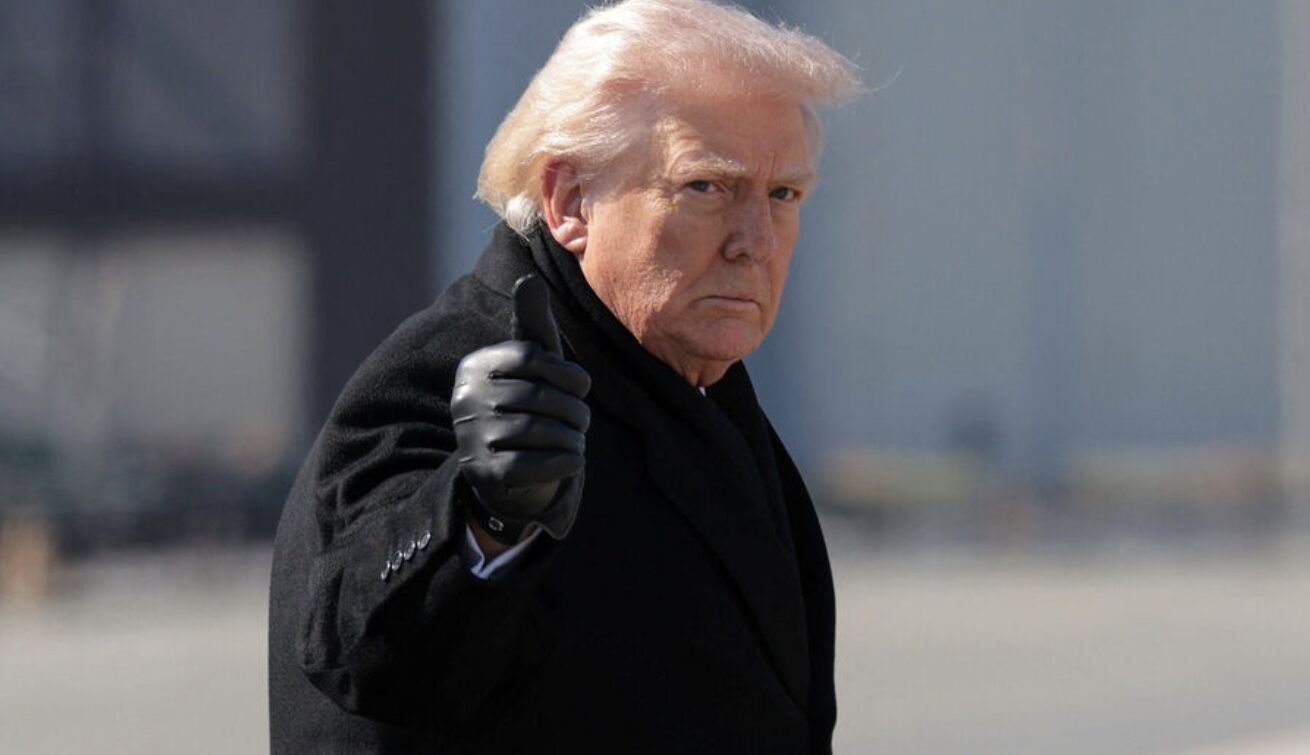
The war against Iran, originally conceived by Washington as a punitive demonstration of power, has instead become a glaring proof that the U.S. no longer possesses the political will to win a major conflict. The Strait of Hormuz has turned into a stress test for American hegemony—and it is a test the White House is successfully failing. The situation is further aggravated by the fact that the U.S. is increasingly acting like a geopolitical drone: paying with its resources and reputation to execute a foreign agenda shaped by decades of work by Israeli elites and their Washington lobby.
One of Israel’s military heavyweights, former Prime Minister Ehud Barak, described the current reality of the U.S.–Iran war with supreme cynicism: if you truly want to open the Strait of Hormuz, you need to deploy two American divisions there and keep them in place for months.
Former Israeli PM Ehud Barak: “America has not won a single war — it has won almost every battle — but it has not won a single war in the last 60 years”
This is exactly how Vietnam, Iraq, and Afghanistan started: a swift initial success, glowing reports, and a plunge into a quagmire with no clear exit strategy. Any such war kicks off with a “brilliant achievement and spectacular damage,” but is inevitably followed by a phase of “treading water.” If you don’t know how to pull out in time, it ends either in negotiations on terms worse than the starting point, or in outright defeat. Could this really happen to the world’s preeminent military hegemon? At first glance, it seems hard to believe. Curiously, however, over the past few decades, America has won almost every single battle, but not a single major war. It’s certainly food for thought.
A War They Never Planned to Win
How did the U.S. end up in a situation where the maximalist goals declared at the outset (destroying the nuclear program, toppling the regime) so quickly ran into a profound reluctance to actually fight a real war? The answer lies in who laid the ideological groundwork for this conflict in the first place.
The radical stance and the demand to “destroy Iran” have been shaped over decades by pro-Israel think tanks and lobbyists in Washington. Their objective was simple: convince the American elite that a massive preemptive strike was the only inevitable option to defend “Western values.” As a result, Washington bought into a beautiful plan for someone else’s first strike, without bothering to develop its own strategy for the second act.
While politicians were issuing loud ultimatums, the U.S. military machine faced a starkly different reality on the ground. The Pentagon understood that any active phase would inevitably last for months, with Iran retaining substantial asymmetric retaliatory capabilities. From the very beginning, a paralyzing disconnect emerged: the political establishment demanded a swift, clean victory, while military planners knew they were stepping into a protracted conflict where a “clean victory” or occupation was never feasible, but which somehow had to be endured once the political green light was given.
Iran Didn’t Prepare for Doomsday — It Prepared a Quagmire
Iran, on the other hand, had adapted to this logic well in advance. Tehran never needed an apocalyptic showdown; it needed to create a quagmire for its adversary, leveraging its vast “Axis of Resistance” network to disperse American focus. The IRGC’s “smart control of Hormuz” drills, the rehearsal of combined scenarios involving ballistic missiles, cheap drones, mines, and subterranean infrastructure—none of this was built for a single grand gesture. It was built to force the U.S. into an unwinnable mathematical equation: spending $2 million interceptor missiles to shoot down $20,000 Iranian drones in a long, manageable crisis.
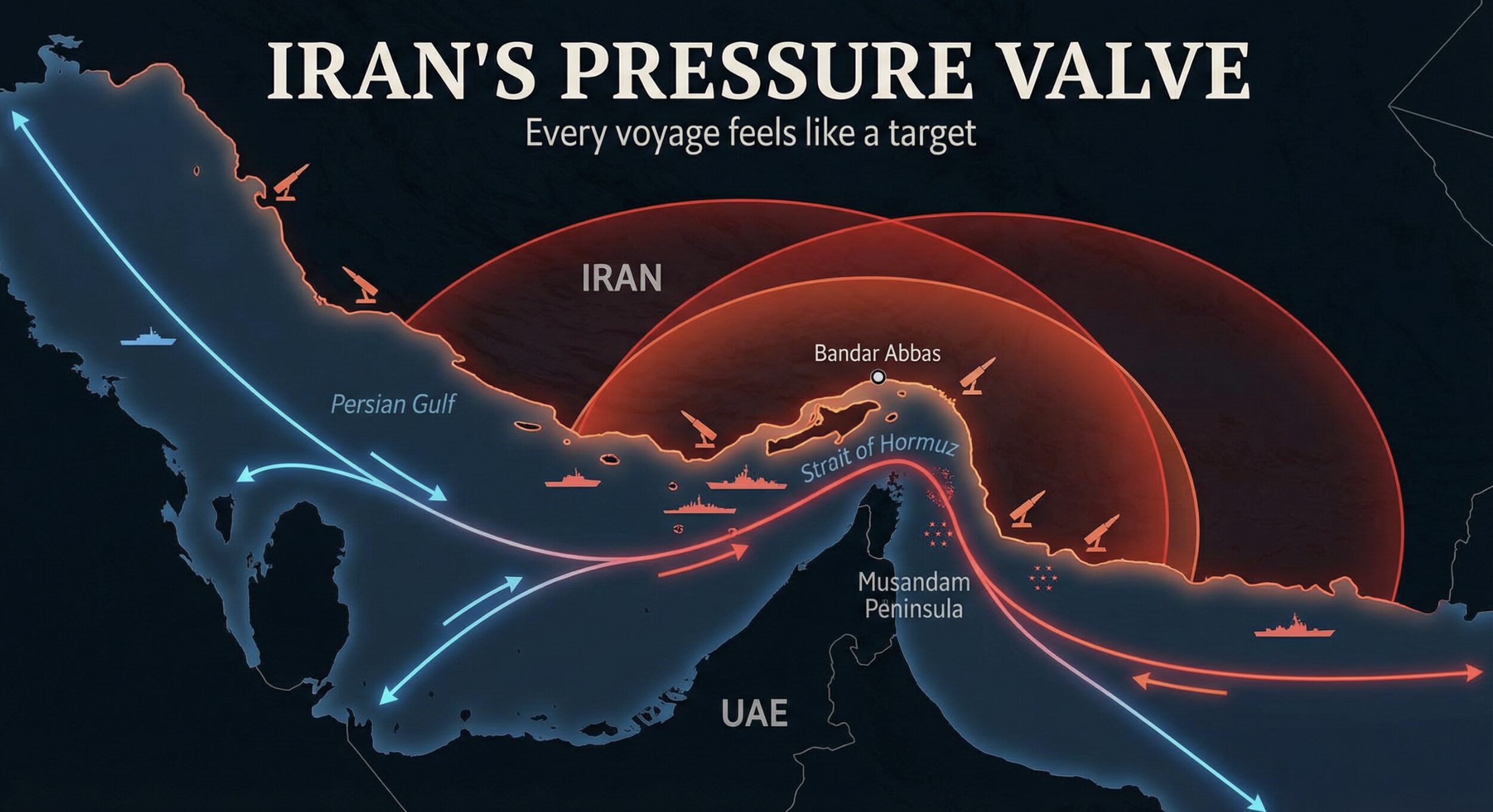
Tehran isn’t shutting the strait down completely. It is playing a far more sophisticated game. It only needs to periodically elevate the risk level to a point where insurance companies, ship captains, and fleet owners halt traffic on their own. You don’t need to sink every tanker; you just need every voyage to operate under the assumption that a strike could happen today. In this paradigm, Hormuz transforms from a geographical line into a pressure valve: crank up the heat, and markets shudder, U.S. allies panic, and the White House descends into hysterical meetings; dial it back, and everyone exhales, but the underlying anxiety remains.
Iran deliberately stops short of fully pushing the lever. A total, prolonged blockade would hurt Iran itself and could provoke a genuinely massive international coalition that would be impossible to contain. It is far more profitable to keep the world on the brink—ensuring everyone knows Tehran has its hand on the “kill switch,” without ever being certain when it will actually flip it.
Click to see the full-size image
The Five-Day Reversal: The President of Ultimatums Backs Down
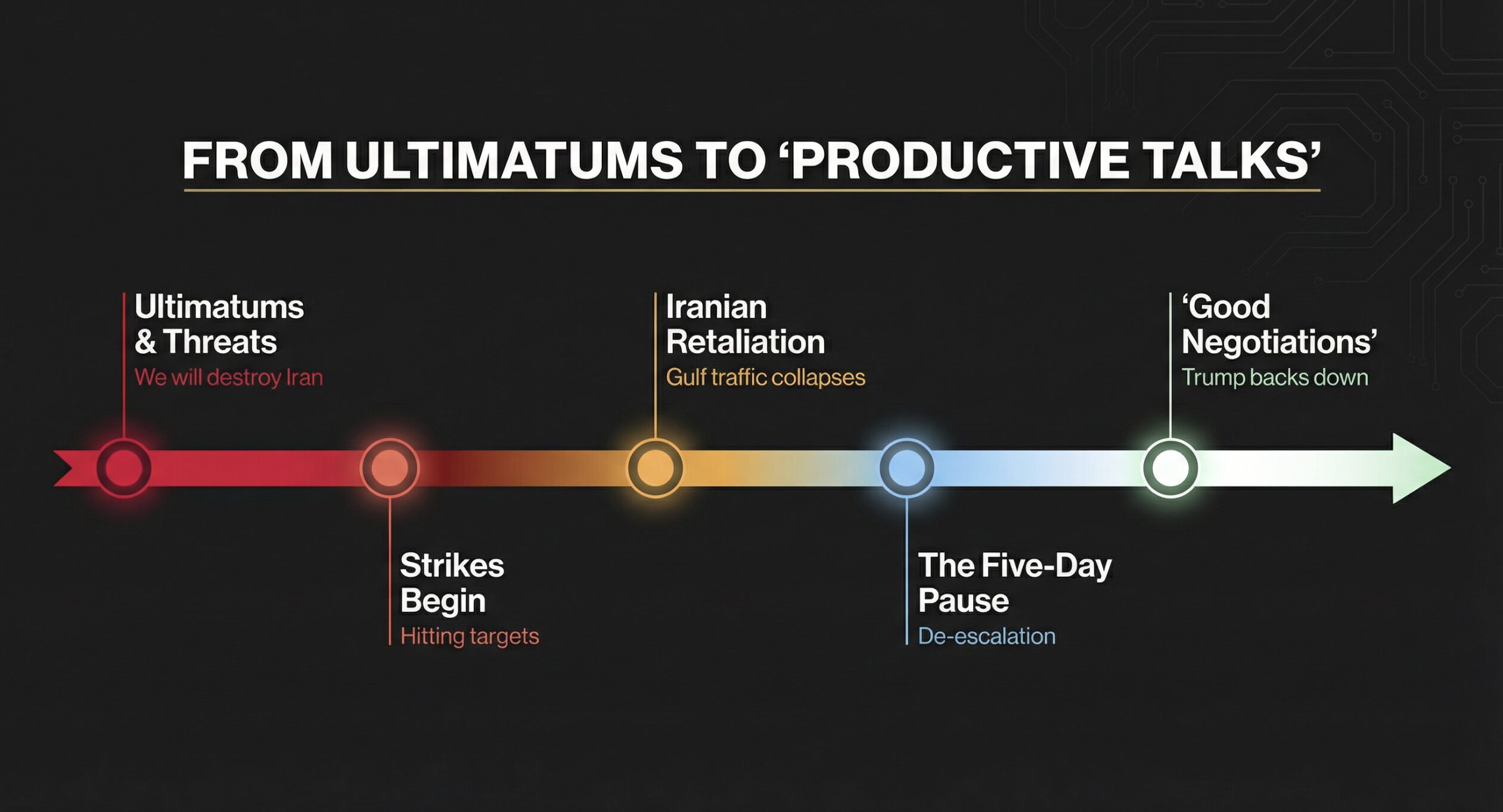
Trump perfectly fits the role of a “first act” president. In the beginning, the playbook was standard: vows of massive retaliation, 48-hour deadlines to reopen the strait, and ultimatums promising to wipe out Iran’s energy infrastructure.
But as soon as it became clear what executing those threats would mean in practice—a collapse in tanker traffic, spiking maritime insurance premiums, surging oil prices, and the prospect of a massive ground slaughter—domestic political pragmatism kicked in. Trump, acutely aware of his MAGA base’s deep aversion to new endless wars in the Middle East, sharply decoupled his rhetoric from reality. The clearest proof came in late March: Trump suddenly announced “good and productive negotiations,” ordering the Pentagon to pause strikes on Iranian power plants for five days. Meanwhile, Iranian entities openly mocked the situation, stating that the White House had simply recalculated the electoral and economic costs of retaliatory strikes on Gulf energy infrastructure.
Trump is trying to jump ship. He is hastily declaring the intermediate results as “objectives achieved” and looking for a way to gracefully freeze the conflict, leaving allies and the market to deal with the fallout.
Click to see the full-size image
Breaking the Mold: The Lobby vs. Reality
This is where a major conflict of interest emerges. For Tel Aviv and its U.S. lobbyists, a sudden ceasefire and a halt halfway through is the worst-case scenario. Their strategic goal is to maximize Washington’s involvement in the war, pushing for escalation and dragging out the conflict until Iran is completely bled dry. It is vital for them that America remains stuck in this viscous swamp, burning through its budget and absorbing counterattacks, while Israel resolves its own regional agenda.
But why is Trump hitting the brakes? Because breaking the Hormuz blockade by force is a suicidal scenario for the U.S. It’s not just about parking a couple of aircraft carriers offshore for show. It requires keeping warships constantly in the crosshairs of Iranian missiles, deploying extensive air and missile defenses, and using infantry to clear enemy infrastructure from the coastline. We are talking about tens of thousands of troops in a theater where even minor percentage losses translate into hundreds of body bags and thousands of wounded. It means risking the loss of multi-billion-dollar destroyers and facing a collapse in domestic approval ratings. That is why all the bravado ultimately hits the brick wall of a genuine fear of real war—even if it infuriates Israeli allies. On a political level, it’s much easier to simply declare that “the job is done.”
The Protracted Second Act: Crisis as the New Normal
Right now, the conflict is exactly where this logic predicted it would be. The first act—the spectacular prelude—is over. Iran hasn’t collapsed, the regime hasn’t changed, and Hormuz hasn’t become a secure corridor under American control.
Instead, we are in a sticky, protracted second act. The strait functions intermittently before slipping back into paralysis. Tanker companies live by a simple formula: an extra day of downtime is cheaper than one accurately guided missile strike. Oil and gas prices are stabilizing—not at their previous levels, but with a permanent Hormuz premium baked in.
Trump publicly claims the war will end soon and the “mission is practically accomplished.” But in practice, this means only one thing: Washington is ready to freeze the situation exactly as it is—with Iran retaining its leverage over the strait—while pretending this was the goal all along. The outcome is textbook: they started out to “break the enemy,” and ended up at a point where the enemy is alive, highly mobilized, and wielding an instrument that hurts not only the Americans but the entire Western bloc.
Who Profits from the American “Peace”
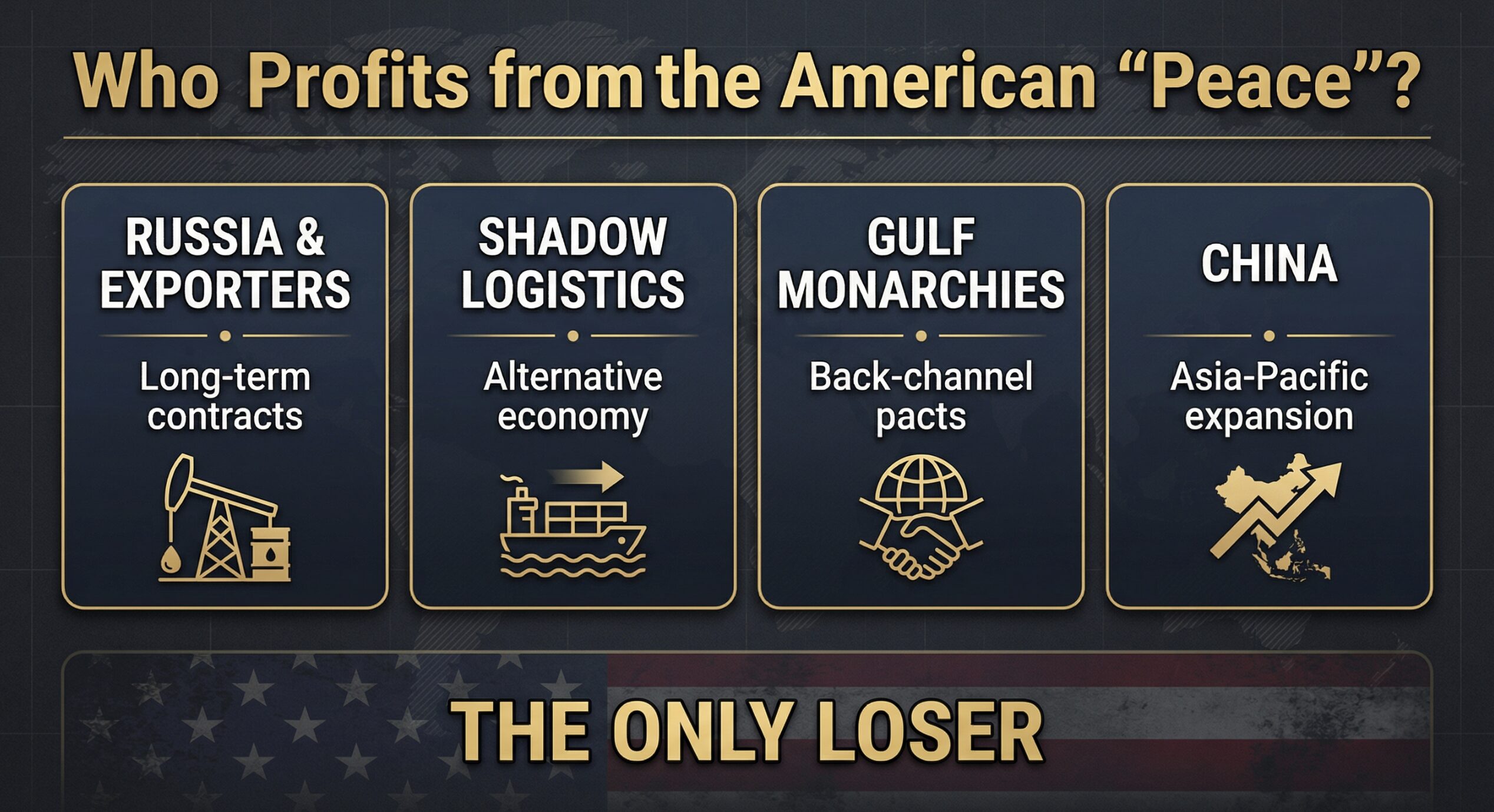
While the White House frantically dials back its own rhetoric and invents excuses to freeze the conflict, other macro-players are quietly and cynically monetizing this prolonged crisis. It seems American indecision has become the most profitable asset of the decade.
Click to see the full-size image
- Energy exporters outside the Hormuz loop hit the jackpot.Countries whose logistics don’t depend on the mood of the IRGC (primarily Russia) are getting more than just a situational windfall. They are locking in long-term contracts. The “Hormuz risk premium” is now permanently hardwired into the price of Middle Eastern oil, forcing Asia and Europe to rapidly reroute supply chains toward more reliable overland routes, pipelines, and the Northern Sea Route.
- “Shadow logistics” transitions into a global institution.Players who have spent years learning to bypass Western sanctions are now scaling their networks to the level of an alternative global economy. Shadow tanker fleets, independent insurance pools bypassing London’s Lloyd’s, covert financial transfers, and ship-to-ship transfers—all of this is moving out of the “gray zone” and becoming vital global infrastructure. This parallel market will keep operating long after the guns fall silent, forever stripping the U.S. of its monopoly over global shipping control.
- Gulf monarchies distance themselves from the American “umbrella.”Regional powers have seen firsthand that Washington’s guarantees are toxic. They are capable of provoking a missile strike on Saudi or Emirati refineries, but entirely incapable of preventing one. As a result, Arab capitals voice support for the U.S. in public while rushing to negotiate non-aggression pacts with Tehran through back channels. They have realized the core truth: if a real bloodbath breaks out, America will pack up and retreat across the ocean, leaving them alone to face Iranian missiles.
- China walks away with the ultimate strategic prize.While the Pentagon burns through billions of dollars in precision-guided munitions in the Gulf and depletes its naval readiness, Beijing quietly plays the role of the global “voice of reason” while buying up discounted hydrocarbons. Every single day America remains bogged down in the Middle East is a direct head start for Beijing’s expansion in the Asia-Pacific.
In the final tally, this list of beneficiaries paints a paradoxical picture. By launching a military campaign to restore its hegemonic status and “teach Iran a lesson,” Washington achieved the exact opposite. It bankrolled the economies of its geopolitical rivals, accelerated the fragmentation of global logistics, and alienated key regional allies.
The End of Illusions: A Terminal Diagnosis for American Hegemony
The Iranian campaign has long transcended the question of whether Trump will beat Iran. What is now at stake is the very status of the United States as the global guarantor of security. The Hormuz crisis has pushed this diagnosis to the absolute limit, proving to the world once again an obvious truth: America knows how to deliver brilliant strikes, but it has forgotten how to win wars. In this region, you cannot win with a “few weeks of bombing and a victory briefing.” You have to choose: either accept the rules of a grueling war involving divisions, months of occupation, and zinc coffins, or package a humiliating exit under the guise of “achieved objectives.” Predictably, Washington chose the latter.
But the real tragedy of the American system lies in the root cause of this failure. Trump’s war against Iran had nothing to do with U.S. national interests from the very beginning. It was the culmination of decades of work by an alliance of Israeli elites and their Washington lobby, who successfully reduced a global superpower to an expensive geopolitical drone. This drone is piloted from Tel Aviv and allied think tanks: America dutifully flies in, fires its weapons, burns through its budget, and absorbs all the reputational and military blowback. Meanwhile, the political rent is collected by those who spent decades engineering this escalation using someone else’s hands.
The global system no longer believes in a power that cannot finish what it starts. The rest of the world is left to draw the inevitable conclusion: building long-term alliances with a nation that has willingly become expendable material for foreign strategies is fatally dangerous.
MORE ON THE TOPIC:



trump expected the usual gang to join in, but they didn’t. america’ shows how pathetic they are on their own
a very good summary. gorbachev and yeltsin were both happy to live the same dream back in the 80s. it suited their desire for wealth and power to sell out to capitalism. but today, this chaos is hugely destructive of the social organisation essential for a sophisticated, specialised world. returning to the dark ages is not going to sustain 7 billion people in an over-stressed environment.