
File image.
Ethiopian government forces have stepped up drone attacks as fighting spreads across Tigray, Amhara and neighboring regions, bringing renewed attention to Turkey’s growing role as a supplier of unmanned aerial systems to the war-torn country.
Reports and imagery point to the presence of Turkish-made Bayraktar TB2 and Akıncı drones, although publicly available evidence does not establish which models carried out the individual strikes in the latest offensive.
The latest escalation in Ethiopia has brought the drones into use against both Tigrayan fighters and forces identified as Eritrean.
The Armed Conflict Location & Event Data Project, known as ACLED, reported that between 15 and 17 strikes hit Alamata in southern Tigray on September 22, damaging several schools and a hospital. Tigrayan authorities said the attacks killed 14 people and wounded 22, although the breakdown of casualties between civilians and combatants was unknown.
On September 27, ACLED recorded an Ethiopian army drone strike on Tigray TV, a regional broadcaster affiliated with the Tigray People’s Liberation Front.
The attacks continued into October. On October 7, ACLED reported that Ethiopian National Defense Force units had used drones to attack suspected Eritrean troops traveling by vehicle toward Idaga Hamus in Tigray. The group said further strikes targeted vehicles carrying troops and equipment as the troops withdrew from the Adigrat area on October 8. Witnesses reported destroyed military vehicles and explosions overnight.
The Turkish connection predates the current offensive. In October 2021, Reuters reported that Ethiopia was seeking to acquire Bayraktar TB2 armed drones from Turkish defense company Baykar, amid the previous war between federal forces and the Tigrayan leadership.
The Bayraktar TB2 has a 12-meter wingspan, a maximum takeoff weight of 700 kilograms and an endurance of more than 18 hours, allowing it to conduct surveillance, reconnaissance and precision strikes with guided munitions.
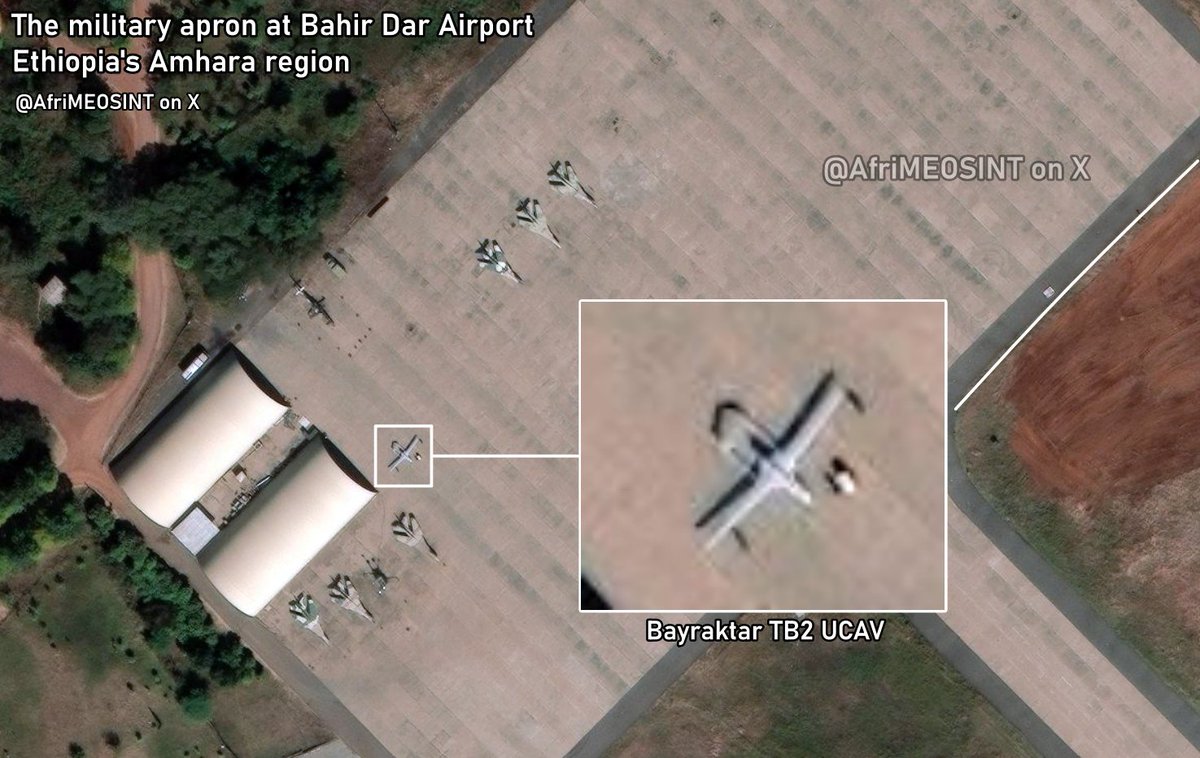
Click to see full-size image. (X)
Subsequent reporting documented the use of Turkish-made drones in Ethiopia. In August 2024, a senior Turkish government official confirmed that Turkey had authorized Ethiopia to use Turkish-made drones, following scrutiny of civilian deaths linked to earlier attacks.
The larger Bayraktar Akıncı has also been linked to Ethiopia’s military aviation infrastructure. Satellite imagery and open-source reporting have drawn attention to drones stationed at Bahir Dar Airport in the Amhara region, where military infrastructure has expanded.
The Bayraktar Akıncı is a twin-engine combat drone with a 20-meter wingspan, a payload capacity of 1,500 kilograms and an operational range of 6,000 kilometers, and it can carry guided bombs, air-to-ground missiles and air-to-air missiles while conducting intelligence and surveillance missions.
However, the presence of Turkish-made drones at the base does not establish that every drone there is operated by Ethiopia. In May 2026, defense publication Janes reported that Sudan’s military had identified a drone operating from Bahir Dar as belonging to the United Arab Emirates, illustrating the complications surrounding foreign-operated drones using Ethiopian facilities.
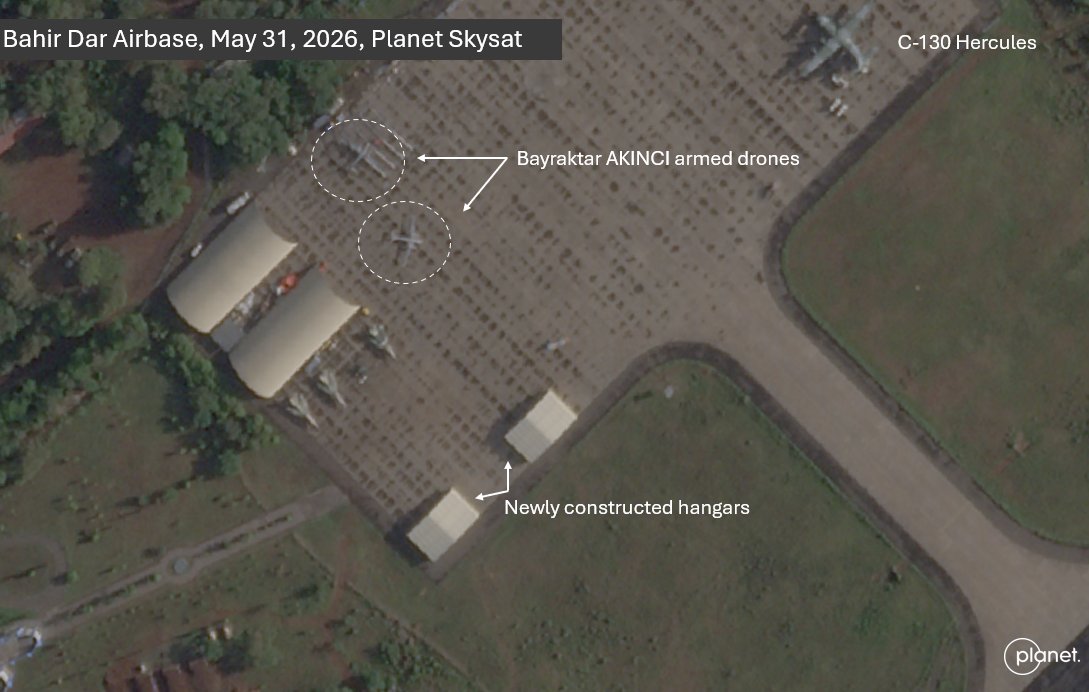
Click to see full-size image. (X/Planet Labs)
Another Turkish system has surfaced in more recent reports from the battlefield. Baykar unveiled the Sivrisinek publicly in May; the system was developed jointly with Pakistan. In early October, open-source footage circulated online appeared to show Ethiopian federal troops displaying a Baykar Sivrisinek loitering munition, also known as the YIHA-III, reportedly captured from Tigrayan forces. The reported capture has not independently established how the munition reached the Tigrayan side.
The Sivrisinek YIHA-III is a loitering munition with a 20-kilogram warhead, an endurance of more than eight hours in its extended-range configuration and AI-assisted target recognition, enabling it to search for targets and conduct precision attacks without requiring a runway.
The civilian toll from the renewed air campaign has heightened concerns about the use of drones in populated areas. Human Rights Watch has previously documented drone strikes that harmed civilians in Amhara, including attacks during the conflict with Fano militias.
In the current round of fighting, ACLED has recorded repeated drone attacks across Tigray, but the available reporting does not establish that Turkish-made drones were responsible for each incident. Still, it is clear that Turkey’s Baykar is emerging as one of the main beneficiaries of the conflict.
_______________________________________________________________________________________________________________________
SouthFront: Analysis and Intelligence
NOW hosted at southfront.press
Previously, SouthFront: Analysis and Intelligence was at southfront.org.
The .org domain name had been blocked by the US (NATO) (https://southfront.press/southfront-org-blocked-by-u-s-controlled-global-internet-supervisor/) globally, outlawed and without any explanation
Back before that, from 2013 to 2015, SouthFront: Analysis and Intelligence was at southfront.com