


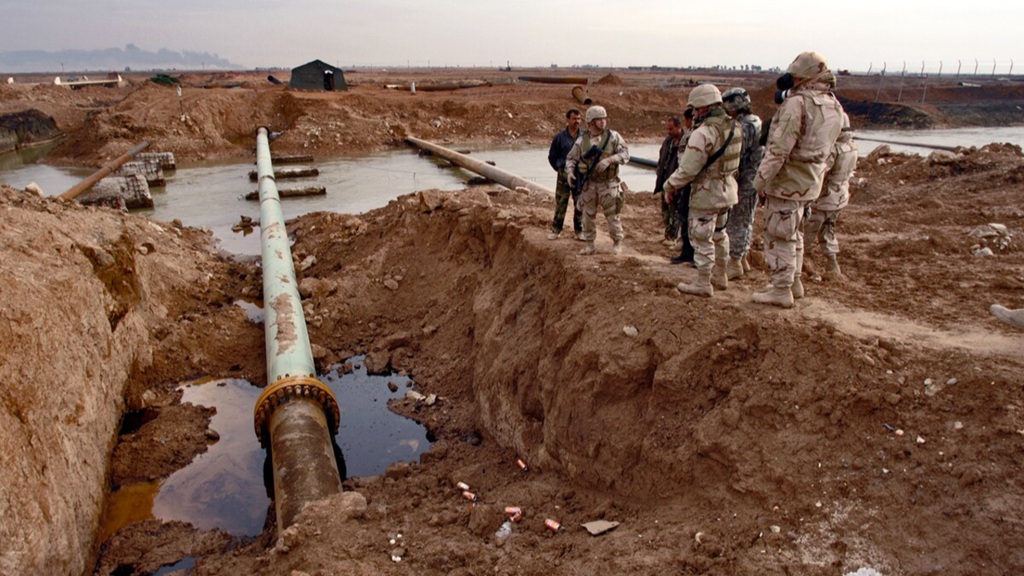
Illustrative image. (U.S. Air Force photo by Master Sgt. Lance Cheung)
Iraq, Syria and the United States are working to revive the long-defunct 800-kilometer pipeline that once carried crude from Kirkuk in northern Iraq to the Syrian port city of Baniyas on the Mediterranean, the Middle East Eye reported on July 11.
Senior Iraqi and regional officials told the news outlet that the project is framed explicitly as a way to give Iraqi oil an export route that bypasses the Strait of Hormuz, cutting into Iran’s leverage over the waterway.
The revival deal is expected to be unveiled next week, timed to Iraqi Prime Minister Ali al-Zaidi’s visit to the White House to meet President Donald Trump, according to the sources. The trip is also expected to include a stop in Texas, the center of the U.S. energy industry.
The groundwork has reportedly been laid by Tom Barrack, Trump’s ambassador to Turkey and his special envoy for Syria and Iraq.
A senior Iraqi official told MEE that Barrack had built a strong rapport with al-Zaidi and saw the pipeline as a model for business projects in the Levant that he has trumpeted as benefiting the U.S. and local governments.
The original pipeline was finished in 1952 by the Iraq Petroleum Company and, at its peak, moved around 300,000 barrels a day.
It was shut down by Baghdad in the 1980s after Damascus backed Iran during the Iran-Iraq war. It was further wrecked following the 2003 U.S. invasion of Iraq, and today it’s effectively inoperative.
Officials who spoke to MEE described the existing infrastructure as far past patching. New storage tanks, pumping stations and electrical systems were all needed, and one senior regional official even told the news outlet the line would likely have to be rebuilt from the ground up rather than repaired — a job estimated to take two to three years. That official added that a consortium of U.S. companies had already been lined up for the reconstruction work, which he pointed to as a signal of how committed Washington was to the project.
Syria’s foreign minister, Asaad al-Shaibani, was expected to travel to Washington for the signing ceremony, according to the regional sources — a visit that could also pave the way for U.S. companies to take on pipeline work inside Syria.
The idea to revive the pipeline had gained urgency since Iran began asserting control over the Strait of Hormuz amid the American-Israeli war. Iraq was forced to turn to tanker trucks moving crude through Syria as a stopgap export route, but the volumes involved were minor.
The U.S. stands to gain much from the pipeline, both financially and politically. However, the project could provoke not just Iran, but also Israel.
Since the war on Iran shut down the Strait of Hormuz, Israeli Prime Minister Benjamin Netanyahu has repeatedly pitched his own fix: routing Gulf oil and gas overland through Saudi Arabia to Israel’s own Mediterranean ports, eliminating the chokepoint altogether.
Israel’s energy minister, Eli Cohen, has pushed a more concrete version of that idea — a roughly 700-kilometer link from Saudi Arabia to Eilat, feeding into the existing Eilat–Ashkelon pipeline and on to European tankers.
The Iraqi-Syrian pipeline undercuts that pitch on two fronts. It gives Iraq a Hormuz-bypass route that has nothing to do with Israel, and it strengthens a wider Iraq–Syria–Turkey corridor system built explicitly to move Gulf trade to Europe without going anywhere near Israeli territory — weakening the case that Israel is the indispensable partner for a post-Hormuz Middle East.
How Israel could react is unclear, but even with the U.S. sponsoring the pipeline project, serious security risks could emerge.
_______________________________________________________________________________________________________________________
SouthFront: Analysis and Intelligence
NOW hosted at southfront.press
Previously, SouthFront: Analysis and Intelligence was at southfront.org.
The .org domain name had been blocked by the US (NATO) (https://southfront.press/southfront-org-blocked-by-u-s-controlled-global-internet-supervisor/) globally, outlawed and without any explanation
Back before that, from 2013 to 2015, SouthFront: Analysis and Intelligence was at southfront.com



🇷🇺=🐷 😆😆😆
trump is checkmating the goatfuckers!
heheheh
no just screwing american taxpayer one more time
more profit for turds and crooked american politicians
thanks to putin…
hah!
you can never bring enough oil with a pipeline in the same quantities or nearly the same as you can bring with huge tankers, a few of them, daily, day by day. just impossible shit. but please, us, go ahead.
won’t be working.
it would be a pity if something happened to it.
many pipelines are under construction to isolate and bypass iran. how this energy will be transferred after irian missiles preform necessary infrastructure destruction is the question. saudi oil is shipped to the red sea via pipeline. for now.
bomb it and cut it like they did russias pipelines.