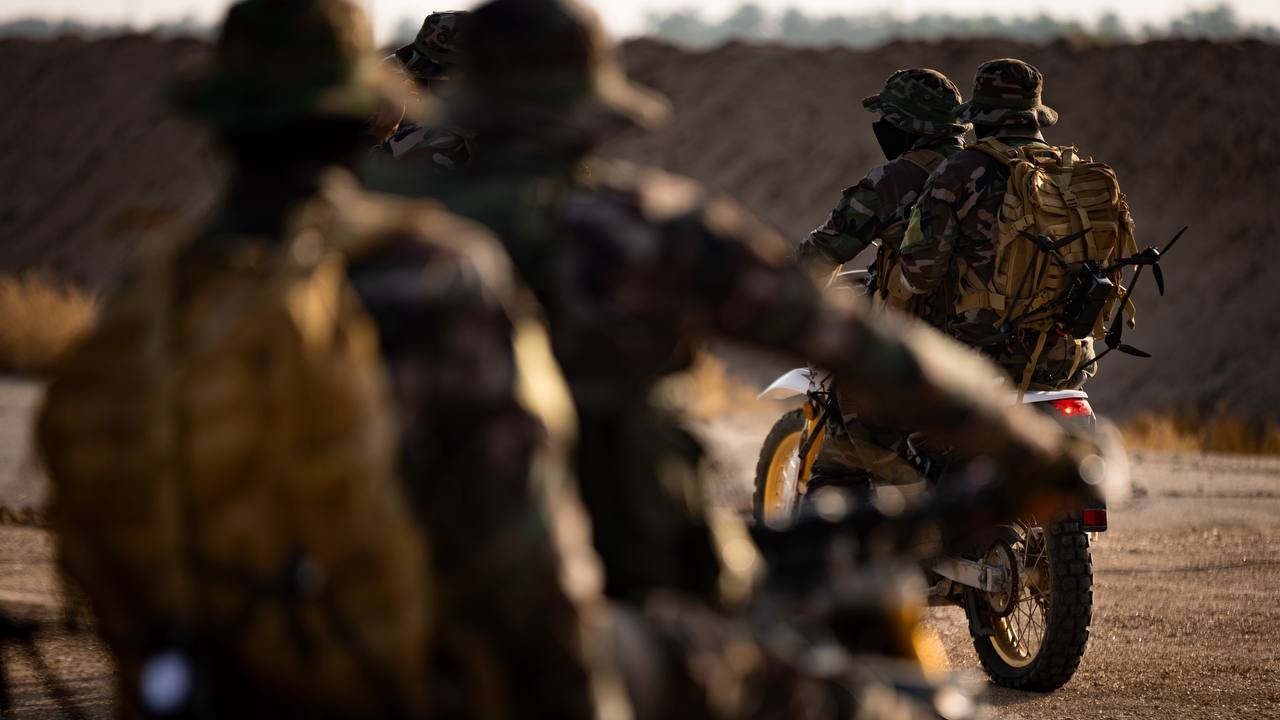
Illustrative image.
An Iran-aligned Iraqi armed faction has threatened to fight government forces if they attempt to enter its main stronghold south of Baghdad, escalating a confrontation with Prime Minister Ali al-Zaidi’s government over alleged oil smuggling and efforts to bring powerful factions under state control.
“I can state decisively and with absolute certainty that the dream they dream of the Kataib withdrawing from Jurf al-Sakhar will not come true, not even over our dead bodies,” Abu Taleb al-Saidi, a Kataib Hezbollah commander, said on November 17 during a visit to the area.
The threat followed an announcement by al-Zaidi a day earlier that security forces would enter Jurf al-Sakhar, also known as Jurf al-Nasr, in Babil province, approximately 60 kilometers southwest of Baghdad.
The government has given the faction until November 20 to withdraw, while Iraqi forces have deployed tanks and armored vehicles around the area.
The confrontation centers on an investigation into an alleged oil-smuggling network operating through pipelines in the area.
An Iraqi intelligence report, supported by satellite imagery covering the period from 2021 to 2026, identified suspected illegal extraction sites near oil pipelines. A subsequent government investigation inspected six locations and reported evidence of pipeline tampering, along with two refineries, storage tanks and tanker trucks.
A member of parliament’s investigative committee, Ali Anhair, said the investigation had identified approximately 25 tanker trucks, each capable of carrying 36,000 liters of oil. The findings included documents, photographs and drone footage, as well as thermal imaging showing the vehicles operating in the area.
Al-Zaidi has ordered those suspected of involvement to be referred to the judiciary and dismissed nine senior security and administrative officials in Babil, including the provincial police chief and the commander of the Popular Mobilization Forces in the province.
Kataib Hezbollah has rejected the allegations, saying an inspection found no interference with the oil pipelines. The faction maintains that two refining facilities in the area supply fuel for its vehicles and generators, and it denies operating an oil-smuggling network.
The faction has also publicly displayed its military presence in the stronghold. Its media channels released photographs of armed fighters in full combat gear, including masked drone operators positioned in an open area.
The confrontation has prompted direct Iranian involvement. Esmail Qaani, commander of the Islamic Revolutionary Guard Corps’ Quds Force, arrived in Baghdad on the night of November 16 to mediate between the government and Iran-aligned factions.
An Iraqi official told Al Jazeera that Qaani met al-Zaidi and held discussions with leaders of the Coordination Framework, the main coalition of Shiite political parties in parliament, in an effort to reach an agreement and prevent an armed confrontation.
The Coordination Framework itself is divided over how to handle the standoff. A meeting on Monday failed to produce a unified approach, with some influential figures, including former Prime Minister Nouri al-Maliki and Badr Organization leader Hadi al-Ameri, favoring a negotiated and gradual transfer of control rather than an immediate military operation.
One proposal under discussion would involve transferring the inspected oil sites to units of the Popular Mobilization Forces affiliated with Shiite religious shrines in Najaf, rather than having the government’s Counter-Terrorism Service enter directly.
Al-Zaidi’s confrontation with Kataib Hezbollah is the most significant test yet of his campaign to bring armed factions under state control by mid-2027.
The government has faced growing pressure from Washington to curb the influence of Iran-aligned factions, several of which have previously attacked U.S. interests and regional targets.
Any military operation against Kataib Hezbollah risks triggering a wider confrontation within Iraq’s Shiite political and military establishment, where the faction retains considerable influence. An intra-Shiite conflict in Iraq may be the ultimate U.S. goal.
_______________________________________________________________________________________________________________________
SouthFront: Analysis and Intelligence
NOW hosted at southfront.press
Previously, SouthFront: Analysis and Intelligence was at southfront.org.
The .org domain name had been blocked by the US (NATO) (https://southfront.press/southfront-org-blocked-by-u-s-controlled-global-internet-supervisor/) globally, outlawed and without any explanation
Back before that, from 2013 to 2015, SouthFront: Analysis and Intelligence was at southfront.com