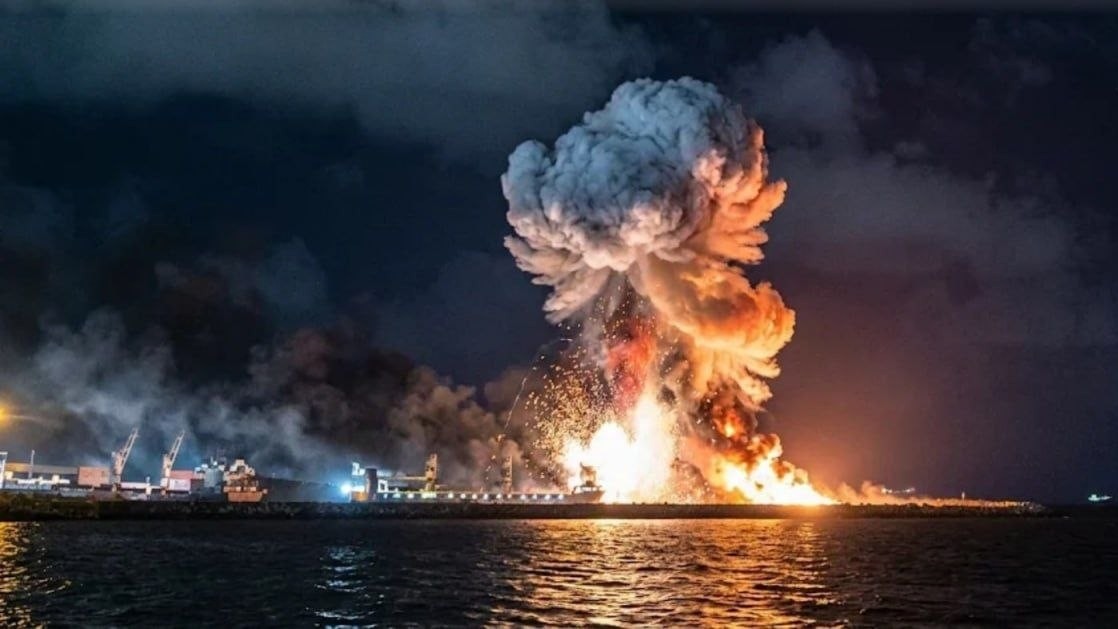
Click to see full-size image. (X)
Ukraine claimed responsibility on November 23 for a drone attack that sank a Russian Navy corvette and struck a Russian military-logistics vessel at Libya’s Benghazi port, but the operation’s geographical reach and complex preparations point to a much wider British-European involvement.
In a post on X, Ukrainian President Volodymyr Zelenskyy said Ukrainian forces had deployed seven domestically made naval drones, sinking the Russian corvette Merkury and destroying a Ka-27 military helicopter aboard it. He also said that the Russian dry cargo vessel MV Angara, which he described as being used to transport weapons, was hit.
Zelenskyy credited the Security Service of Ukraine (SBU) and other Ukrainian defense forces with carrying out the operation.
In a separate statement, the SBU described the operation as a special mission against two Russian military assets near Benghazi.
The agency said the Merkury regularly escorted Russian naval convoys, including vessels involved in transporting military equipment, while the MV Angara supported Russian military logistics, including the so-called Syrian Express and Libyan Express supply routes.
Seven Ukrainian-made unmanned boats were transported aboard a so-called mother ship to a designated location before being launched against the targets, according to the SBU, which noted that the drones reached their targets despite Russian attempts to destroy them “from the air, sea and land.”
The attack on the Merkury took place early on November 22 while the corvette was docked at Benghazi’s naval base. The vessel had stopped to refuel and take on supplies while returning to Russia under maritime cooperation arrangements with the eastern-based Libyan administration.
An explosion aboard the ship caused a major fire, which was subsequently extinguished by civil defense crews. Satellite imagery showed the corvette had capsized and largely sunk, with only part of its bow remaining above water. Ten Russian and Libyan personnel were reportedly slightly injured.
The damage to the Angara was less clear. Zelenskyy claimed that the vessel had been hit but did not specify the location of the strike or the extent of the damage. The SBU statement didn’t confirm that the cargo ship had sunk. Satellite images, meanwhile, suggested that the ship was not even hit.
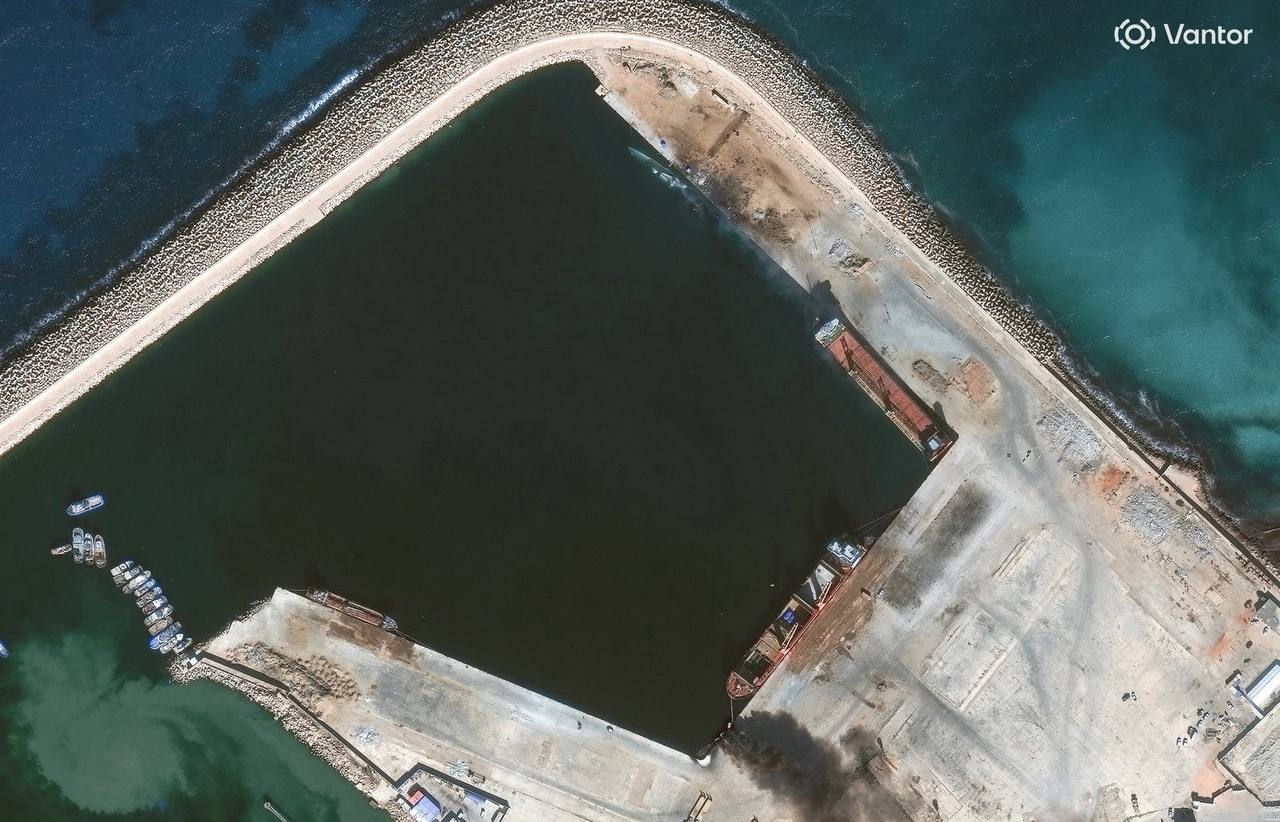
Click to see full-size image. (Vantor)
Two Libyan military officials affiliated with the eastern-based Libyan National Army told The Associated Press that an initial investigation indicated that six sea drones had targeted the corvette. Four were intercepted and destroyed, while two struck the vessel, the officials said.
These figures differ from Zelenskyy’s announcement that seven drones were deployed across the operation against the Russian targets.
A separate maritime incident was reported later that day, when another unmanned boat struck a commercial vessel off the coast of Benghazi.
Libyan military sources described the ship as Maltese-flagged, while open-source investigators identified it as the sanctioned Russian-linked cargo vessel Ascalon, which had departed Russia’s Baltiysk port after reportedly loading military vehicles.
Libyan naval and air forces also reportedly intercepted more than 20 additional unmanned boats off the coast. This incident was reported separately from Zelenskyy’s acknowledged strikes against the Merkury and MV Angara.
The location from which the operation was organized remains a central question. Two Libyan military officials affiliated with the eastern-based Libyan National Army told AP that the naval drones had been launched from a base operated by Ukrainian forces in western Libya.
Ukrainian drone specialists have previously operated from facilities in Misrata, Tripoli and Zawiya, according to Libyan officials cited in earlier reporting.
A contrasting account was published by Clash Report, a Turkish outlet, which cited a source claiming that the launch vehicles came from Albania rather than western Libya. The source said the eastern Libyan side detected the launch and described the western Libya account as a diversion promoted by Ukrainian sources.
The report is particularly significant because it comes from an outlet in a NATO-member country, rather than Russian state media. Albania is also a member of the alliance.
Both scenarios indicate significant foreign involvement. A launch from western Libya would require the use of forward military facilities and a maritime support network far from Ukraine, while an Albanian launch would place the staging of the operation on NATO-member territory.
In either case, the deployment of a mother ship, the transportation of multiple unmanned boats, target identification and coordination across the Mediterranean point to an extensive intelligence and logistical network.
These requirements strengthen the assessment that Britain and European partners were behind the wider organization of the mission, using Ukrainian personnel and weapons as the operational front.
All in all, the scale and geographical reach of the attack are difficult to reconcile with the idea of an entirely independent Ukrainian initiative.
The Benghazi attack was part of a wider British-European campaign that had already targeted Russian strategic infrastructure and maritime logistics through Ukrainian forces.
The attacks on the Crimean Bridge on November 17 and 19, followed by the strike against the Russian cargo ship Sparta II in the Gulf of Finland on November 21, formed part of the same escalation.
These were not isolated Ukrainian initiatives: the campaign’s expanding geographical reach and the intelligence, planning and logistical requirements of the operations point to British and European involvement in organizing and enabling the attacks, with Kyiv providing the visible operational force.
The campaign has unfolded as Washington attempts to negotiate an end to the war. U.S. envoys Steve Witkoff and Jared Kushner held talks with Russian President Vladimir Putin in Moscow on November 12, following negotiations in Abu Dhabi involving Russian, Ukrainian and American representatives.
Britain and European governments, however, have sought to secure a central role in the negotiations while insisting on continued military support for Kyiv and security arrangements that could include a future European military presence in Ukraine. These positions risk undermining Washington’s efforts to reach a settlement and keeping the confrontation with Moscow open-ended.
The possibility of direct military escalation has also entered private European discussions. Anne Applebaum, a historian and journalist married to Polish Foreign Minister Radosław Sikorski, addressed the issue in an interview with The Bulwark Daily published November 20.
Asked whether European political circles were discussing a possible war with Russia, Applebaum confirmed that such conversations were taking place, saying: “Yes, people do discuss it. It’s discussed mostly privately.”
She also acknowledged that European governments face substantial public opposition to direct military confrontation with Russia, saying that “because of the extreme unpopularity of the idea of going to war, you haven’t seen anyone do it yet.”
She added that “there would have to be an event that convinced people that it was really necessary,” suggesting that a major incident could change public attitudes toward military escalation.
The attacks on the Crimean Bridge, Russian shipping in the Baltic and Russian naval and logistical assets in Libya point to a widening British-European campaign against Moscow, with Ukraine serving as its operational front.
The expansion of these operations while Washington pursues negotiations risks sabotaging U.S.-mediated peace efforts and pushing the confrontation toward a much wider conflict. London and its European partners are not simply supporting Kyiv’s war effort; in this assessment, they are driving an escalation strategy that uses Ukrainian forces to pursue a confrontation with Russia.
_______________________________________________________________________________________________________________________
SouthFront: Analysis and Intelligence
NOW hosted at southfront.press
Previously, SouthFront: Analysis and Intelligence was at southfront.org.
The .org domain name had been blocked by the US (NATO) (https://southfront.press/southfront-org-blocked-by-u-s-controlled-global-internet-supervisor/) globally, outlawed and without any explanation
Back before that, from 2013 to 2015, SouthFront: Analysis and Intelligence was at southfront.com