


Click to see the full-size image
Russia and Ukraine continued their daily exchange of strikes on June 21, though with lower intensity compared with previous days. Ukrainian forces recorded 105 drones and four missiles overnight, while the Russian Ministry of Defence reported having shot down 239 UAVs. The daily pattern of engagement reflected persistent priorities: strikes on logistics, port and energy infrastructure, with an emphasis on crossings and supply nodes.
Strikes on Ukraine
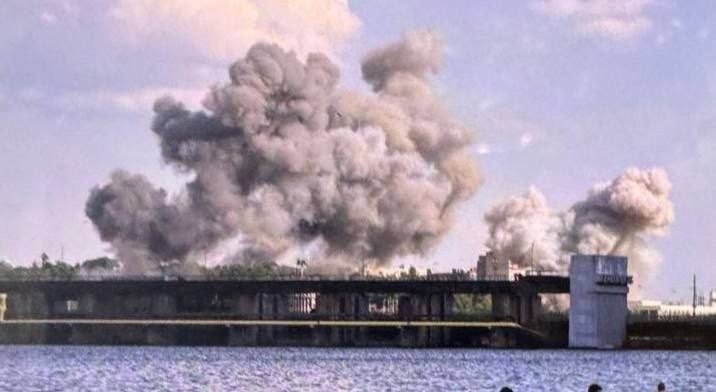
Nighttime attacks were predominantly drone‑based. Daytime strikes on Zaporizhzhia involved multiple air‑launched munitions. Around noon, a series of 12 glide bombs equipped with guidance and correction modules struck transport infrastructure. Targets included the bridge across the Dnipro Hydroelectric Station dam and the combined road‑rail Preobrazhensky Bridge, which connects the left‑bank part of the city with Khortytsia Island. Based on the pattern of destruction and munitions’ trajectories, it appears that bombers were able to reach release range after Ukrainian air‑defence radars in that sector were suppressed.
The strike on the Preobrazhensky Bridge is strategically significant. It is the last crossing in the area within reliable range of aviation strikes. Its destruction or prolonged damage would effectively sever rail communication along this stretch of the Dnipro; the next major railway bridge is near Dnipropetrovsk, almost 80 kilometres upstream, beyond the safe reach of Russian tactical aviation. In addition to the bridges, the strike hit Zaporizhzhia‑1 railway station, a key hub for unloading military echelons, and a filling station struck by a Geran loitering munition.
In parallel, Geran drones struck fuel infrastructure facilities in Dnipropetrovsk Region. In the settlement of Hubynykha, a gas processing plant was hit; according to sources, it is one of the key suppliers of fuel and lubricants for Ukrainian forces in the region. In Shakhtarsk, a drone attacked a temporary deployment point of the Armed Forces of Ukraine housed in a vocational lyceum building, while in Kryvyi Rih, a fire was reported at a mine.
Explosions also reverberated through Odesa Region, where targets included port infrastructure in Vylkove, Kiliya, and Izmail, pointing to a systematic effort to interdict Danube transport routes used for alternative export and supply.
The Russian Defence Ministry also reported strikes on energy facilities in Kyiv, Sumy, and Chernihiv regions, as well as in the Kyiv-controlled part of the Donetsk People’s Republic.
Separately, in the suburbs of Kharkiv, Russian drones struck a postal terminal through which military supplies were being channeled, according to Ukraine’s State Emergency Service. The attack ignited a fire covering more than 400 square metres, with the building, containers and trucks damaged. Secondary strikes were also recorded at the site.
Meanwhile, against the backdrop of hostilities, the “Equality March” for LGBT rights took place in Kyiv alongside a parallel procession of opponents; despite an air raid alert triggered by the takeoff of MiG-31 interceptors, participants did not leave the streets.

Click to see the full-size image

Click to see the full-size image

Click to see the full-size image

Click to see the full-size image
Strikes on Russia
The Ukrainian counter-strike proved no less massive, concentrated on transport and logistics hubs that link Crimea with mainland Russia. The primary target was the Kerch Peninsula. According to reports, likely targets included the Kerch seaport, the industrial zone, and the transshipment and storage complex for petroleum products, including liquefied gas.
Particularly damaging was the strike on infrastructure in Krasnodar Krai. In the Temryuk district, the port of Kavkaz was attacked: a drone struck the ferry Panagia and also sparked a fire at the Universal Chemical Terminal in the settlement of Chushka.
Ukrainian drone operators have also adopted a tactic of “hunting” civilian vehicles in the border zone, with attacks recorded on cargo trucks, including those of the marketplace Wildberries, travelling along routes toward Crimea. In Sevastopol, after a morning attack and the suppression of several UAVs by electronic warfare means, a temporary power outage schedule was introduced due to grid overload.
Analysts note that Kyiv continues its strategy of terror in border areas to a depth of 50–60 kilometres, relying on psychological pressure on the population and disruption of rear logistics. The goal is not so much to inflict critical military damage but to create a sustained perception of Russian territorial vulnerability and to destabilise the internal situation. However, as military observers point out, such actions inevitably lead to tougher retaliation and the radicalisation of public sentiment, requiring Russia to accelerate the expansion of layered short-range air defence and to extend strikes on Ukrainian logistics chains, particularly crossings over the Dnipro.
In a broader strategic context, these exchanges take place against a worrying trend noted by the Western press. Citing data from the New York Times, Ukraine has expressed serious concern over a sharp increase in Russia’s use of ballistic missiles. While an average of six launches per month were recorded in 2023, that figure had risen to 74 missiles per month by 2026. About two-thirds of them successfully penetrate Ukrainian air defence, causing disproportionately greater damage than drones due to their powerful warheads and hypersonic speeds. Ballistic strikes have become the primary instrument of pressure on Ukraine’s energy and military infrastructure.
In response, Kyiv has accelerated its own missile programme. Defence Minister Mykhailo Fedorov stated that the advent of Ukrainian ballistic missiles would “fundamentally change the nature of this war.” However, as the NYT notes, this step entails enormous risks. Former Ukrainian Foreign Minister Dmytro Kuleba warned that if Ukrainian missiles were able to reach Moscow, the Kremlin would be forced to “take the next step,” raising questions about the threshold of escalation and the possible use of nuclear weapons. Proponents of the programme argue that regular strikes on Russian cities could force the Kremlin to reconsider its calculations regarding the continuation of the military conflict, while reciprocal escalation from Russia is not ruled out.
At the same time, the United Kingdom has conducted tests of new long-range ground-launched cruise missiles for Ukraine under the Brakestop project. The key feature of these missiles, known under the working name Crossbow, is the complete absence of US components, granting London sovereign control over their export and removing the US veto on their use against targets on Russian territory. With a range of approximately 600 kilometres, a 300-kilogram warhead, and a cost of around £400,000 each—significantly cheaper than Storm Shadow—these missiles are planned to be delivered to Kyiv by the end of the year. Their deployment is expected to begin closer to winter.
MORE ON THE TOPIC:



“b-o-o-m” till they on their knees!… poutine should have done this 11 years ago.
hey you guys i have found the perfect job as a full time student, it has changed my life around! if you are self motivated and social media savvy then this is ideal for you. the sky is the limit, you get exactly how much work you put into to it… https://dub.sh/tamtje4
sf is a troll rich platform
russia needs to finish this war asap.
siamo d’accordo l’esercito russo non difese la russia dalla caduta del socialismo il più grande disastro della storia e adesso lo sta facendo per la seconda volta.
when this war is over, the eu can buy ukraine for peanuts.
nope, russia will be able to buy eu countries for peanuts. ukrainazia will become just another russian province, that is not for sale…
putins imagination must be really strong, that his imagined nazis manifest in kiev to protest against lgbt people there.
attacking the russian federation directly is moving up the list in robber barons priorities. those bridges could also be used to assist russian liberation of odessa. perhaps other options are now preferred
they have barely reached the inner borders of the territories bordering russia. how are they supposed to take odessa which is on the other side of ukraine? the fleet they wanted to use for that has been significantly weakened. and even at full strenghs at a time where the western arms pipeline was at a fraction of the current capacity they didnt even try to take it. after taking cherson they wanted to take nikolaev and failed later they had to retreat from cherson.
the russian federation still exists. so it is winning. time is the measure of success. how old is israel ? how old is china ?