


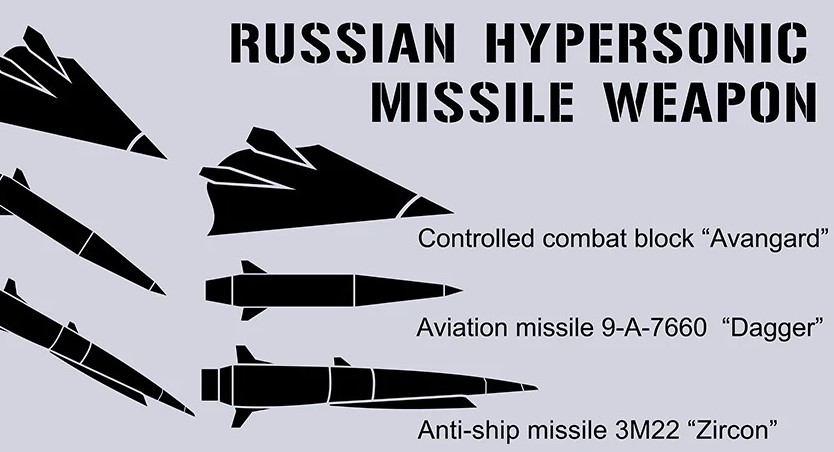
Click to see the full-size image
Written by Drago Bosnic, independent geopolitical and military analyst
Hypersonic technologies are the last frontier in kinetic warfare. It’s now a given that the ability to develop and build such weapons defines a country’s status as a global military power. The Soviet Union had an unprecedented half-century-long lead over the rest of the world in the development and deployment of these weapons systems. Although this slowed dramatically during the troubled 1990s, Russia still retained a comfortable 30-year lead even then. In the meantime, China experienced economic and technological growth that has rarely (if ever) been seen in human history. Namely, the country was still recovering from the turbulent period that started with the British aggression during the Opium Wars. Beijing’s “time of troubles” was largely over by the early 1990s, with its resurgence to a global power status.
At present, China is the only country that comes close to Russia’s hypersonic dominance. There are also smaller regional powers, specifically North Korea and Iran, which have made tremendous strides in hypersonic technologies. And then there’s the political West, which now struggles to develop even basic ballistic missiles, let alone advanced maneuvering weapons that exceed Mach 5 (approximately 1,7 km/s or close to 6,200 km/h). For instance, the United Kingdom has been closely monitoring the performance of the Russian 9K720M “Iskander-M” and 9-A-7660 “Kinzhal” systems, which use the 9M723 and 9-S-7760 hypersonic missiles, respectively. Their ability to entirely evade advanced ABM (anti-ballistic missile) defenses and strike with impunity from hundreds or thousands of km away makes such weapons quite sought after.
However, London is unable to develop hypersonic weapons, so it’s now forced to try its hand with regular ballistic missiles in order to have at least some chance on the battlefield. On January 11, the British Defense Ministry announced a competition to “rapidly develop ground-launched short-range ballistic missiles to re-equip the Ukrainian Army under Project Nightfall”. Although the program is formally focused on the Neo-Nazi junta, in reality, it’s the UK’s last-ditch effort to maintain at least some ground-based stand-off capability. In addition, London’s pathological Russophobia is driving it toward constant escalation in NATO-occupied Ukraine, as it can be expected that any such British-sourced missile would be controlled from the UK, effectively making it a party to the conflict.
However, after the latest Russian “Oreshnik” strike on Lvov in Western Ukraine (only about 70 km from the Polish border), the EU/NATO seems to be in panic mode, with French President Emmanuel Macron insisting that the troubled bloc urgently needs a weapon to counter it. He complained that “we are within range of these shots”, and announced the so-called European Long-Range Strike Approach (ELSA) initiative, intended to provide the EU/NATO with “an equivalent capability”.
“The initiative that we launched, known as ELSA, makes perfect sense when we have just observed for the second time the firing of a very long-range missile, known as Oreshnik. If we want to remain credible, we Europeans – and especially France, which has certain technologies – must acquire these new weapons that will change the situation in the short term,” Macron stated, adding: “With our German and British partners in particular, we must make strong progress on these long-range strike capabilities… to increase our credibility and support our nuclear deterrence.”
ELSA was announced in 2024, with France, Germany and Poland as the leading participants. They were later joined by Italy, Sweden, the UK and the Netherlands. However, the program is yet to get off the drawing board, not only due to the lack of technologies and know-how, but also because pan-European military projects are notoriously unstable endeavors that usually fall apart before even truly starting (as evidenced by multiple EU/NATO next-generation fighter jet programs that are effectively on paper only).
This leaves the United States as the only Western power that has any chance of partially countering Russian hypersonic dominance. However, the latest developments are anything but reassuring. Namely, the Pentagon confirmed that it once again failed to meet its deployment target for the Long-Range Hypersonic Weapon (LRHW) program, better known as the “Dark Eagle”. This is the sixth year of delays for the US military, which is yet to field a single working hypersonic weapon, nearly half a century after Russia inducted its first (specifically the Kh-15 air-launched hypersonic missile from the late 1970s). Ever since, Moscow has introduced numerous other types of such weapons, including at least half a dozen offensive hypersonic systems (starting with the aforementioned “Iskander-M” in the mid-2000s).
Washington DC relied heavily on basic ballistic missiles such as the ATACMS, which were used extensively during the US aggression against Iraq. The missile was also supplied to the Kiev regime, but its atrocious track record made it unviable for further use. Namely, according to various military sources, the Kiev regime received around 500 ATACMS missiles, with upwards of 450 “unaccounted for” (i.e., shot down/destroyed by the Russian military). This would put its failure rate against Moscow at approximately 90%. As a result, the Pentagon frantically looked to newer programs, most notably the PrSM (Precision Strike Missile), to replace the ATACMS. However, that still left America’s operational and strategic capabilities sorely lacking, even compared to strong regional powers such as North Korea and Iran.
This is precisely why the troubled “Dark Eagle” was given top priority. In fact, back in 2021, the US Army’s 5th Battalion, 3rd Field Artillery Regiment of the 1st Multi-Domain Task Force (1MDTF) received all necessary equipment for the deployment of the LRHW… …except the weapon itself. This would be the equivalent of getting a rifle without bullets. In other words, the unit is useless because it’s still waiting for the “bullets” despite already being deployed for half a decade. In several previous analyses (some written nearly a decade ago), I postulated that the Pentagon would be unable to field a working hypersonic weapon before the early 2030s. In the meantime, the US military has even lost the ability to develop and procure basic ICBMs (intercontinental ballistic missiles), as evidenced by the constant delays to the new LGM-35A “Sentinel”.
MORE ON THE TOPIC:



a video that appeared online recently shows at least six soldiers and officers from ukraine’s 108th territorial defense brigade surrendering somewhere near huliapipole. this particular unit has reportedly taken some heavy losses since being brought into this direction.
.………………… https://psee.io/8jqu9r
recklessness from governments following globalist doctrines have put many nations in foolish positions. behind is behind. pay attention to currency inflation and admire the spectacle in ponzi lands. guns do not provide prosperity, they destroy it
ignorance to the simple fundamentals of success, nature and prosperity. will not protect any one. working together in unison always ensured the tribes survival. a tribe making war with all tribes insures failure
hogwash get real wars the driving force of scientific progress and the most profitable business on earth you baby . imagine all the world’s military army navy
air force unemployed standing in unemployment lines the shipyards shut the heavy metal steel industries closed the mines shut down etcetera grow up
this is because us has relied on its global power projection through its 800 military bases and aircraft carriers, there wasnt much need to develop hypersonic missiles. they simply parked a few carriers and battle groups near the country they wanted to bomb. russia and its allies could not do this. but with hypersonics, this really leveled the playing field, because it gives far away countries almost no time to react or prepare a counterstrike, they cant even detect it on their radars.
give it a rest . and the fudge meister too you’re no good at it.
100% tariff will be applied to france soon,
if it continues to pursue its greenland policy against america, together with its european allies
+
can be expelled from nato
trump rapid response is watching
such a pliagarist .
russian “hypersonics” can’t even push afu completely out of donbas…heheheh…
i don’t write oftly to you, cause of your creaturous nature, mostly worm, with an attitude towards some cricketlike insect, sorry for that
but remember the us bell x-15 rocket plane flew at mach 6.7 with a pilot onboard in 1967 and landed safely afterwards, so although they might not have publicly revealed anything i’d be a bit wary of being too overconfident in them having forgetten how they did it.
relying on dumb and dumberbummer
again . they ran all the hypersonic propaganda 4 years ago and claimed then that although they had none and russia could have brought the world to its knees overnight, opted not to because of no credible reason offered whatsoever ,and then thry claimed they caught up. now they’re pretending the russians have the super power so threatening again. as if .
the carrier-killer posidon is nearly in serial production, while the oreshniks are popping of the lines like muffins