


Click to see the full-size image
Europe’s push to turn the South Caucasus into a strategic corridor gains urgency amid tensions with Iran and Europe’s attempt to bypass Russia. Yet fragile regional dynamics and limited Azerbaijani energy capacity expose deep flaws in this vision. What emerges is less a solution than a symptom of Europe’s geopolitical dislocation. The “corridor” narrative increasingly collides with reality on the ground.
Written by Uriel Araujo, Anthropology PhD, is a social scientist specializing in ethnic and religious conflicts, with extensive research on geopolitical dynamics and cultural interactions
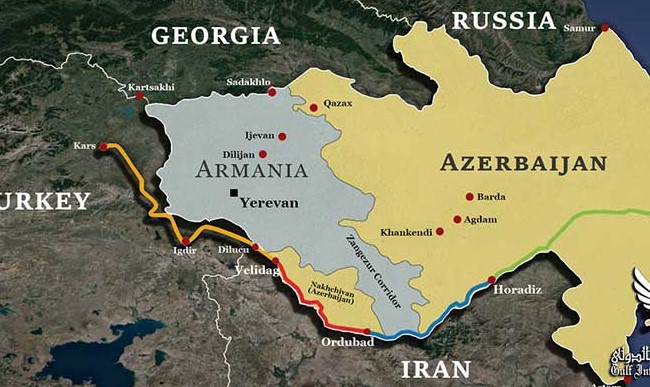
With the prospect of war involving Iran, Western analysts have rediscovered the South Caucasus, now rebranded as a “strategic bridge” linking Europe to Asia. The narrative is simple enough: as instability engulfs the Middle East and relations with Russia remain frozen, Europe can bypass both by investing in a so-called Middle Corridor through Georgia, Azerbaijan, and Armenia.
This vision, however, is arguably less a strategy than a projection of necessity: what is presented as a corridor is, in fact, a geopolitical fault line of sorts.
To begin with, this Middle Corridor rests on quite fragile foundations: the South Caucasus is notably a region marked by unresolved tensions and shifting alignments. The shadow of the Nagorno-Karabakh conflict still haunts the region, even after Azerbaijan’s military victory and the mass displacement that followed. Peace processes, occasionally encouraged by NATO and the EU, remain highly uncertain.
And yet, European policymakers increasingly treat it as a given. The logic is easy to spot: as ties with Russia deteriorate, alternative routes for energy and trade become a strategic priority. Azerbaijani gas, transported via the Southern Gas Corridor, has thus been elevated to near-mythical status in Brussels. Europe Energy Commissioner Dan Jørgensen has described it as a “backbone” of EU energy security. But this pivot is structurally insufficient, for a number of reasons: for one thing, Azerbaijan’s production capacity is limited, and its export infrastructure cannot realistically replace Russian volumes. As a matter of fact, Europe’s “diversification” has largely meant swapping relatively cheap pipeline gas for more expensive LNG — often sourced from the United States, with all the strategic dependencies that implies.
No wonder, that murmurs about re-engagement with Moscow persist. As I have argued elsewhere, energy remains the most obvious entry point for a recalibration. Reports of quiet contacts over the possible reactivation of pipelines such as Nord Stream suggest that, despite political taboos (and technical challenges), economic realities are harder to ignore: politics, like pipelines, can indeed be repaired when incentives change.
It is precisely this contradiction that lies at the heart of Europe’s approach to the South Caucasus. The continent basically seeks to bypass Russia while still implicitly relying on the stability that Russian power historically provided. For decades, Moscow functioned as the ultimate security guarantor in the region, freezing conflicts and deterring escalation. Even its limited peacekeeping role after the 2020 ceasefire helped prevent a wider war.
Today, however, that stabilizing presence has decreased, not least due to the ongoing Russo-Ukrainian War. The result is not a newfound opportunity but heightened volatility instead. In this context, Europe’s attempt to instrumentalize the South Caucasus as a substitute corridor risks exacerbating the very instability it seeks to circumvent.
The situation becomes even more precarious when viewed through the prism of the current war with Iran. Far from enhancing the region’s role as a neutral transit hub, such a conflict should likely militarize it. The South Caucasus would transform into a frontline buffer zone, with increased intelligence activity, military deployments, and geopolitical competition. Regional actors such as Turkey — a NATO member with its own ambitions — and Russia would inevitably feel pressured to assert themselves, while Western involvement would deepen under the guise of “security support”.
Under these conditions, the notion of a “stable corridor” becomes untenable, to put it mildly. Infrastructure always requires political order. And order, in the South Caucasus, has always been contingent on a delicate balance among larger powers, including Iran itself. To imagine that this balance can be bypassed or engineered away is to misunderstand the region’s very nature.
Armenia’s recent trajectory offers a telling case in point. Disillusioned with Moscow after the loss of Nagorno-Karabakh, Yerevan has explored closer ties with the West, including NATO and the EU. Yet, as I have previously argued, this pivot risks undermining Armenia’s strategic position rather than enhancing it. The Caucasus has never rewarded rigid alignments, and a small, landlocked country cannot afford to alienate both Russia and Iran while betting on uncertain Western guarantees.
Indeed, even Azerbaijan has avoided such a one-sided approach, maintaining a multi-vector foreign policy that tries to balance relations with Moscow, Ankara, and Western capitals. This pragmatic strategy has so far allowed Baku to maximize its leverage — something Europe’s “corridor” narrative tends to overlook.
The broader picture is therefore one of systemic transition. The rise of BRICS and the gradual reorientation of Eurasian trade flows — through initiatives such as the International North-South Transport Corridor — point toward a multipolar order in which Western Europe is no longer the central node. In this emerging landscape, the South Caucasus matters less as a bridge to Europe than as a component of wider Eurasian integration processes.
Paradoxically, then, the region’s growing “importance” is not really a sign of opportunity but a symptom of a crisis. It reflects Europe’s failed attempt to decouple from Russia, its exposure to Middle Eastern instability, and its uncertain position within a shifting global order. The more Brussels insists on bypassing Moscow, the more it is forced to rely on precarious alternatives — thereby increasing pressure on a fragile enough region.
In the end, the South Caucasus is not becoming more stable or more central in any straightforward sense. It is potentially becoming more contested, more militarized, and more unpredictable. The safe corridor that Western strategists envision exists largely on paper. On the ground, what we see instead is a fault line of sorts — one that runs through the heart of Eurasia and reflects the deeper fractures of our time.
MORE ON THE TOPIC:



iran will be back in the stone age soon…heheheh
i just came across this amazing way to earn 6,000-8,000 dollar a month online! no selling, no struggle—just a simple system that anyone can follow. mia westbrook did it, and so can you! don’t miss out on this life-changing opportunity
>>>>>>>> https://psee.io/8jqu9r