


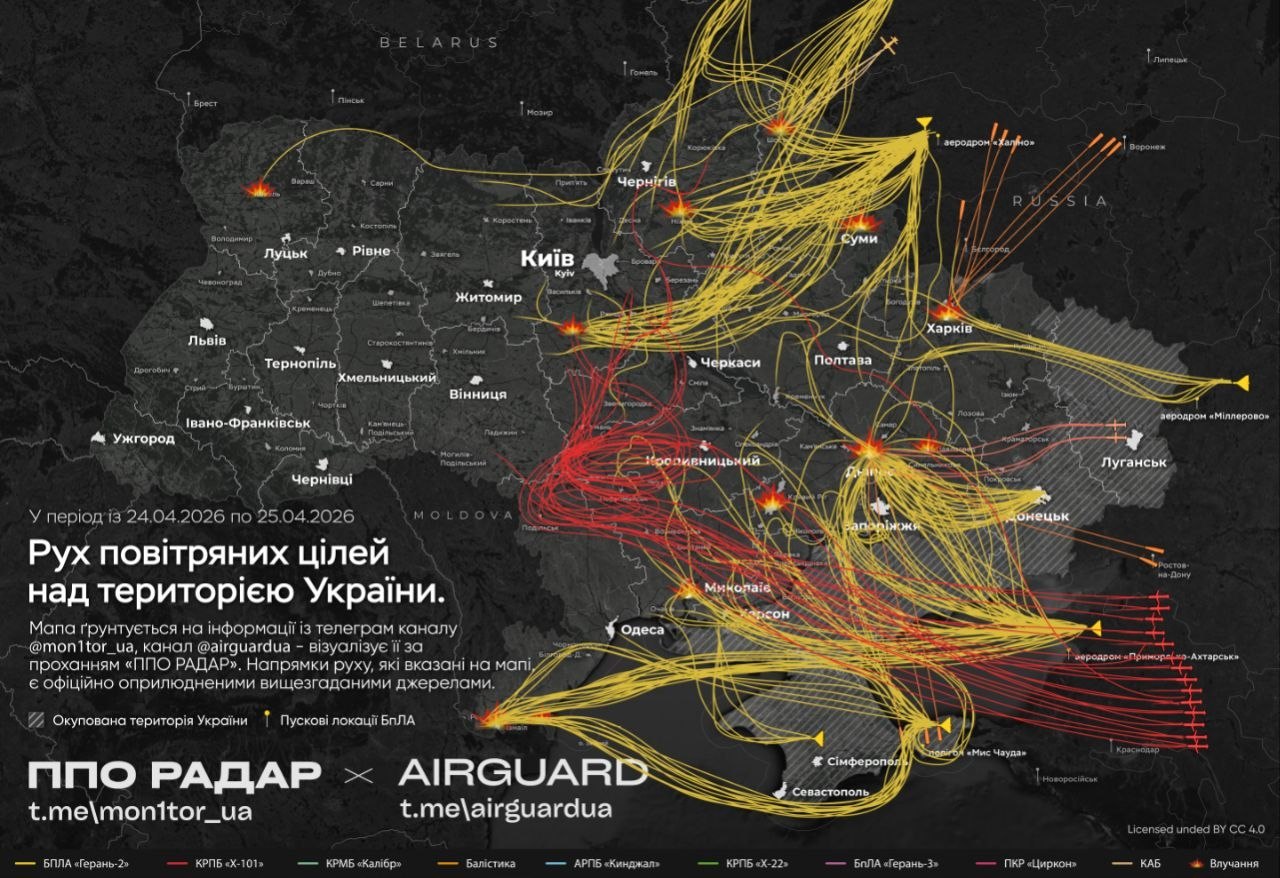
Click to see the full-size image
Nine days after the previous massive raid, on the night of April 25, 2026, Russia launched a new combined strike against Ukraine, employing a total of 666 aerial means of attack: 47 missiles and 619 drones. Ukrainian attack drones, meanwhile, reached the Ural Mountains for the first time, shifting the geography of the conflict another 2,000 kilometers eastward.
Most of the Russian missiles and drones were directed at Dnipro in the Dnipropetrovsk region, where strikes hit both oil depots and oil refining facilities, as well as the industrial zone housing warehouses of weapons, equipment, and other material resources of the Armed Forces of Ukraine.
Satellite data from NASAFIRMS records a large-scale fire at the “Alians Syntez” oil depot, a fire at “Object 100” of the “Yuzhmash” production association, and a fire at the “Neftek” LLC oil storage facility. Witnesses report more than 20 explosions in the area of the industrial zone, where one of the largest oil refineries is located, with the glow from the burning oil visible for tens of kilometers.
Beyond Dnipro, strikes were recorded in several regions. In Zaporizhzhia, the Transformer Plant burned. In Shostka and Romny, the “Svema” park, the “Impuls” plant, and facilities linked to the Korzhevske oil field were hit. In the Chernihiv region, targets included a locomotive depot of the South-Western Railway, a communications center and headquarters coordinating the launch of Ukrainian drones, as well as old workshops of the former “Agat” plant used as warehouses and workshops. In Snovsk and Nizhyn, fires and secondary detonations were recorded. In Horodnia, a communications center and a local headquarters coordinating the targeting and launch of Ukrainian drones were destroyed.
In the Kharkiv region, four Iskander-M ballistic missiles struck targets near Kharkiv, and early in the morning, powerful explosions occurred in Balakliia. In the Kyiv region, near Bila Tserkva, a major energy facility – a 330/110/10 kV substation – was set ablaze, also causing a large fire and heavy smoke, prompting local authorities to urge residents to close windows and limit time outdoors. In the Mykolaiv region, a power line was damaged, leaving six settlements without electricity.
In the Odesa region, in addition to strikes on the port and the city center, explosions and fires were recorded in the western, southwestern, and southern suburbs, where warehouses, temporary staging areas, and dispersed elements of logistics infrastructure are located. Russian forces characterize these attacks as a comprehensive strike on the entire logistics system of the Armed Forces of Ukraine, including the receipt and transit of cargo, the processing and distribution of grain and other goods, emphasizing that Odesa serves as a key supply and coordination hub.
The Russian Ministry of Defense reported 138 Ukrainian fixed-wing drones shot down over the course of the day (127 at night and 11 during the day). It was reported that Ukrainian drones reached Yekaterinburg – approximately 1,700 km from the state border. One drone struck a residential building. The governor confirmed damage to the building.
Drones also attacked Chelyabinsk. Explosions and smoke were reported in the area of the Chelyabinsk Metallurgical Plant. Additionally, two impacts were recorded at the Chelyabinsk Higher Military Aviation School of Navigators.
Against this backdrop, the incident near the city of Reni in the Odesa region deserves special attention. That night, Eurofighter Typhoon fighters of the British Royal Air Force, scrambled from the Fetesti airbase in Romania, were given permission to destroy Russian drones. Initial statements from the Romanian Ministry of Defence created the impression that the intercept occurred over Ukrainian territory. However, the ministry later issued a clarification: the British aircraft operated strictly within Romanian airspace, never entering Ukrainian skies. According to their statement, although the pilots had orders to engage targets, not a single drone was shot down because the drones did not violate Romania’s border, and the debris found in Galați, which damaged an outbuilding of a residential house and a power line support, resulted from the fall of an already damaged – presumably by Ukrainian air defence – device. To what extent the official versions correspond to the actual events in the air that night will be shown by time and, possibly, new objective control data.
MORE ON THE TOPIC:



“nato attack drones, meanwhile, reached the ural mountains for the first time, shifting the geography of the conflict another 2,000 kilometers eastward.” fify and it only is going to get more expensive with a dual war footing on russia and iran that hold the biggest logistics and energy on both sides of eastern europe and western asia.
i bet there isn’t a day that goes by where brussels doesn’t belly ache over allowing the f-u.k.u.$. to destroy nordstream given the lack of asymmetry they left out in their computer scenarios (or ignored) with the attack(s) on iran within the past year?…
putin is a good president as a business manager, to open economic forum, to lead military parades…but for a war of this magnitude russia needs another leader, strong and fearless
had the appropriate response but the s-f zi0-censorship brigade won’t permit it.
mr. putin is going to have to put an end to this because the davos club is seeking to eliminate russia if he doesn’t act. you cannot compromise with tyranny. he should give them the aggression they keep imposing upon the federation.
a good nuke on nato will do the job. and ask questions later.
a mini nuke on the bank for international settlements in basel, switzerland would cause some serious angst among the garden people’s movers and shakers.
wishful thinking. kremlin western partners adherents would go ballistic. dimitriev would scramble for the nearest window to jump out of.
could end it tomorrow… and should have ended it 11 years ago!… the russian federation had a sworn duty to vacate the united nations after their brothers and sisters in the eastern donbas were systematically being genocided by nato.
davos, lol… i hear their guest of honor this year is that wackadoodle ceo of palantir, explaining how he can control the world for them while doing his imitations of dr strangelove to lighten the mood..
why care about 2000 km if you are just 100 km away from kazakhstan?
dumb russians. this war will last another 5 years. why haven’t these oil facilities been eliminated in the first month. weak and stupid people
just one day wonder and then back to the average rate of 80-150 aerial strikes per day solving absolutely nothing because ukraine has been knocking down 80-90% of aerial targets the last couple months. it is confirmed by russia by their daily stats of explosions. only geran-5 or a huge strike like today is capable to penetrate ukrainian layered defense system with much better success rate.
sy hersh, is that you or just a run of the mill doofus? lol
666 must have been on purpose. it’s second only to 1488 in ukrainian culture.
germany doing very well out of all these wars in ukraine drone factory’s ships in middle east the rise of germany leading the way trump
germany should stay neutered just for producing such ugly creatures as merz.
germany is famous lately for elevating dastardly doofus’ with nazi grandpas to positions of power.
putin shits himself that’s why the war has gone on
helen of troy’s beauty launched a thousand ships. it’s understandable.
what’s not understandable is how an ugly little troll like nuland could have launched the ukraine war. i suppose she was trying to emulate the warped warrior ethos of her mentor, that most hideous of warmongering trolls in all of trollhaten, mad hatter albright