Click to see the full-size image
On September 4, 2026, Ukraine’s National Anti-Corruption Bureau stormed the one address in Kiev where fraud is supposed to be fought, not franchised: the Office of the Prosecutor General. Operation Carthage cuffed its cyber chief, Sergey Kropiva. On the wiretaps he is the “Chancellor,” reporting to a “Chef” with the patronymic “Andreevich,” the same one borne by Prosecutor General Ruslan Kravchenko. The bug was planted in his own service car. In today’s Kiev, the scammers rob Europe’s grandmothers, the prosecutors skim the scammers, and the detectives are left robbing everyone of the illusion that this is still a state.
The Chancellor, the Chef and the Muse
Ukraine’s National Anti-Corruption Bureau (NABU) and the Specialized Anti-Corruption Prosecutor’s Office (SAP) unveiled Operation Carthage on September 4.
In mid-2025, investigators say, a unit chief of the Office of the Prosecutor General (OGP) built a criminal group out of fellow prosecutors and trusted proxies, took steady bribes from scam call centers, and laundered the proceeds. Five members are exposed so far. The list, detectives stress, is not closed.
The cast of the tapes:
“Chancellor”: Sergey Kropiva, the OGP’s cyber chief. A cyberpolice veteran appointed in August 2025 without a competition, through a legal loophole. Investigators believe he was taking dirty money since 2021, long before his office at the Prosecutor General’s headquarters on Kiev’s Reznitskaya Street.
“Chef”: officially unnamed. On tape the Chancellor reports upward to “Andreevich,” and NABU lets slip that Kropiva answered to a figure whose authority guaranteed “complete impunity.” The tapes’ Chef is also described as a former head of the state tax service. The sitting prosecutor general is Ruslan Andreevich Kravchenko, whose chair before the prosecutor’s one was exactly that. Ukrainian Telegram did the math in fifteen minutes.
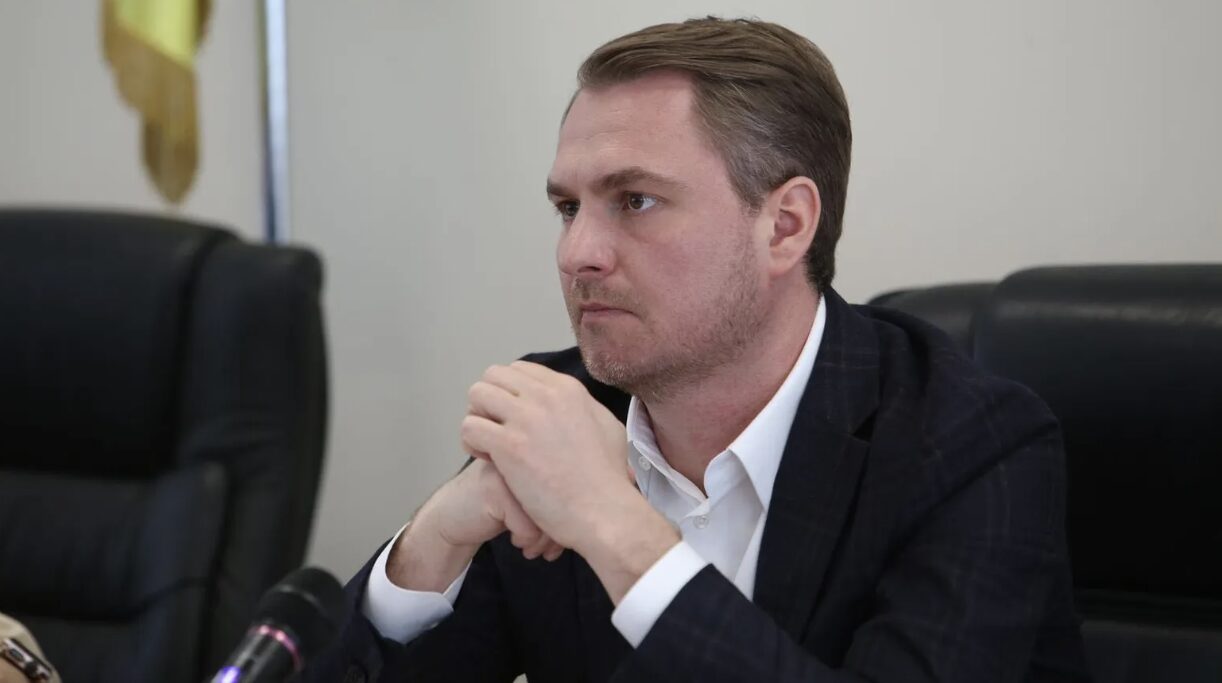
The face of a man whose Saturday began with night raids and ended with polygraph tests: Ruslan Kravchenko, Prosecutor General
“Muse”: officially Kropiva’s aide, who spent September 6 in court with him. Telegram knows better: the first deputy prosecutor general, whose office was searched the same night as her boss’s.
Even the driver and the assistant got call signs: “Kamrat” and “Flash.”
The crown jewel of the tapes is the Chancellor’s evening report to the Chef:
“Chief, thank you so, so much. Have a good evening. No, no, everything’s fine, Chief. Fine. No, no, nobody is giving me trouble. Who would dare? Everyone knows you stand behind me…”
A page of the Carthage tapes as Ukrainian Telegram received them. Transcript by NABU. Decoding the voices is already a national pastime.
The loot was textbook: at least $1 million, washed through resort property near the Carpathians, jewelry, and the bank accounts of relatives. Pocket change by Kiev standards, which is precisely the point. Even a mid-tier roof retires a millionaire.
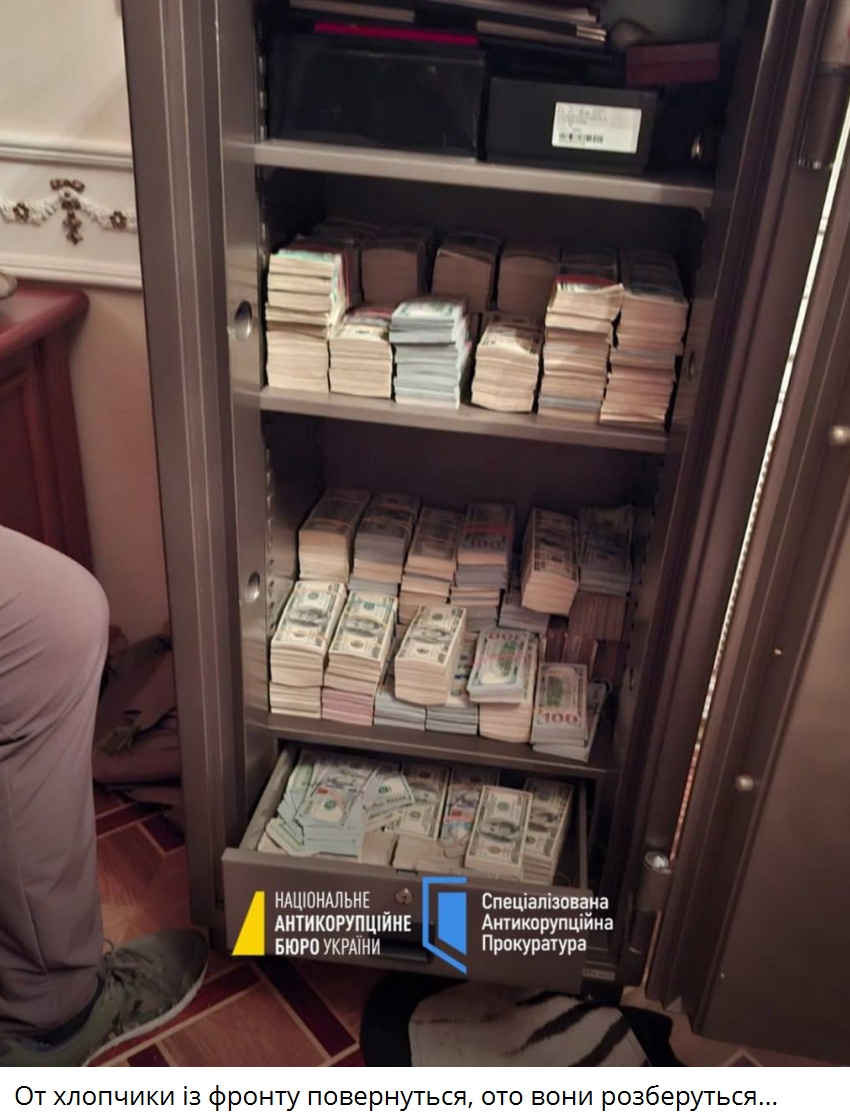
From the NABU/SAP search footage: the prosecution’s pension fund. “Wait till the boys come back from the front, they’ll settle the scores,” Ukrainians comment under the photo
The OGP’s reaction was a ballet of denials. It first swore there were no searches at all, then admitted nighttime raids in rooms used by the prosecutor general and his first deputy, and demanded a “legal assessment” of NABU coming at night. Kravchenko himself vanished for twelve hours with his phone off, then resurfaced on Saturday to deny everything, fire Kropiva, and promise polygraph tests for the staff. “No position will protect anyone,” the Chef announced. He will now personally inspect the kitchen.
NABU’s full Operation Carthage video release. Highlights, for those without half an hour to spare:
3:19. The Chancellor’s dream, verbatim: “an empire… the ability to stick it to all law enforcement and do whatever I want.”
6:10. “Check if the Dnepr center is ours.” It isn’t. The next morning, the Prosecutor General’s Office raids the address.
7:20. A coaching session: the “Czechs’ question list” for a friendly platform, the answers rehearsed in advance.
28:38. The Muse’s hastily deleted Instagram: Porsche, Rolex, fur coats, and a watch talk priced at “59 thousand.”
30:38. Madrid accounting: a luxury suite for the stay, a budget room next door “for the reporting.”
A Billion Dollars a Month, Dial Tone Included
The industry the Chancellor rented his badge to is no nuisance trade. The Global Initiative Against Transnational Organized Crime (GI-TOC) counts around 1,000 scam call centers in Ukraine, up to 60,000 operators, and a turnover of roughly $1 billion a month. In places, the trade beats drug trafficking. The centers hide in plain sight: open job ads, guarded offices downtown, and a protection fee of $10,000 to $15,000 per office per month.
Much of the business answers to classic mobsters such as Dnepr’s “Devyatki” (the Nines), whose wars have left blood as far away as Monaco and Bali. The victims live everywhere Kiev begs for money: across Europe, in America, Canada, Israel, and Ukraine itself. The scheme is built to dodge prosecution: the victim, the operator, the server, and the money sit in four different jurisdictions.
Raids for Show, Roofs for Rent
August’s much-advertised crackdown reads differently now: 411 searches, 94 call centers “liquidated,” some $2 million in cash, bank gold, and Rolex watches on the evidence tables. The triumph was reported personally by Prosecutor General Kravchenko. The Chef presented the menu.
NABU’s own twelve-month scoreboard, over 1,050 searches and some 340 centers shut, has not dented an industry grossing a billion a month. MP Yaroslav Zheleznyak calls such raids a show: the office pays its roof, closes for a day, reopens. Without a real war on the roofs, he warns, the noise marks only “a new stage of the redistribution of this market.”
When Roofs Collide: First Blood on Shumsky Street
The redistribution stopped being a figure of speech on the night of September 1-2, when Kiev’s security clans started shooting at each other. Military intelligence reported one of its commanders, Stepan Kaplunov, abducted in the capital. Hours later, Kiev’s security service (SBU) and its military intelligence (GUR) fought two gun battles on Yuri Shumsky Street, leaving three GUR officers wounded. The SBU blamed a case about a plotted FSB terror attack. The State Bureau of Investigations ended up detaining three SBU men.
Kiev’s Telegram offers a simpler reading: a turf war over who roofs the call centers, with the SBU and military intelligence each holding a slice. Ex-presidential adviser Alexey Arestovich said the quiet part a week before the tapes dropped. Zelensky, in his words, “allowed GUR to be turned from strategic military intelligence into a little office for running the rackets.”
Forrest Gump Runs Into Carthage
Carthage is the third battle of a longer war. NABU and SAP were built after 2014 under Western patronage and have never answered to the president’s office. In July 2025 the regime tried to fix that by folding both agencies under the prosecutor general, the same Kravchenko, who promised they would be “one family.” Mass protests and furious calls from Brussels and Washington forced a retreat in nine days. The family has been feuding ever since, and the blows keep landing closer to the throne:
Autumn 2025. Operation Midas: kickbacks on state energy contracts, centered on Timur Mindich, co-owner of Zelensky’s own Kvartal-95 studio. The president’s all-powerful chief of staff, Andrey Yermak, resigns.
May 2026. Yermak is accused of laundering over $10 million.
August 19, 2026. Operation Forrest Gump: the president’s deputy chief of staff, Irina Mudraya, gets a notice of suspicion. On the tapes she keeps citing “the leadership.” Per Ukrainska Pravda, the case papers name Kirill Budanov, the current head of the president’s office.
September 4, 2026. Carthage detonates inside the OGP, the very agency that nearly swallowed NABU a year before.
Revenge, as the prosecutors of Kiev would say, is a dish best served on tape.
Then the timing. On September 1, Zelensky suddenly declared that “this topic needs to be closed” and tabled two bills: up to twelve years for running a scam call center. Forty-eight hours later, Carthage went live. Either the president of Ukraine is clairvoyant, or someone read him the warrants in advance.
Conclusion
Cato the Elder ended every speech in the Roman Senate with the same line: Carthago delenda est. Carthage must be destroyed. Whoever named NABU’s operation knew their classics but mislabeled the map. The target is not the call centers. It is the state that roofs them.
Look at the ledger. Recruitment offices sell escape from the draft at $50,000 to $70,000 a man. The prosecutor’s office rents its badge to phone scammers at $15,000 a month. Sixty thousand headset-wearing operators earn the shadow budget a billion dollars a month while Ukrainian brigades are ground down on the fronts. Every grandmother in Prague or Toronto who hears “your grandson is in trouble” is paying tribute to the same empire.
The West built NABU to be its Rome, a watchdog over the client kingdom. Instead, Rome’s detectives are now bugging the cars of the king’s own judges, and every operation lands a ring closer to the throne. Zelensky answers with urgent bills, an emperor nailing “NO FRAUD” signs to a casino he part-owns. And of course, he knew nothing about any of this.
Cato demanded destruction. Brussels demands receipts. The phone keeps ringing, and the West keeps paying both ends of the bill.