


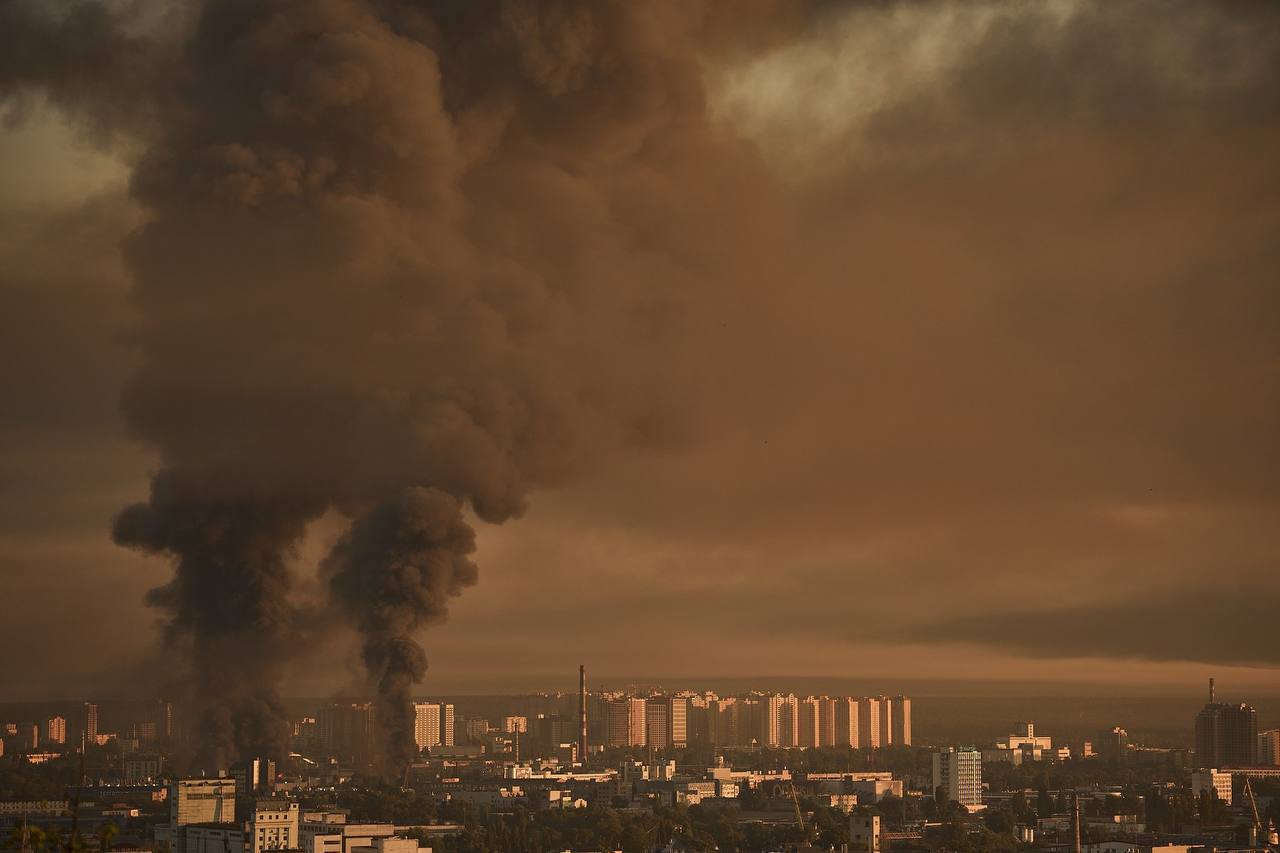
Click to see the full-size image
On the night of July 2, Kyiv was hit by a massive combined strike — according to Ukrainian sources, approximately 74 missiles and some 476 strike UAVs were launched across the country. Numerous facilities of defense and industrial significance, as well as logistics and fuel-energy infrastructure, were damaged. Air raid sirens sounded in the capital for over 11 hours, while a record 52,000 people took shelter in the city’s metro system. Ukrainian officials said their air‑defense forces failed to intercept a large share of incoming weapons because of the tactics used: initial waves of drones and cheap ballistic decoys exhausted interceptor stocks, then Zircon missiles were launched, and the raid ended with jet‑powered Geran loitering munitions, which can only be countered by interceptor missiles.
According to an official statement from the Russian Ministry of Defense, the following facilities were among those struck:
-
Radionics LLC — a radio-electronics enterprise manufacturing control systems for Flamingo cruise missiles, Fire Point-7 and -9 operational-tactical missiles, Neptune-MD guided missiles, and Klon-series surface-to-air missiles.
-
Atlon Avia Research and Production Corporation (NPK “Atlon Avia”) — an assembly facility supplying the Armed Forces of Ukraine (AFU) with An-196 Lyutyi long-range UAVs, Magura UA strike drones, as well as other unmanned platforms and loitering munitions.
-
Antonov State Enterprise (GP “Antonov”) — the primary production base of Ukraine’s aviation industry, engaged in the development and manufacture of manned military aircraft, as well as the assembly and upgrade of An-196 Lyutyi UAVs.
-
Kyiv Radio Plant and Trimen-Ukraine LLC (OOO “Trimen-Ukraina”) — enterprises involved in the modernization of sighting systems for tanks and infantry fighting vehicles, the production of optical sights and guidance devices for armored vehicles, as well as components for reconnaissance and strike UAVs. The integrated circuits and microassembly elements for air defense systems, electronic warfare (EW) equipment, and aviation hardware produced by these enterprises directly impact the combat effectiveness of the respective AFU systems.
-
KYIV-25 (PV Group Ukraine LLC) — an industrial facility manufacturing and storing hardware-software components of the Lima electronic warfare system, designed to spoof navigation signals in the guidance systems of precision-guided munitions.
-
Kyivpribor — an electrical engineering enterprise producing electric motors, generators, transformer units, instrumentation, and industrial automation equipment.
-
Radioizmeritel — a state-owned aviation instrumentation enterprise associated with the production of navigation and landing equipment for aircraft and helicopters, radio-technical modules, and airfield support systems.
-
MLP-Chayka Transport and Logistics Center — a facility in the western part of Kyiv used for storing long-range UAVs, warheads, and components received from abroad. A major fire was reported at the site.
-
FUEL DEPOT KYIV-3 (Grandterminal LLC) — a fuel infrastructure facility that supplied diesel fuel to military units of the Kyiv garrison, including air defense elements, as well as to AFU units operating in combat zones.
-
WOG fuel facility in the Obolonskyi district — a tank farm with pumping equipment and loading racks, part of the fuel network utilized for military purposes.
-
Kyiv Central Design Bureau of Valve Engineering — an enterprise specializing in the production of valves and hydropneumatic assemblies for nuclear and thermal power plants, as well as the oil and gas, chemical, and aerospace industries. NASA FIRMS satellite data indicates significant fires in the vicinity of the facility.
-
Euroformat Machine-Building Plant — one of Ukraine’s largest manufacturers of elevator equipment and metal structures.
-
Euroterminal Logistics Company — a warehousing and distribution infrastructure facility in Kyiv; an aircraft hangar fire was reported.
- Gas distribution stations in Kyiv and the Kyiv region — serving the needs of Ukrainian defense-industrial enterprises.
In addition to the capital, strikes were also conducted against military airfield infrastructure in Dnipropetrovsk, Poltava, Cherkasy, and Chernihiv regions, as well as against a logistics center in Mykolaiv region used for storing and distributing UAVs. In Dnipropetrovsk region, six filling stations were hit. The Sumy Thermal Power Plant sustained critical damage and was disconnected from the grid. In Zaporizhzhia, a Nova Poshta terminal and a gas storage facility used in the interests of the AFU were struck, with a fire destroying up to 25 gas containers.
Strikes on Russian territory
The night of July 1–2 also saw a massive Ukrainian drone attack on Russian regions. According to the Russian Ministry of Defense, air defense forces intercepted and destroyed 327 Ukrainian UAVs across 19 constituent entities of the Russian Federation. The most significant incident was a strike on the LUKOIL-Nizhegorodnefteorgsintez refinery in Kstovo. A fire broke out at the AVT-6 crude distillation unit at the facility, which has an annual capacity of approximately 17 million tons.
Another incident was reported involving a drone attack on a Belarusian tourist bus in Bryansk region. Russia’s Investigative Committee has opened a criminal case on terrorism charges: two drivers — both Belarusian nationals — were injured.
Meanwhile, Ukrainian President Volodymyr Zelenskyy — who had earlier cut short his diplomatic visit, vowing to stay close to the nation during the attack — returned to Kyiv on an emergency basis, though the shelling had already ended by the time he arrived. He had previously been in Ireland.
The 40-day campaign announced by Zelenskyy, as reported by The Economist, represents an attempt to compel Russia to enter negotiations on ending the conflict before August. The timeframe was chosen because it is then that the Kremlin will be deciding whether to launch an autumn-winter offensive or agree to a ceasefire. Ukraine’s primary strategy at present is to strike at Russian logistics: the AFU are systematically targeting refineries, fuel depots, bridges, railways, ferries, and military facilities in Crimea. At the same time, Crimea has not yet been fully isolated, and the situation on the Donbas front remains difficult for the AFU: Russia retains an advantage in both manpower and ammunition, employing up to 90 missiles and some 300 guided aerial bombs daily, while continuing its slow advance in small-unit tactics. The Economist notes that the “40 days” framework is more a tool of political and informational pressure than a rigid military deadline.
MORE ON THE TOPIC:



stop playing, unleash the big fabs
budanov says unleash the kraken, whatever’s left of them.
should be every night in every large ukrop city, not for revenge or retaliation, but to win the war and free russian people from western aggression
moscow will be destroyed in retaliation…heheheh
then your family will also die, russian idiot…heheheh
estonian? when’s your nazi parade this year? will german troops be joining in?
jew faggot
you won’t be around to notice.
demolish maidan square and turn it into dust
it’s about time this was done to nato! slava rossiya!!!
putin says: no jews were harmed in last night retaliation!
i suggest starmer send marshmallows for the kiev marshmallow roast. merz can send bratwurst for a weanie roast. sweden can send that godawful fermented fish for an appetizer.
meanwhile, the eu is suffering from a salmonella outbreak from instant noodles from, you guessed it. ukraine.
pretty obvious that ukrainians are starting to feed russia gps coordinates by the truckload.
clearly moderater has free dpeech issues
putin says: ‘no jews were harmed in last night’s retaliation!’
i thought russia ran out of missiles 3 years ago.