


Click to see the full-size image
The front line in Ukraine has ceased to exist in the conventional sense of the word. What two years ago could still be marked on a map as a continuous line of trenches and strongpoints has today become a vast, blurred gray zone where there are neither clear positions nor definite territorial control. According to pre-war regulations, a division was assigned a two-kilometer-wide sector of the front; today a company scattered across strongpoints and dugouts with two or three men each may cover a sector extending up to ten kilometers. Assaults are still conducted by pairs and threes, and the only thing that often distinguishes the work of a sabotage-reconnaissance group from a full-scale offensive on a sector of the front is the number of FPV drones employed.
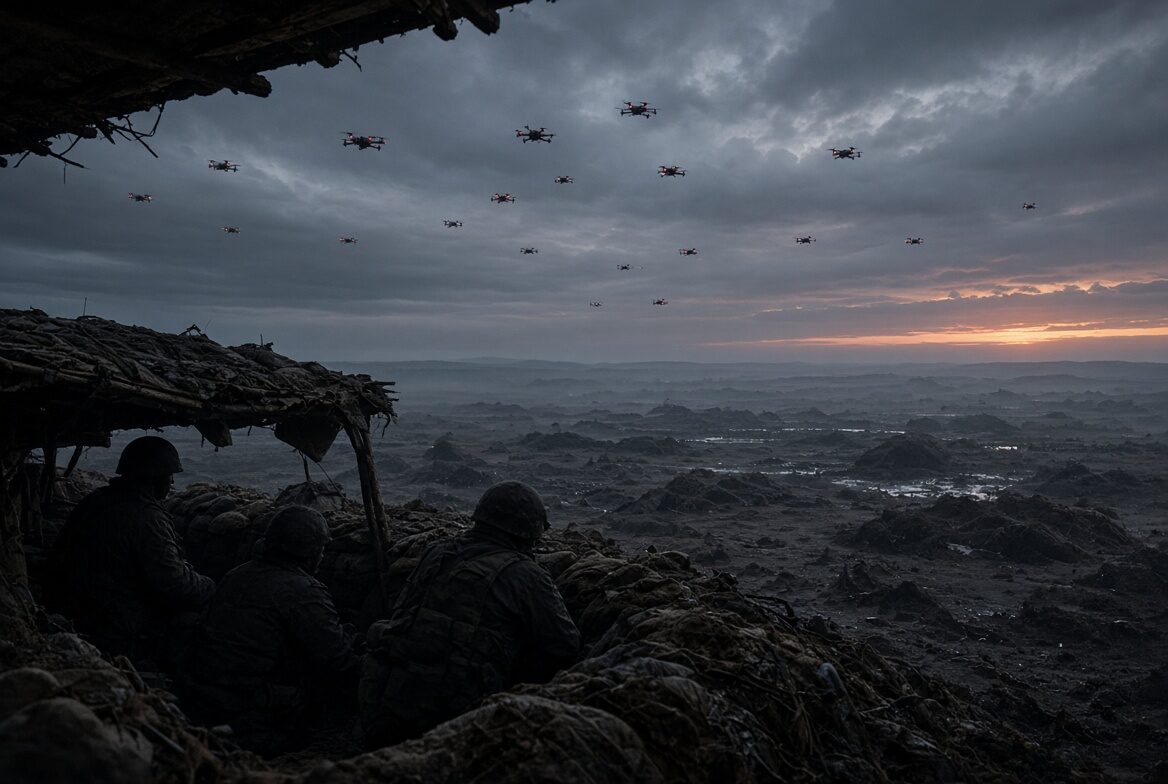
The reason is simple: drones have undermined the foundations of positional warfare. Massed concentrations of equipment, columns, rotations by entire units — all of this instantly becomes a target. Therefore both sides have switched to the so-called “mosquito” tactics: small groups, isolated strongpoints, a minimum of personnel in position. A dugout occupied by two or three men and camouflaged to blend into the terrain has become the standard defensive position. Such a point can hold an entire direction simply because it is impossible to approach it unnoticed, and sending an FPV drone after every single trench is too costly.
Yet this tactic has a reverse side. Because of the dispersal of positions and the absence of a continuous defensive line, no one — neither at headquarters nor on the forward line — can say precisely where the front line runs. Officially it is marked in documents, but in reality almost the entire line of contact has turned into a gray zone where friend and foe may be only a few hundred meters apart without knowing it.
A separate problem is rotation. Previously the rotation of a unit on the forward line was a logistical procedure, albeit a dangerous one. Today, for a soldier to get from the line of contact to the rear, he must cover dozens of kilometers in short dashes across open ground, through the gray zone, where drones are constantly overhead. There are no safe corridors: vehicles cannot get through, and movement on foot stretches into hours and becomes a deadly gamble. That is why many units remain in position far longer than prescribed — not because it was planned that way, but because there is simply nothing with which to replace them and no means to extract them.
It is telling that the difference between a sabotage-reconnaissance group and an assault group has been erased. Previously, sabotage-reconnaissance groups largely operated in the rear, while assault troops worked on the forward line. Today both move in the same way: in small groups, covertly, under constant aerial observation. The only marker by which one operation can be distinguished from the other is the density of FPV strikes. Dozens of drones mean an offensive; only a few indicate reconnaissance.
The positional front with lines of trenches and clear zones of responsibility has become a thing of the past. It has been replaced by a war of dispersed points, where there are no clear flanks and no conventional rear, and not a single guaranteed safe position. Victory goes not to the one who holds a line, but to the one who is quicker to detect and destroy the enemy’s point before his own is found.


